
A close-up
July 3, 2026
Freedom Round the Globe
The Boston Tea Party, as it is now called, originated far from Boston. Tea, whether in shiny silver pots or in dusty shipping crates, came from Asia. In the 1770s, tea took on new political meanings for those in Asian cities, American colonies, and the halls of Parliament. Reading tea leaves reveals global transformation as well as major questions about government and its functions in this era.
An Asian revolution took place before the American one. These “Modern Times,” as one Indian historian phrased it, wrought an inqilab, or an inversion of politics and society. In the 1765 Treaty of Allahabad, the Mughal emperor granted the responsibility for the civil administration of Bengal, to the English East India Company. Suddenly, this company, a private enterprise of 250 civil servants connected to the British government, came to govern twenty million people and 150,000 square miles: an area three times larger than England. An unholy combination of plunder, violence, and military power characterized the EIC’s brand of government in India. When a drought struck in 1769, the poor policies of the EIC led to a devastating famine and smallpox pandemic. Estimates range from one million to ten million dead; some regions of Bengal lost half their population.
The anguish of ’76 (1176 on the Fasli calendar, 1770 on the English one) was unspeakable. Yet protestors in Kolkata and elsewhere spoke of it. Ordinary Indians as well as critical British observers denounced EIC policies, on streets and in newspapers. Some of these reports re-appeared in colonial American newspapers. Many Americans came to fear that the EIC now planned to oppress Americans as they had Asians.
When Parliament passed the Tea Act of 1773 (to help the finances of a company, the EIC, deemed too big to fail), it seemed to many to offer proof of impending tyranny in North America. Enraged colonists—including John Dickinson, more famous of his Letters from a Farmer in Pennsylvania of the late 1760s— wrote letters and tracts against the EIC. Still others refused to land EIC tea and also organized protests, of which the most famous was the destruction of tea in the Boston harbor in December 1773. This demolition of the private property of the EIC was audacious, horrifying many in England and even in Massachusetts itself. It also put at least some of the American colonies on a collision course with the British government, leading ultimately to the events that came to be called the American Revolution.
What happened in Boston, Massachusetts mattered to the course of the American Revolution. So did what happened in Kolkata, India.
Curator: Bora Pajo
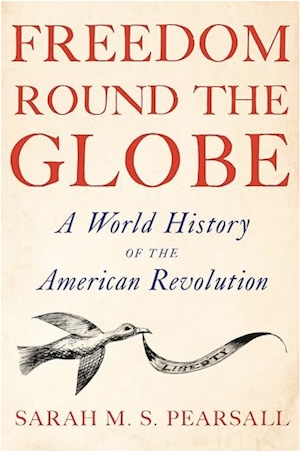
Freedom Round the Globe
Pearsall, Sarah M. S. Freedom Round the Globe: A World History of the American Revolution. New York: Knopf Doubleday, 432 pages, 6 × 9 inches, ISBN: 9780385548717
Get the book →July 3, 2026
20260703-pearsall-freedom-round-the-globe-close-up
The rest of this thread

Sarah M.S. Pearsall
Sarah M.S. Pearsall is a prize-winning historian of early America. She is a Professor of History at Johns Hopkins University; she previously taught for nearly a decade at Cambridge University. She is a Fellow of the Royal Historical Society and Distinguished Fellow in the American Revolution, Eccles Institute, British Library. She holds degrees from Yale, Cambridge, and Harvard. Freedom Round the Globe, her fourth book, is appearing in May 2026 with Knopf Doubleday (U.S.), Picador (U.K.), and Rowohlt Berlin (Germany).
Propose a thread
Know something the rest of us don't?
Most threads on Rorotoko begin with our invitation. Some begin with a proposal. Both use the same prompts and the same editing, with your own pages in the archive. Proposed threads carry a small Sponsored label and a fee.
Propose a thread →