
A close-up
June 30, 2026
King PONG
Understanding the market of coin-operated amusement is something that readers ought to know about to better understand King Pong. When I say that Atari was successful in two markets, I have to explain what that means. Atari produced a new product and new product category, a video game called PONG. They launched with one product into a market and industry called coin-operated amusements. Amusement is a subsection of vending, which, like coin-op amusements, goes back to the 19th century. Atari may have had a new product type, but it easily slotted into an ecosystem, an infrastructure, benefitting from annual conventions, trade magazines, distributor networks, etc..
Here’s how the coin-op amusement industry worked when Atari launched: you have manufacturers, so, for instance, Atari manufactures a game. The clients, or the consumers of that game, are distributors. The manufactured product is advertised to distributors, distributors purchase these products, and they either lease or sell them to operators. Operators run local routes. The operator then has a relation with a location owner — let's say the person who owned Andy Capp's Tavern. Operators split the machine’s earnings with the location owner. Promotional materials and advertisements placed in trade publications materials targeted distributors, the consumers of a manufacturer’s products.
What PONG did, and what Atari did that was so successful — was to radically change the way the coin-operated amusement industry functioned. Games have very limited locations. What Atari did was to get its product into those existing or conventional locations — let's call them markets — like recreation centers, game rooms, or arcades. But most importantly, Atari created an entirely different markets for its coin-op products. The packaging of PONG – it’s cabinet, control panel – was minimal. It was understated. There were no graphics on the cabinet’s side. It had the 70s leisure suit of wood grain on its side panels with a single word name at the top of its bezel. Because of its understated appearance, PONG gained access at locations where other coin-operated machines could not venture into. Atari’s product competed in existing marketplaces, but also radically expanded where coin-op games were played. All of sudden, posh cocktail lounges, hotel lobbies, restaurants became places to play video games. Eventually, BART in San Francisco had Atari games you could play in between trains. Any place — and this was a beautiful phrase that Nolan Bushnell said, and I used in Atari Design, and I brought it back in King PONG — was that his job was to harvest vacant time. Atari was designing products for markets that other coin-operated amusement operators or manufacturers had no foot in the door. They radically expanded the profit potential for Atari; having its products in existing markets, while opening entirely new ones.
Now, here's an interesting point to consider. Atari was successful in the coin-op amusement market. And then all of a sudden, the company switched into an entirely different industry! They pivoted to consumer electronics. The fascinating thing here was that Magnavox introduced a home console, the Odyssey, in 1972, the same year PONG came out. There's a backstory detailed in the book around this. Magnavox was a television manufacturer. And there was no industry, or market for consumer video games when the Odyssey debuted. When Atari produced its home version of PONG, they partnered with Sears, which was one of the leading retailers in the world at that time. Atari had the benefit of Sears' infrastructure — the mail order catalog, the department stores that were anchors at shopping malls. In addition to that, all the financing, marketing, sales, advertising, and distribution was provided by Sears. Unlike Magnavox, Atari had a brand name established with coin-op video games. People already recognized PONG in public. They've put (lots of) quarters in Atari’s products, they've played games displaying the name “Atari”. The brand resonated in public, and now that experience of playing an Atari game can be redirected to the home. Atari had a powerful brand name that they can further promote through the infrastructure of Sears.
The big takeaway is — and this is where I happily stick my neck out a little bit — we have Atari to thank for ubiquitous game play today. We have games in our pockets, we play them on our laptops, we play them on our tablets, on our mobile devices, and we still play them in public. Coin-operated games still exist in public. I think we can look back at Atari and draw lines to how it was really the engine behind ubiquitous gaming today.
Consider this example: I was just in Paris at Charles de Gaulle Airport. The airport had two arcade spaces populated by older games. Loads of people were playing. I also observed several Sony PlayStation 5 kiosks. People were playing games of EA FC before they got on airplanes! And I was recently at LAX. There's a company called “GameWay” that operates in, I think, 13 airports across the U.S. You pay by the hour or can purchase a day pass for $50. At GameWay you can play these little plug-and-play retro games of the NES, or SNES. You have PC games, and you have Xbox Series X, Nintendo Switch, and PlayStation 5 all set up. I was talking to one of the guys working there about their business model — “don't people already have games in their pockets,” I asked? Sure, the rep said, but people who play console games or PC games want to do that too. We give them the opportunity to do it.
Flight delays or layovers are, no doubt, great for GameWay’s business! I found myself again thinking back to Bushnell’s concept of harvesting vacant time. Atari built cabinets specifically designed for airports (the 2 Game Module). They designed cocktail table cabinets so that players could put a drink on that flat surface while they played. They designed for multiple environments, and in doing so, they radically changed our understanding of amusement. In fact, Atari, in 1974, repackaged itself as Innovative Leisure. They increased the status of what coin-operated amusements can be.
Atari had a marketing concept that the book delves into at length. Here I’ll just say that the concept of “sophistication” drove Atari’s marketing strategy. The question I raised was, where did this concept come from? I can't buy the fact that three engineers came up with this. It was already an active marketing strategy at Nutting Associates, where Dabney and Bushnell worked before Atari. They adopted Nutting’s marketing strategy as their own for their company. Nutting Associates’ marketing for Computer Quiz focused on universities, student unions, department stores, cafeterias, and shopping malls. Nutting never even mentioned game rooms or arcades in its marketing materials for Computer Quiz. They sought to open new markets. Sound familiar?
Because Dabney and Bushnell worked at Nutting Associates on Computer Space they experienced this marketing strategy directly. Now confronted with the daunting task of running their own company, they simply adopted and perfected a strategy already familiar. Also, Atari had the benefit of location: the tech-industry rich San Fransico peninsula. Recently coined, “Silicon Valley,” in 1971, Atari positioned its products and company as technologically sophisticated in contrast to the products coming of out Chicago, the historical home of coin-op amusement companies.
A joy to write
King Pong was an absolute joy to write. Most of my books are archive-research based and they're interview-oriented. I conduct a lot of site-specific research trips. Books like Game After and Atari Design each took six years to produce. Because I've amassed such a rich foundation from these, I was able to write King Pong in 9 months. From the get-go, I knew the story that I wanted to tell. I knew exactly how I wanted to take a familiar story and tell it in different ways, to expand our understanding on one of the most iconic companies in the history of games.
King Pong hasn’t tried to refute the familiarity we already have with the company, the people, the products they produced. Instead, I've tried to introduce a new way of thinking about that success — one that looks at marketing strategies, productization, and new product category creation. In a line, Atari’s innovation in marketing proved just as valuable as its innovation in technology.
King Pong also became a bridge to a new Substack project that I have been developing, writing short essays based on my field observations at museums specializing in video games. Towards the end of King Pong, I realized that the product in my mind at least, is still a leader in markets. The market is now heritage. PONG was one of the first games inducted into the World Video Game Hall of Fame, at The Strong National Museum of Play in Rochester, NY. What I’ve witnessed the world over is how prevalent PONG and Atari are at museums across Europe and Asia. PONG is probably the one game I've seen in every single museum I've traveled to. Even in Shanghai, the museum there has two recreated coin-op PONG machines. The museum created surrogates of the coin-operated cabinet because PONG was never released in the People’s Republic of China in the 1970s. Museums are showing us that games are valuable in so many different ways: for reasons of education, history, economics, business, aesthetics, technological invention and innovation.
In the last chapter of King Pong I share an exciting discovery: I'm in Berlin, and I came across this Volkswagen Group exhibition that was devoted to icons of modern design. “Oh, let's go in, let's check this out,” I said to my wife. We're probably going to see a lot of old VW and Porsche models. But guess what? There's a PONG cabinet! So, according to Volkswagen at least, PONG is now considered an icon of modern design. PONG is continuing to access new markets, if you will. It's everywhere. If you have an iPhone, if you have an Apple Watch, you can play it there. It's in your browser. That's something that astonished me as well — a game that's so simple, it's over 50 years old, is still readily available today.
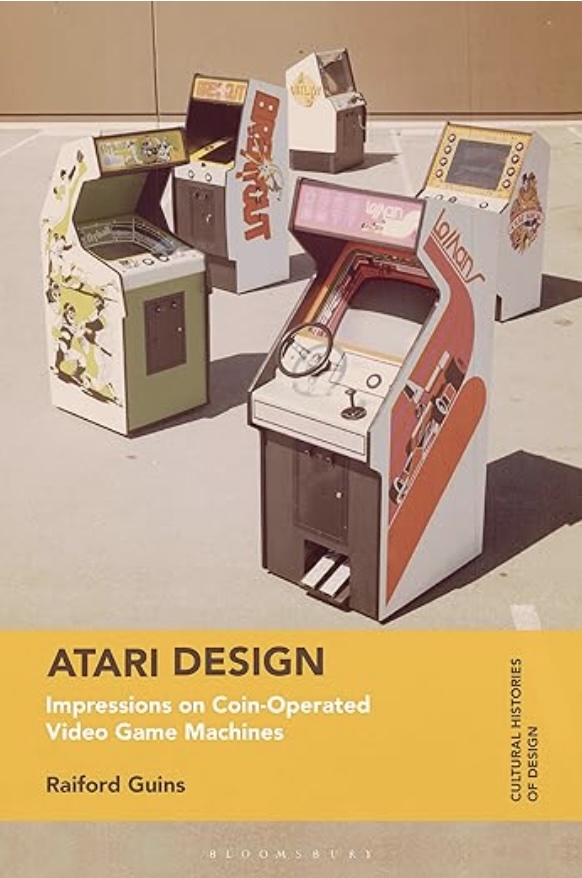
Guins, R. (2020). Atari design: Impressions on coin-operated video game machines. Bloomsbury Visual Arts.
Curator: Bora Pajo
.jpg)
King PONG
Guins, R. (2026). King PONG: How Atari bounced across markets to make millions. MIT Press. ISBN: 9780262051330
Get the book →June 30, 2026
20260630-guins-king-pong-a-close-up
The rest of this thread

Raiford Guins
Raiford Guins is a Professor and Chair of Cinema and Media Studies in the Media School at Indiana University, Bloomington. His scholarship is devoted to the critical study of technological artifacts and their complex material lives. This commitment is expressed through unique areas of research such as life cycles of artifacts, preservation and conservation of games, the museology of games, and design histories of games. Guins is the author of five books including his latest, King PONG: How Atari Bounced Across Markets to Make Millions (MIT Press, 2026). He has also co-edited five collections including Replayed: Essential Writings on Software Preservation and Game Histories (Johns Hopkins UP, 2023). Guins co-founded the field-defining journal ROMchip: A Journal of Game Histories, and co-edits MIT Press's Game Histories book series.
Propose a thread
Know something the rest of us don't?
Most threads on Rorotoko begin with our invitation. Some begin with a proposal. Both use the same prompts and the same editing, with your own pages in the archive. Proposed threads carry a small Sponsored label and a fee.
Propose a thread →