
Rod Phillips
Cats: A History
One of the key findings of research into cats links the earliest cats to all of today's cats: all cats today – whether they are pet cats, street cats, or feral cats, common tabby cats or purebred cats – derive from the Middle Eastern wildcat and share its DNA. This was the finding of a team of researchers who took hundreds of samples of DNA from five different subspecies of wildcats indigenous to Africa, Asia, and Europe, and from cats from Europe, the Middle East, and the Americas.
Among other things, my book explains this, starting with the earliest time, about 12,000 years ago, that wildcats entered human settlements in the Middle East. Humans had begun to establish permanent settlements where they practised agriculture and stored food, mainly grain. The grain attracted rodents and the rodents attracted wildcats, who soon became indispensable for dealing with the rodent problem. Over thousands of years, as they became fixtures in human settlements, wildcats evolved into cats – slightly smaller, with somewhat different physical and behavioral characters, but with the same DNA.
As the practice of agriculture spread from the Middle East, cats – now integral to the preservation of produce – accompanied it. Cats, all derived from the Middle Eastern wildcat, were found in Egypt about 5,000 years ago, and later in Greece and Rome, which dispersed them throughout Europe. Two thousand years ago, cats were part of the landscape of the Roman Empire.
Much later, from the late 1400s, long-distance voyages from Europe to Africa, Asia, the Americas, and the Pacific region took cats on board to deal with rodents. Some cats escaped, while some ships deliberately put cats (and other European animals) ashore to populate the territories they encountered.
The result is that by 1900, cats were to be found throughout the world: on all continents except Antarctica, and on most island groups. And all these cats had a common ancestor: the Middle Eastern wildcats that had entered human settlements thousands of years earlier to feed on rodents in grain stores.
Curator: Bora Pajo
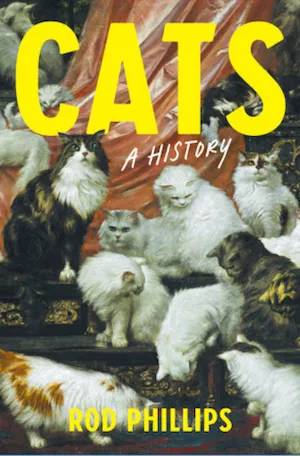
Cats: A History
Phillips, R. (2026). Cats: A history. Johns Hopkins University Press.
Available here →July 12, 2026
20260712-roderick-phillips-cats-a-history-a-close-up
A close-up
The rest of this thread

Zoë Quinn-Phillips
Rod Phillips
Rod Phillips is a professor of history at Carleton University in Ottawa, Canada, where he teaches European history. His fields of research are the history of the family, the history of alcohol (especially wine), and now the history of animals. He has published many books, notably Putting Asunder: A History of Divorce in Western Society, A Short History of Wine, and Alcohol: A History. His books have been translated into a number of languages.
Know something the rest of us don't?
Most threads on Rorotoko begin with our invitation. Some begin with a proposal. Both use the same prompts and the same editing, with your own pages in the archive. Proposed threads carry a small Sponsored label and a fee.
Propose a thread →