
Rod Phillips
Cats: A History
Before I wrote Cats, most of my books were about the history of the family and about wine. I had often talked about writing a history of cats when I retired, because I love cats and find them fascinating. When Covid struck in 2020, I was working on two wine books, but being unable to travel to Europe to do research, I decided to start my book on cats.
It was a book I could write from printed and on-line sources that included medieval works on animals, paintings and other artworks available online, nineteenth-century books for and against cats, twentieth-century books on caring for cats, and thousands of cat videos.
But cats rarely entered the historical record except tangentially. It's likely that all elite households had cats to keep the mouse population down, but family portraits far more often show a dog than a cat – presumably because they had a relationship with the dog or the dog was of a prestigious breed.
I had come across references to cats only twice in my archival research in 50 years. When I was doing my doctoral research on divorce in the French Revolution, one husband was said to have thrown a cat at his wife. Later, when I was working on the history wine in Beaune, in Burgundy, a nineteenth-century document noted that dead cats were disposed of in a drain running through a town.
Because of the rarity of documents dealing specifically and directly with cats, I often turned to sources that were indirectly informative. One question that dogs animal historians is when cats became popular as pets, and some historians have suggested periods starting in the nineteenth century. My approach was to look for evidence in the availability of cat food, veterinary services, and books on caring for cats. They led me to conclude that mass ownership of cats (in many countries today, cats are present in a quarter to a third of households) began only in the 1950s and 1960s.
Another challenge was periodizing the history of cats. I've written three survey histories before this one – on divorce, wine, and alcohol – and each case, the chronological narrative was quite different. As far as cats are concerned, there appear to be three pivotal moments, the first being the Middle Ages, when the Church turned on cats.
Cats had been regarded as neutral in religious terms, but from about 1200 they were associated with heresies, magic, and witchcraft. Various heretical cults were said to worship cats, while cats were often singled out as witches' familiars. This negative view of cats informed secular attitudes and produced a general dislike of cats throughout Europe. The Church's position on cats underpinned a history of their being tortured and killed. Wikipedia has an entry on cat-burning.
The second important period was the nineteenth century, when attitudes towards cats polarized. Dislike of cats intensified, to the point that there were calls in Europe and North America for cats to be exterminated. On the other hand, there is evidence that many people look upon cats favourably and there were calls for cats to be "rehabilitated" from the negative attitudes and treatment.
Finally, the second half of the twentieth century saw cats being kept as pets on a mass scale in many countries, especially in the 'Western' world, but also in Russia and more recently in China. Although there are references to cats being kept as pets before this time, it is only since the 1960s that pet cats became as common as they are today.
Curator: Bora Pajo
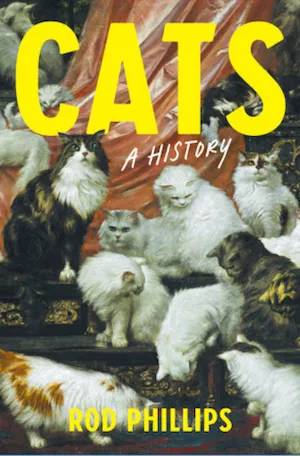
Cats: A History
Phillips, R. (2026). Cats: A history. Johns Hopkins University Press.
Available here →July 12, 2026
20260712-roderick-phillips-cats-a-history-the-wide-angle
The wide angle
The rest of this thread

Zoë Quinn-Phillips
Rod Phillips
Rod Phillips is a professor of history at Carleton University in Ottawa, Canada, where he teaches European history. His fields of research are the history of the family, the history of alcohol (especially wine), and now the history of animals. He has published many books, notably Putting Asunder: A History of Divorce in Western Society, A Short History of Wine, and Alcohol: A History. His books have been translated into a number of languages.
Know something the rest of us don't?
Most threads on Rorotoko begin with our invitation. Some begin with a proposal. Both use the same prompts and the same editing, with your own pages in the archive. Proposed threads carry a small Sponsored label and a fee.
Propose a thread →