
Jonathan Weber
City on the Edge: Technology, Politics, and the Fight for the Soul of San Francisco
Being editor of The Industry Standard during the dot-com bubble in the late 90s was the best job I ever had, for sure. It was really fun. The person whose idea it was was a guy named John Battelle. He was a young guy but very smart, and he had been one of the founding team at Wired Magazine. Then he had this idea, and he had hooked up with this other company, this publisher called IDG. They were going to do a weekly news magazine about this new internet thing, and he was looking for an editor. He ended up finding me. I was working at the LA Times, so he recruited me to be the editor. In those days, people thought it was bizarre that I would leave the LA Times — but it seemed obvious to me.
I went to San Francisco and hired up a whole staff. I think the editorial staff at the start was 16 or 17 people. The first six months were kind of rough. Journalistically, I came at it like, the way to make a good magazine here is to be the skeptics, to play against the hype and be critical, because that's what people actually want to read. John was into that, even though it can be tricky as a publisher. So we took some big swings early on and really made some noise. Pissed some people off, which was fun — that's part of what we were trying to do.
The business was complicated, with the parent company and how we were trying to build the circulation. Magazines — it's super expensive to get paid circulation. You just have to spend a fortune on direct mail and all this stuff. There was an original sin, which was that John and Pat McGovern, who owned the company that was funding all this, really didn't have the same idea. Ultimately, that was a fatal problem. So there was a lot of stress right in the first six months, because we were not making the numbers at all.
But then, kind of overnight, it just grabbed, and there was this huge boom, and it just went crazy. We had more advertising than we could physically accommodate. We were at the limit of the printer, which could only print 300 pages — for a weekly magazine, 300 pages was insane. Eventually I had 100 people on my editorial staff. Then we launched a European edition, so I hired a whole new team in London — 30 people in London. It was super fun, flying over to London, hiring a bunch of people, having big parties. And I was very proud of the journalism. We were doing real stuff and we stuck to it. It was ironic, because our calling card was, don't believe the hype, but then we were the biggest symbol of the hype out there.
I'll give two different answers about a story to draw attention to. One thing I'm very proud of about the book is that it weaves together a couple of different narratives — the history of Burning Man, which is like a metaphor for everything else, and the history, the politics, and the rise of the internet. That's all braided together. So that big story of the relationship between the technology, the politics, and the culture — that is something that I'm very proud of. That's the big story of the book.
In terms of the smaller stories, I'm a little biased because some of them are my story. The chapter three about The Industry Standard — how good is that? I don't know, but I think it's pretty good. So I would say The Industry Standard story is one of my favorites. Another one I would point to is the story of the Google buses.
Back in the early to mid-2010s, as the internet really exploded, and the Silicon Valley companies — especially Google and Facebook — were getting very, very big, a lot of the employees wanted to live in the city. So Google started running a shuttle bus to take employees from the city. After a while there were a lot of them, and other companies started running their buses, and they became a flashpoint of political protest. It seems weird, because it's better that people take a bus down there than that everyone drive their cars, right? But people didn't see it that way. The buses were a symbol of the tech takeover of San Francisco. It's an interesting tale. The book is in four parts, and the title of that part is ‘Prosperity and Its Discontents’.
The Google buses got a lot of press, a lot of attention at the time. Pretty much anybody who lived on the West Coast in those years, if you mentioned the Google buses — oh yeah, you know.
Curator: Bora Pajo
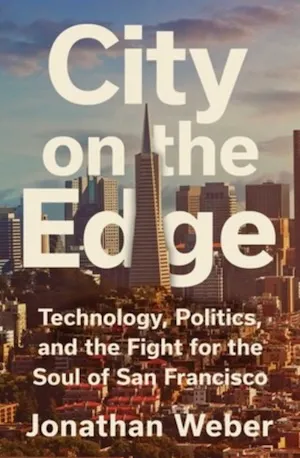
City on the Edge: Technology, Politics, and the Fight for the Soul of San Francisco
Weber, J. (2026). City on the edge: Technology, politics, and the fight for the soul of San Francisco. Simon & Schuster.
Available here →July 17, 2026
20260717-jonathan-weber-city-on-the-edge-a-close-up
A close-up
The rest of this thread

Jonathan Weber
Jonathan covered technology and politics for more than thirty years as a reporter, editor, newsroom leader and journalism entrepreneur. After a stint in the trade press that included a posting in Paris, in 1990 he was named the first Silicon Valley correspondent for the Los Angeles Times. He subsequently served as co-founder and editor in chief of The Industry Standard, a weekly news magazine that became a symbol of the dot-com boom of the late 1990s. In 2005, as independent online media was beginning to take shape, he launched a local and regional online magazine called New West, serving the Rocky Mountain West. He then returned to San Francisco as the founding editor of The Bay Citizen, a non-profit news organization devoted to Bay Area news. Later he served as West Coast Bureau chief and Global Technology editor for Reuters News, and then was the founding editor of another local news organization, the San Francisco Standard. He holds a BA in Philosophy from Wesleyan University.
Pull this thread
pulls againstpulls alongside
The commercial internet was made in the city of San Francisco, not in Silicon Valley, and the reason is cultural.
Know something the rest of us don't?
Most threads on Rorotoko begin with our invitation. Any thread can begin with a proposal: you write it with the same prompts every thread answers, and we review it.
Propose a thread →