
Amani C. Morrison
A Kitchenette to Fit Your Needs
A Kitchenette to Fit Your Needs argues that the mid-20th-century Chicago kitchenette helped redefine how the city was understood, both locally and nationally — through its use in policy, in discourse, in the cultural landscape, and in the built environment.
Chicago set national housing policy in large part because so many of the city's power brokers sat on federal boards. The National Association of Real Estate Boards (NAREB) was headquartered in Chicago at a key moment, so something like the template restrictive covenant issued by the Chicago Real Estate Board became the national standard. The hyper-segregated Chicago of the mid-20th century was partly a response to the Great Migration, which ran from the 1910s into the 1960s but peaked across the 1920s, '30s, '40s, and '50s. That's when mass migration to the city crested — and the most consequential demographic shift by far was Black Southerners arriving in Chicago, bringing with it a further entrenchment of racial segregation.
Because this is happening at the same time as a decline in new housing construction, people start converting buildings into what become known as kitchenette apartments. So we see the built environment; we see policy responding, or not responding, to the needs of this population shift; and we see artists sitting with these experiences and representing them out. Some of the most notable, award-winning texts — Richard Wright's Native Son, Lorraine Hansberry's A Raisin in the Sun — featured the kitchenette. Then we have the actual needs of the residents living there, the needs of the landlords, and how those come into conflict at points.
There's a way Chicago is being understood at the mid-20th century. We think of the Chicago School of Sociology, for instance, but there's something happening in the more vernacular architectural built environment that is being symbolized through the discourse around the kitchenette and its representation.
What a kitchenette was
Kitchenettes were often one- or two-room apartments subdivided from a larger standard-size apartment. You might think of it as having space for sleeping (whether or not in a separate bedroom), maybe some combined living and dining room space, a makeshift or communal kitchen area, and a shared hall bathroom. I have a diagram in my book that I adapted from another scholar, and it was based on a 600-square-foot apartment for a single family. It was subdivided into multiple 100-square-foot one-room units. So that one bathroom that was originally for that apartment is now a communal, because it's serving all of these units that are still contained in the original footprint. That means the kitchen becomes communal, or often they would put hot plates in closets. And that's where the name kitchenette comes from.
We might think of a kitchenette today as just a small kitchen, cute or efficient. There's a version of that in the 1910s, but it devolves quickly into apartments with a hot plate in the closet, or no cooking facilities at all, to maximize the number of housing units. So they're overcrowded. They used very thin partitions, what they called beaverboard, which were highly flammable. There often was not adequate access to fire escapes. The building infrastructure was more dilapidated, because you had more people living there than there should have been. But because of the hypersegregation in Chicago, often Black people could not move to other neighborhoods. They lived primarily on the segregated South Side and West Side. So the building becomes hyper-degraded because people didn't have anywhere else to go; it's overburdened. And they are being charged more for rent than the people living in the 600-square-foot flat. So imagine paying more for your 100-square-foot room, that maybe your family of four or five is sleeping in, than it would have cost someone to live there prior. And sometimes landlords were kicking people out of the building so they could convert it to kitchenettes, not necessarily to meet a dire housing need, but because they knew they could make money. That's the landscape of the kitchenette: that's materially what it looked like, but also some of the qualitative conditions of it.
A lot of times people think my book is all about cooking or food-based. I don't have that much in the book about cooking. But the name ends up standing in for the small size, the lack of space. People were living in them. You'd have rent parties happening sometimes. They did meet a housing need, but not well, and not with the quality of life in mind. For many, it was just a way to make money.
There are a lot of buildings in Chicago that are standard — a three-flat, or a six-flat — a left side and a right side, three levels plus a basement. That's standard residential construction in Chicago. There are bigger buildings; the most floors I've seen referenced may be a five-story building, one of those that takes up a whole corner. Sometimes they were converted from mansions, and sometimes from hotels, so they were called kitchenette apartment hotels, in part because they were such a transient population, or they were rented by the week instead of by the year. But they didn't have the same facilities we think of now with a hotel. Not like the Residence Inn, where you have a kitchenette for your use. Different than that.
When I present about the work, some people ask, what about SROs — single-room or single-resident occupancies? Many people have told me there's a version of this in Brazil, where the word translates very similarly to kitchenette. I would argue that the particular moment that produced the kitchenette is not the one we're living in. The various factors and forces that produced the discourse and the built environment of the South Side Chicago kitchenette. But I think we could be heading quickly to a moment that could be similar. Thinking about movement from natural disasters, from refugee crises, from different political reasons. What happens in a city when there's an influx of people and a need for housing? And how much care and consideration is taken with the quality of that housing? And then what do people do? Do people exploit that? So I think there are probably versions of the kitchenette still, definitely in other countries and probably also in the U.S., but not as a standard way, as it seemed like they were at the time.
The title of the book comes from an advertisement. There were classified ads in the newspaper, and housing was one of the things advertised. The Chicago Defender — the banner African American-owned and led newspaper at the time, focused on issues of the race, had its own business advertisements. I came across this banner ad on one of the classifieds pages that said something like, 'check the Defender ads daily to find the room, apartment, or kitchenette to fit your needs'. I was thinking about the use of the kitchenette: how many different ways, and on how many different registers, it's used. It's used discursively, it's used for space, it's used for money generation, it's used to have a place to live, it's used symbolically. I was dealing with the title, and it was too wordy, and then I came across this ad and I thought how perfect.
Ongoing thread. More from Amani C. Morrison to follow.
Curator: Bora Pajo
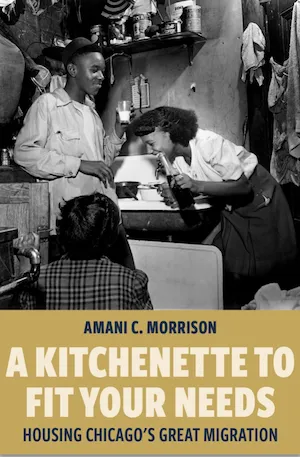
A Kitchenette to Fit Your Needs
Morrison, A. C. (2026). A Kitchenette to Fit Your Needs: Housing Chicago's Great Migration. New York University Press.
Available here →July 22, 2026
20260722-morrison-a-kitchenette-to-fit-your-needs-in-a-nutshell
In a nutshell
The rest of this thread

Amani C. Morrison
Amani C. Morrison, Ph.D. is Assistant Professor of African American Literature and Culture in Georgetown University's English Department and researches Black engagements with place and property through a cultural and historical lens. Morrison's book, A Kitchenette to Fit Your Needs: Housing Chicago's Great Migration (NYU Press 2026), is the first cultural history of Chicago's mid-twentieth-century kitchenette apartments. She is also building a digital map and archival database, the Chicago Kitchenette Archive, as a corollary project. From 2023-2025, Morrison served as the Lead Principal Investigator for the Mellon Sawyer Seminar on "Creative Placemaking, Black Restorative Ecologies, and Black Spatial Futures." Her work has appeared in American Quarterly, Meridians, Environment and Society: Advances in Research, African American Review, and The Common Reader.
Pull this thread
Chicago's kitchenette was not just a symptom of housing shortage but shaped national housing policy.
Know something the rest of us don't?
Most threads on Rorotoko begin with our invitation. Any thread can begin with a proposal: you write it with the same prompts every thread answers, and we review it.
Propose a thread →