
A close-up
August 13, 2026
A Kitchenette to Fit Your Needs
Lorraine Hansberry wrote A Raisin in the Sun that's seen as a civil rights play, a racial uplift play. A work that wants to humanize Black experience, but also elevate the everyday to the level of serious drama. Not slapstick comedy, not just for entertainment, but to be taken seriously through art. And she uses the kitchenette to do this. She's widely awarded for it. It becomes one of the most continuously produced Black plays. It's set in a kitchenette. So there's something about the kitchenette that lends itself to conveying this universal, resonant experience of the Black family and the pressures on it. But there's something particular about it as well, because the pressures put on the family are in part a result of the society they're living in, and the kitchenette becomes the perfect lens to understand that society. Why haven't they been able to move out? Because of segregation. Why are they so crowded? And we don't get an analysis of the kitchenette in the play itself.
Part of what's interesting is that Lorraine Hansberry's father and family owned many kitchenettes. So this becomes an interesting layer. Some of my book is about interracial relations and class dynamics, and part of it is intraracial dynamics. Lorraine Hansberry's father is called by some at the time the kitchenette king. So there's a layer that brings in the Black middle class, in how they are trying to meet their own community's needs, but also how it can be a slippery slope when you're thinking about a class analysis. It's not as simple as good and bad.
So the way that Hansberry produces art that is lauded and becomes its own racial uplift play and her father, and the family after he passes away, are using the proceeds from their kitchenette business, their real estate business, to fund civil rights advocacy. He has a landmark Supreme Court case that is decided. They're using their real estate proceeds to fund what is genuinely meaningful and material racial uplift for the community. And so there's something interesting about that, and it's not straightforward at all. That's one of the things that people often find intriguing.
What I hope people get from that is not a condemnation of any of the parties, but an understanding of how we must approach history, not with just heroes and villains, but with a sense of the nuanced landscape that comes when people are working within the context they're in, with the resources they have, and with the change they'd like to see on whatever timetable. That necessarily gets layered and complicated. And sometimes, even with a desire to do well, there are ways that in a capitalist society, a white supremacist society, an ableist society, you can easily get caught up in the limitations and the exploitation of those systems, even when you're trying to leverage them for good.
Curator: Bora Pajo
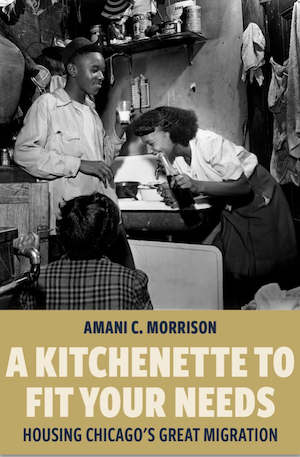
A Kitchenette to Fit Your Needs
Morrison, A. C. (2026). A Kitchenette to Fit Your Needs: Housing Chicago's Great Migration. New York University Press.
Get the book →August 13, 2026
20260813-morrison-a-kitchenette-to-fit-your-needs-a-close-up
The rest of this thread

Amani C. Morrison
Amani C. Morrison, Ph.D. is Assistant Professor of African American Literature and Culture in Georgetown University's English Department and researches Black engagements with place and property through a cultural and historical lens. Morrison's book, A Kitchenette to Fit Your Needs: Housing Chicago's Great Migration (NYU Press 2026), is the first cultural history of Chicago's mid-twentieth-century kitchenette apartments. She is also building a digital map and archival database, the Chicago Kitchenette Archive, as a corollary project. From 2023-2025, Morrison served as the Lead Principal Investigator for the Mellon Sawyer Seminar on "Creative Placemaking, Black Restorative Ecologies, and Black Spatial Futures." Her work has appeared in American Quarterly, Meridians, Environment and Society: Advances in Research, African American Review, and The Common Reader.
Feature your book, your art, your project
Publishing with a small press, or on your own?
A Sponsored Thread runs like every other thread on Rorotoko: three parts on three dates, the same editorial review, your own pages in the archive. Marked Sponsored. $199, paid only once accepted.
Get featured →