
Gabriele Neri
Alan Dunn: The Cartoonist as Architectural Critic
There is an extraordinary Alan Dunn cartoon devoted to Marcel Breuer's Whitney Museum in New York, at the corner of Madison Avenue and 75th Street, inaugurated in 1966 and today home to Sotheby's. The building's form is strikingly unconventional: it resembles a fortress, with a stepped silhouette widening toward the top like a concrete tree, and a large trapezoidal window that looks like the eye of a Cubist Cyclops. In Dunn's cartoon, two women walk past the museum, and one says to the other: "Why can't they design a museum that doesn't have to be explained?"
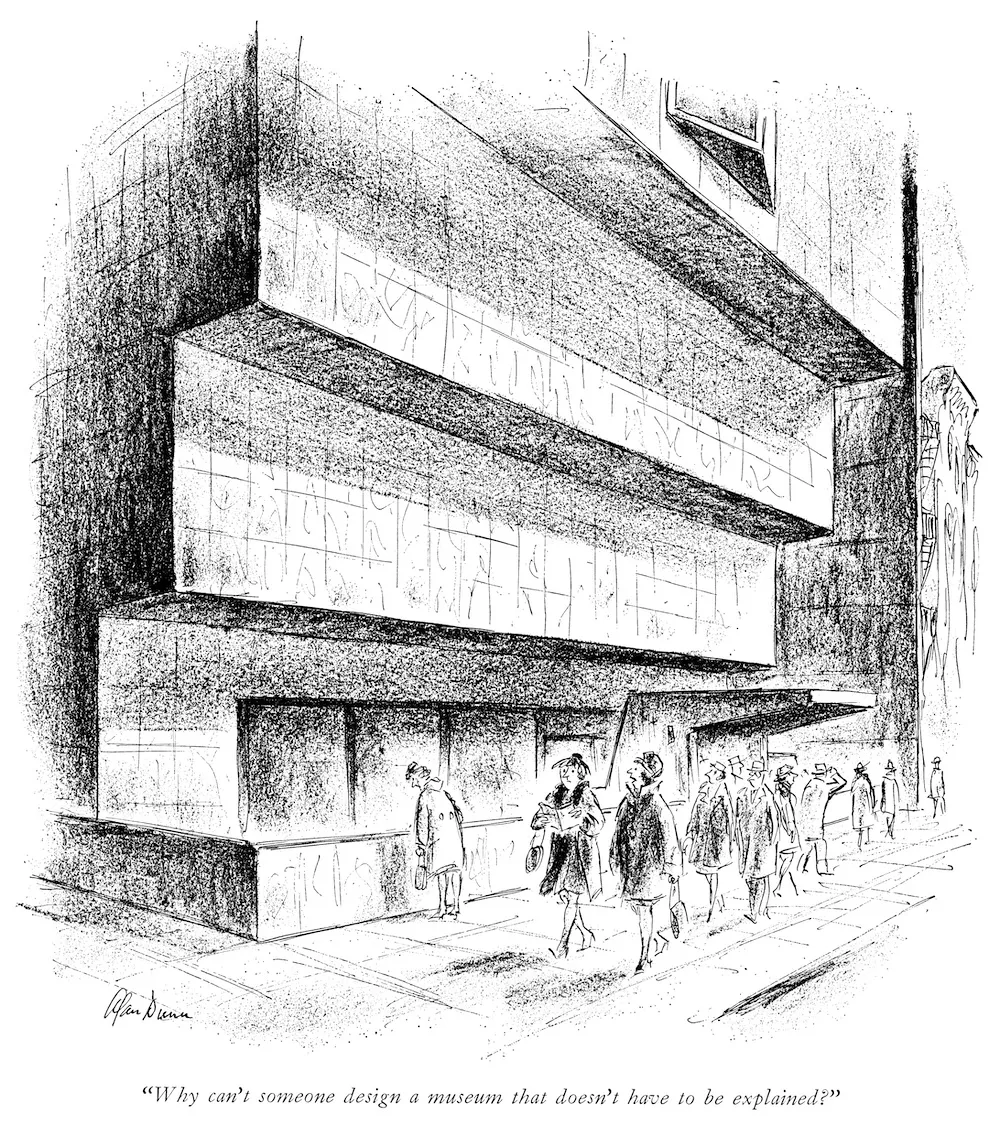
That small, brilliant joke encapsulates an entire debate that had been raging for years about the "readability" of modern architecture, about the relationship between museums and artworks, and between museums and the city itself. Dunn distilled all of it into a single drawing and a single line.
He had done something similar in 1959, at the opening of Frank Lloyd Wright's Guggenheim Museum, another unconventional building that provoked years of controversy: too strange for many New Yorkers, too overpowering for many artists, too unusual for city officials. Alan Dunn, who actually lived across the street from the museum, devoted dozens of cartoons to the building, once again condensing into a few lines and a few words what newspapers discussed at far greater length — often with more sophistication, perhaps, but far less ability to reach a broad public.
Lewis Mumford, for example, wrote a more than twenty-page essay in The New Yorker devoted to Wright's museum. I doubt that every reader eagerly immersed themselves in that learned and lengthy discussion; but virtually everyone would have laughed at Dunn's cartoons, participating — at least in part — in the broader public debate surrounding the building. It is telling that, for many years, the Guggenheim Museum shop sold a postcard featuring one of Dunn's cartoons captioned: "Are they allowed to do that on Fifth Avenue?"
Not coincidentally, Lewis Mumford — one of the most influential American intellectuals of the twentieth century — was a friend of Alan Dunn, collaborated with him, and even wrote a beautiful foreword to Dunn's final book.
This communicative power also played an active role in the preservation campaigns of the 1960s. Dunn devoted cartoons to the protection of Pennsylvania Station, New York's brownstone buildings, and other urban landmarks. For all these reasons, in 1973 he received the Architecture Critics' Citation — an honor that, to give a sense of its significance, was awarded two years later to Jane Jacobs. In effect, the award formally recognized that a cartoonist, too, could be considered an architectural critic, and that cartoons are an important tool for understanding the built environment that surrounds us.
Curator: Bora Pajo
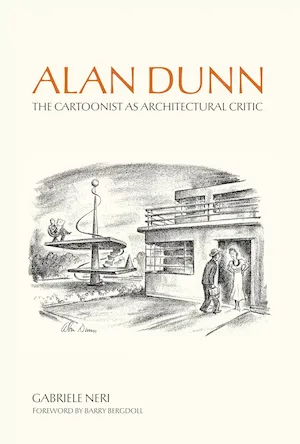
Alan Dunn: The Cartoonist as Architectural Critic
Neri, G. (2026). Alan Dunn: The cartoonist as architectural critic. The MIT Press.
Available here →July 29, 2026
20260729-neri-alan-dunn-a-close-up
A close-up
The rest of this thread

© Stefano Marras
Gabriele Neri
Gabriele Neri, Ph.D., is Associate Professor of Architectural History at Politecnico di Torino, Italy. He was a Weinberg Fellow at the Italian Academy for Advanced Studies in America at Columbia University in New York (2022) and has taught at the Accademia di architettura in Mendrisio, Switzerland, since 2012. He is currently a member of the Scientific Committee of Fondazione MAXXI, Rome. He contributes to several newspapers and magazines, including Il Sole 24 Ore and Architectural Record. He has curated various exhibitions and catalogues on twentieth-century architecture and design, including ARCHISATIRE. A Counter-History of Architecture (TAM, Mendrisio, CH, 2025–26).
Pull this thread
The cartoon is a form of architectural criticism, and often a more effective one than the essay.
Know something the rest of us don't?
Most threads on Rorotoko begin with our invitation. Any thread can begin with a proposal: you write it with the same prompts every thread answers, and we review it.
Propose a thread →