
A close-up
August 16, 2026
Voices in Stone: The Lives of Public Statues
An equestrian statue of the Duke of Wellington stands outside the Royal Exchange in Glasgow, now the Gallery of Modern Art. It is an unremarkable example of the monuments erected across the United Kingdom over the first few decades of the nineteenth century to honour the hero of Waterloo. This statue has however been rendered remarkable through an action first undertaken in the 1980s by an unknown soul who was very probably inebriated at the time. The duke acquired a plastic traffic cone on his head.
This simple act set in motion a battle of wills that has been fought out over the last forty years. Glasgow City Council, concerned to preserve the duke's dignity, endeavoured to remove cones as they appeared, but the very act of removal was seen as a challenge by the cone placers, who responded with enthusiasm. By 2013, the council's patience had been exhausted, and they decided to add a concrete base to raise the duke beyond the reach of anyone bearing a cone. This proposal had the effect of highlighting Glaswegian affection for the cones: an online petition was launched by a group of self-styed 'Coneheids' to oppose the council's plan. The Coneheids won the day.
The cone-bearing statue is now far more important to Glasgow than the unadorned Duke of Wellington ever was. For, in truth, most statues seem destined to live out their lives as mundane and ignored features of our cityscapes. As the Austrian writer Robert Musil put it back in 1936, 'there is nothing in this world as invisible as a monument'. This was the destiny of the equestrian duke until fate, in the form of a traffic cone, intervened. The cone-bearing statue now has a starring role in Glasgow's tourist offer. It has been depicted on key rings and coasters, and name-checked on lists of the world's most bizarre monuments. Steet artist Banksy has described the cone-topped statue as his 'favourite work of art in the UK.'
The lives of statues then can take unexpected twists. While some are ready to write the obituary of the public statue, the appearance in many places of new monuments to honour modern-day heroes, whether the leaders of independence struggles or top-flight football players, demonstrates that the genre continues to thrive. We are initiating new statuary lives, whose subjects will be loved, worshipped, assaulted and ignored by future generations, who will greet these statues with appreciation, hostility and indifference.
Curator: Bora Pajo
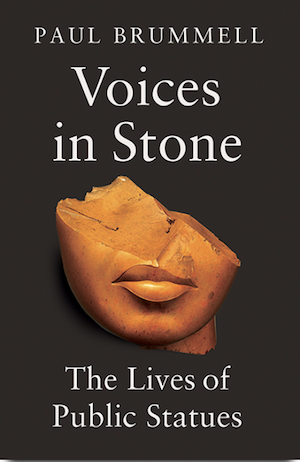
Voices in Stone: The Lives of Public Statues
Brummell, P. (2026). Voices in stone: The lives of public statues. Hurst.
Get the book →August 16, 2026
20260816-brummell-voices-in-stone-a-close-up
The rest of this thread

Paul Brummell
Paul Brummell is a British career diplomat and the current UK High Commissioner to Mauritius. He previously served as Ambassador to Latvia, Romania, Turkmenistan, and Kazakhstan and Kyrgyzstan, and was UK High Commissioner to Barbados and the Eastern Caribbean. He is the author of Diplomatic Gifts: A History in Fifty Presents (Hurst, 2022) as well as four travel guides, published by Bradt Guides.
Propose a thread
Know something the rest of us don't?
Most threads on Rorotoko begin with our invitation. Some begin with a proposal. Both use the same prompts and the same editing, with your own pages in the archive. Proposed threads carry a small Sponsored label and a fee.
Propose a thread →