
Susan E. Farrell
Vonnegut's War: The Making of Slaughterhouse-Five
Why should we care about Vonnegut's novel today? Slaughterhouse-Five, a critically-acclaimed bestseller when it was first released in 1969, has much to say about the turbulent late 1960s even though the novel is set largely during World War Two. It was the 1960s, with the rise of the counterculture, increasing social and racial unrest, and especially U.S. entanglement in the unpopular American war in Vietnam, that gave the novel its widespread appeal. Slaughterhouse-Five was released into an America that was finally willing to listen to Vonnegut's story of atrocity from an earlier conflict that had been mythologized as the Good War. Readers in today's troubled times could learn a great deal from Vonnegut's self-professed "lousy little book" as well.
In America of 2026, we're facing extreme political polarization, reminiscent of rifts during the Vietnam Era, as well as threats to elective democracy, the global rise of the far right, raging wars in Ukraine and the Middle East, and the resulting refugee crises that ensue. Today's political environment makes Vonnegut's novel more relevant than ever. Slaughterhouse-Five raises important questions about the nature of war: Is a good war possible? Is a just war possible? Does a critique of one side imply sympathy for the other? Vonnegut himself hated the Nazi fascists who captured, beat, and starved him. He was part of a sea of refugees during a war that displaced and killed more civilians than any other. Yet, he was sometimes accused of diminishing Nazi brutality by drawing attention to an atrocity committed by the Allies as he asked hard questions about America itself: Are we simply the good guys we like to imagine ourselves, the saviors rushing in to make the world safe for democracy, or is the story more complex than that? Vonnegut's novel offers a voice of humility, humanity, and compassion in the midst of a world that, like ours today, seems to have descended into absurdity. The novel reminds us that, no matter how unprecedented today's political events might seem, we've faced even more turbulent times in the past and survived. Above all, Vonnegut's novel offers a profoundly moral vision that insists upon maintaining human kindness and common decency in the worst of circumstances.
Ongoing thread. More from Susan E. Farrell to follow.
Curator: Bora Pajo
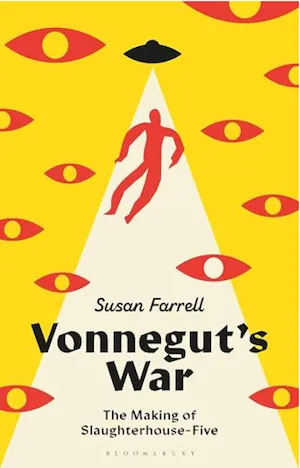
Vonnegut's War: The Making of Slaughterhouse-Five
Farrell, S. (2026). Vonnegut's war: The making of Slaughterhouse-Five. Bloomsbury.
Available here →September 5, 2026
20260905-farrell-vonneguts-war-the-wide-angle
The wide angle
The rest of this thread

Susan E. Farrell
Susan Farrell is a professor of English at the College of Charleston and a recipient of the Bill Moore Distinguished Teacher-Scholar Award. She specializes in contemporary American fiction and teaches a variety of courses on American literature, contemporary fiction, women's studies, and academic writing. She has published articles on contemporary American writers Toni Morrison, Louise Erdrich, Alice Walker, Shirley Jackson, Tim O'Brien, Kurt Vonnegut, Alice McDermott, and others.
Her most recent research has focused on American war literature. In 2017 she published Imagining Home: American War Fiction from Hemingway to 9/11. Her new book is called Vonnegut's War: The Making of Slaughterhouse-Five. From the brutality of Nazi POW camps to a charming mid-century love story, from a devastating firebombing to Holocaust denial, from tales of UFOs and alien abduction to the 1960s counterculture, this book tells the fascinating story behind Kurt Vonnegut's seminal 1969 novel, Slaughterhouse-Five.
Pull this thread
The Tralfamadorians entered Slaughterhouse-Five only in 1967, borrowed from the alien-abduction culture around Betty and Barney Hill.
Know something the rest of us don't?
Most threads on Rorotoko begin with our invitation. Any thread can begin with a proposal: you write it with the same prompts every thread answers, and we review it.
Propose a thread →