
Susan E. Farrell
Vonnegut's War: The Making of Slaughterhouse-Five
Kurt Vonnegut's 1969 novel, Slaughterhouse-Five, is a cultural touchstone. A novel that changed the way we think and write about war and that helped usher in a new style of literature, Slaughterhouse-Five has been named as one of the top novels of the twentieth century. It's been transformed into film, a graphic novel, and visual art. It has inspired rock bands. Phrases from the novel have entered the popular lexicon. It has been banned, burned, and censored.
The story behind the writing of Vonnegut's masterpiece is as fascinating as the book itself. A veteran of World War Two, Vonnegut was captured behind enemy lines during the Battle of the Bulge, forced to march for days without food, and imprisoned in two separate German P-O-W camps. One was a former slaughterhouse in the city of Dresden, where he experienced the Allied firebombing of the city. Put to work digging out rotting corpses from underground basements and shelters afterward, Vonnegut witnessed the worst of the war's destruction.
Slaughterhouse-Five would be inspired largely by two of Vonnegut's fellow prisoners—one, a starving American soldier shot by the Germans for pilfering a jar of string beans, would become Edgar Derby in the novel, a high school teacher "mournfully pregnant with patriotism…and imagined wisdom." The second, a passive and awkward soldier who stopped eating, gave in to the "thousand-mile stare," and died of malnutrition, would transform into the novel's anti-hero Billy Pilgrim, an ungainly and bewildered chaplain's assistant who famously becomes "unstuck in time."
After his return home, Vonnegut struggled for 24 years to write his war novel, facing obstacles at every turn. Told by the U.S. Air Force that information about the bombing was still top secret, he turned instead to the work of David Irving, a brash young British historian who had written the best-known account of the firebombing at the time. But Irving would turn out to be a Nazi sympathizer who had greatly inflated the numbers of those killed in the bombing. He would later be imprisoned in Austria for Holocaust denial.
Vonnegut also struggled with the shape of his war story. He didn't want to write a book that could be turned into a movie starring John Wayne or Frank Sinatra. He didn't want to glorify war. It wasn't until the mid-1960s, twenty years after his return from fighting overseas, that he struck on the idea of having Billy experience an alien abduction. The novel was greatly influenced by tales of UFOs and alien kidnappings prominent in the culture at the time.
The novel vaulted Vonnegut into both literary and popular fame, making him a household name and perhaps the most recognizable author of the late 20th century. But it also provoked a backlash, becoming the target of numerous censorship campaigns.
Vonnegut's War tells the real-life story of Slaughterhouse-Five. It sheds light on one of America's most beloved writers, asks questions about the possibility of a so-called "Good War," and explores how cultural forces helped shape a modern masterpiece.
Ongoing thread. More from Susan E. Farrell to follow.
Curator: Bora Pajo
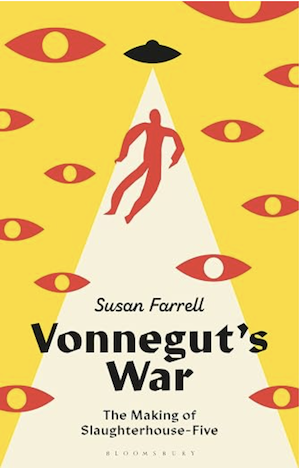
Vonnegut's War: The Making of Slaughterhouse-Five
Farrell, S. (2026). Vonnegut's war: The making of Slaughterhouse-Five. Bloomsbury.
Get the book →August 22, 2026
20260822-farrell-vonneguts-war-in-a-nutshell
In a nutshell
The rest of this thread

Susan E. Farrell
Susan Farrell is a professor of English at the College of Charleston and a recipient of the Bill Moore Distinguished Teacher-Scholar Award. She specializes in contemporary American fiction and teaches a variety of courses on American literature, contemporary fiction, women's studies, and academic writing. She has published articles on contemporary American writers Toni Morrison, Louise Erdrich, Alice Walker, Shirley Jackson, Tim O'Brien, Kurt Vonnegut, Alice McDermott, and others.
Her most recent research has focused on American war literature. In 2017 she published Imagining Home: American War Fiction from Hemingway to 9/11. Her new book is called Vonnegut's War: The Making of Slaughterhouse-Five. From the brutality of Nazi POW camps to a charming mid-century love story, from a devastating firebombing to Holocaust denial, from tales of UFOs and alien abduction to the 1960s counterculture, this book tells the fascinating story behind Kurt Vonnegut's seminal 1969 novel, Slaughterhouse-Five.
Know something the rest of us don't?
Most threads on Rorotoko begin with our invitation. Some begin with a proposal. Both use the same prompts and the same editing, with your own pages in the archive. Proposed threads carry a small Sponsored label and a fee.
Propose a thread →