
Neil Van Leeuwen
Religion as Make-Believe: A Theory of Belief, Imagination, and Group Identity
There are theoretical and practical implications to my religion-as-make-believe view.
Theoretically, it shifts what one focuses on from belief contents to believing as an attitude, or way of relating to ideas, whatever they may be. One might "believe" that the supermarket closes at 9 PM. One might also "believe" that there will be eternal life for the faithful. Of course, those are different ideas or contents. But my work opens the possibility that the so-called "believing" attitude in either case is very different as well. What one is doing with the respective ideas is different: matter-of-fact taking things to be so versus a reverential, identity-constituting attitude. This possibility has been largely overlooked in many philosophical circles, largely due to failure to appreciate the extent to which the word "belief" is multi-valanced.
Practically, the view helps explain why many people's "beliefs" are so resistant to evidence—in ways that affect not only religious but political discourse. When people "believe" something in a matter-of-fact way, what I call factual belief, such belief is actually quite responsive to evidence. When you factually believe the supermarket is open until 9 PM and then encounter compelling evidence to the contrary, your belief updates so swiftly you barely notice it. But if, as I think, it is part of the job of religious credences to signal group identity, then they wouldn't do their job well if they were responsive to evidence in the way that factual beliefs are: one would be a poor group member if one's groupish "beliefs" changed over something so trifling as evidence! Invulnerability to evidence, which would be a bug for one's factual beliefs, is actually (and tragically, some might say) a feature when it comes to religious credence. That's why, in a sense, religious credence has to be a form of imagining: it needs to be maintainable, come what slings and arrows of contrary evidence may come.
There is also a way in which my shift in theoretical focus amplifies these practical implications. Since I focus on religious credence as an attitude that can be held in relation to variable ideas (as opposed to defining religious "belief" as being about the idea of God, or whatever), I help explain the dynamics of ideological cognition more generally. Political polarization on hot topics—say, about the existence of anthropogenic climate change—occurs in part because contents that should be managed by people's evidentially vulnerable factual beliefs end up becoming identity markers, toward which people have an attitude of religious credence. As I put it in the book, "Anything can be sacralized."
Ongoing thread. More from Neil Van Leeuwen to follow.
Curator: Bora Pajo
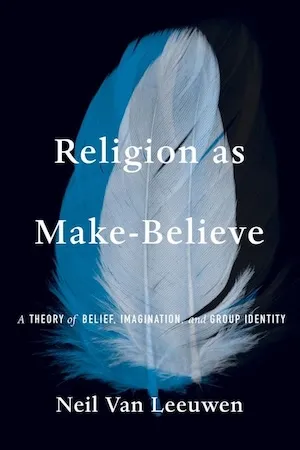
Religion as Make-Believe: A Theory of Belief, Imagination, and Group Identity
Van Leeuwen, N. (2023). Religion as make-believe: A theory of belief, imagination, and group identity. Harvard University Press.
Available here →September 6, 2026
20260906-van-leeuwen-religion-as-make-believe-the-wide-angle
The wide angle
The rest of this thread

Neil Van Leeuwen
Neil Van Leeuwen is Professor of Philosophy at Florida State University. He has published widely in philosophy of mind and cognitive science. His book, Religion as Make-Believe: A Theory of Belief, Imagination, and Group Identity, was published by Harvard University Press in 2023. He is co-editor, with Tania Lombrozo, of the forthcoming Oxford Handbook of the Cognitive Science of Belief. His work has been featured in range of popular venues, including The Atlantic, The New Yorker, The New York Times, and NPR.
Pull this thread
Religious credence is a form of imagining, continuous with children's make-believe, and its imperviousness to evidence is the job.
Know something the rest of us don't?
Most threads on Rorotoko begin with our invitation. Any thread can begin with a proposal: you write it with the same prompts every thread answers, and we review it.
Propose a thread →