
Neil Van Leeuwen
Religion as Make-Believe: A Theory of Belief, Imagination, and Group Identity
For the last decade and a half, I've been developing a line of research that theorizes religion as a form of make-believe play. Consider kids playing games of pretend on a playground during recess. Those who play with G.I. Joe dolls congregate. Those who play with Barbie dolls congregate. Those who play with He-Man dolls congregate. So the children form in-groups around which kind of imagined super-agent they make-believe. And it is viscerally important to them that they play these games. This sets up the overarching idea of my recent book, Religion as Make-Believe. Religion, in many of its instances, is a large-scale version of that: games of make-believe play, in which people form group identities around which super-agent they imaginatively represent and venerate through symbolic action.
Religion as Make-Believe is thus also about the psychology of "belief." I put the word "belief" in quotation marks, because in different contexts that word means different things. A core thesis of my book is that what I call factual belief and religious credence are different attitudes—different ways of relating to ideas. The even-more-provocative thesis, which stems from the overarching idea laid out above, is that religious credence is a form of imagining. In other words, in terms of its cognitive dynamics, it's basically like the attitude people utilize in make-believe play. Yet religious credence also connects imagining to sacred values in ways that make it far more serious than other forms of make-believe.
Let's return to the kids on the playground. Importantly, they have two-map cognitive structures in their minds. The factual belief map tracks where the sand piles are, how big the plastic dolls are, which kid is holding which doll, and so on. The imagining map represents giant palaces, life-sized heroic beings, the voices of such beings, and so on. Importantly, both maps, though distinct, help guide the kids' make-believe actions.
Likewise, in religious contexts—or at least in many religious contexts, since it is an empirical question how widely my theory applies—people have two-map cognitive structures in their minds. The factual belief map layer, for example, may represent a Styrofoam-textured wafer, while the religious credence layer represents the flesh of a deity-made-man from 2,000 years ago. What makes the layers distinct is that the factual belief layer is formed involuntarily, is uncompartmentalized in how it guides action, and is highly vulnerable to evidence, whereas religious credence is something chosen, is compartmentalized to sacred or ritual times and places, and can be maintained without or even contrary to evidence—as a matter of "faith."
The astonishing thing about human beings, if I am right about the psychology of religious credence, is that we pervasively define our communities and what is sacred to us through what we imaginatively represent. Our make-believe tendencies do not stop in our childhood, as many mistakenly think. They become redeployed in symbolic religious activities. My book is therefore not just about "belief," it is about the power of imagination.
Ongoing thread. More from Neil Van Leeuwen to follow.
Curator: Bora Pajo
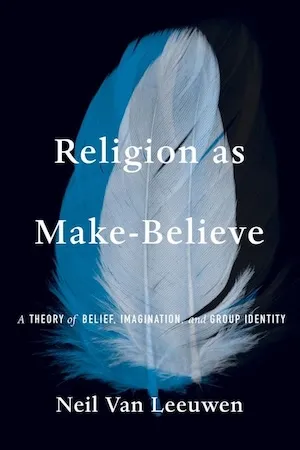
Religion as Make-Believe: A Theory of Belief, Imagination, and Group Identity
Van Leeuwen, N. (2023). Religion as make-believe: A theory of belief, imagination, and group identity. Harvard University Press.
Available here →August 26, 2026
20260826-van-leeuwen-religion-as-make-believe-in-a-nutshell
In a nutshell
The rest of this thread

Neil Van Leeuwen
Neil Van Leeuwen is Professor of Philosophy at Florida State University. He has published widely in philosophy of mind and cognitive science. His book, Religion as Make-Believe: A Theory of Belief, Imagination, and Group Identity, was published by Harvard University Press in 2023. He is co-editor, with Tania Lombrozo, of the forthcoming Oxford Handbook of the Cognitive Science of Belief. His work has been featured in range of popular venues, including The Atlantic, The New Yorker, The New York Times, and NPR.
Know something the rest of us don't?
Most threads on Rorotoko begin with our invitation. Some begin with a proposal. Both use the same prompts and the same editing, with your own pages in the archive. Proposed threads carry a small Sponsored label and a fee.
Propose a thread →