
Yucheng Lin
Committed Antarctic Ice Sheet mass loss by the end of the twenty-first century
Even at 1.5 °C, Antarctica loses ice this century. How much is our choice.
Antarctica is already committed to losing ice this century, even if the world meets the Paris Agreement’s most ambitious goal of holding warming to 1.5 °C.
That may sound obvious. It isn’t. For years, the best computer models of Antarctica could not agree on which way it would go.
Here’s why. Warming pulls Antarctica in two directions at once. A warmer ocean eats away at the ice shelves, the floating slabs of ice that fringe the continent, melting them from below. But warmer air also holds more moisture, so more snow falls on the ice sheet. In some projections, the extra snow outweighs the ice lost to the ocean, and the ice sheet actually grows.
Antarctica has long been the wild card of sea-level science. It holds enough ice to raise global sea level by about 58 meters. Yet no one has been able to say with confidence whether it will add to rising seas by 2100 or hold them back a little.
My colleagues and I now think that question has an answer. Antarctica loses. Our analysis puts the chance at 92 percent or higher. That is not certainty. Fewer than one in twelve of the futures that fit the evidence still ends with Antarctica holding more ice than it does today.
How did we get there? Previous assessments relied on running ice-sheet models, which are slow. We took a shortcut. We trained an AI on a large archive of existing simulations. Its speed let us test hundreds of thousands of possible futures against what satellites have measured since 2002. Only futures that matched the real ice sheet survived. The survivors point one way: ice loss this century, even at 1.5 °C.
Now the part that’s easy to get wrong. “Committed” doesn’t mean “too late.”
The commitment comes from the state the ice sheet is in today. It is already out of balance, and it responds to warming with a long delay. That fixes the direction of change, not its size. How much ice Antarctica loses still depends on what we emit. Every ton of greenhouse gas we avoid reduces the loss this century, and the benefit lasts for hundreds of years.
So this isn’t a story of doom. It’s a change in the question. We used to ask whether Antarctica would shrink this century. It will. The question now is by how much, and that part is still up to us.
Ongoing thread. More from Yucheng Lin to follow.
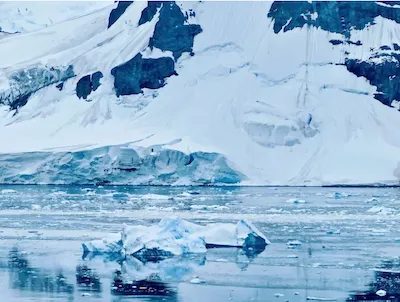
A glacier front meets the sea in Antarctica. The ice sheet holds enough ice to raise global sea level by about 58 meters. © Qiyue Sun
Curator: Bora Pajo
Committed Antarctic Ice Sheet mass loss by the end of the twenty-first century
Lin, Y., Zhang, X., Golledge, N. R., Kopp, R. E., Church, J. A., Jin, Y., Zhao, C., … Stokes, C. R. (2026). Committed Antarctic Ice Sheet mass loss by the end of the twenty-first century. Nature Geoscience. https://doi.org/10.1038/s41561-026-02102-1
Available here →October 17, 2026
20261017-lin-committed-antarctic-ice-sheet-mass-loss-by-the-end-of-the-twenty-first-century-in-a-nutshell
In a nutshell
The rest of this thread

© Yucheng Lin
Yucheng Lin
Yucheng Lin is an assistant professor in the School of Energy and Environment at City University of Hong Kong. He earned his PhD in physical geography at Durham University, then worked as a postdoctoral researcher at Rutgers University and a research scientist at CSIRO in Australia. His research combines geophysics, Bayesian statistics and artificial intelligence to reconstruct the past, characterize the present and project the future of sea-level change, and to quantify the risks it poses. He led the 2026 Nature Geoscience study on committed Antarctic ice loss, and a 2025 Nature study on quantifying global sea-level rise since 1900 is at least faster than any century over the past 4,000 years.
Pull this thread
Antarctica will lose ice this century even at 1.5 °C, but emissions still decide how much.
Know something the rest of us don't?
Most threads on Rorotoko begin with our invitation. Any thread can begin with a proposal: you write it with the same prompts every thread answers, and we review it.
Propose a thread →