
Yucheng Lin
Committed Antarctic Ice Sheet mass loss by the end of the twenty-first century
Even at 1.5 °C, Antarctica loses ice this century. How much is our choice.
Picture the underside of an ice shelf.
Overhead is a ceiling of ice hundreds of meters thick, floating on the sea and stretching farther than you can see. Down here it is dark and very cold. Behind you, where the shelf meets the land, glaciers still rest on rock. The shelf holds them back, like a brake.
Now run the world forward under very high emissions.
Warm water slips in beneath the shelf. The ceiling melts from below and thins. A thinner shelf is a weaker brake, so the glaciers behind it slide faster over their beds. Weakened, the shelf breaks apart. The brake is gone.
Each step makes the next one easier. That is the domino effect at the high end of our results. Together, these steps could add as much as 25 centimeters to global sea level from Antarctica alone by 2100. That high end is the part our emissions still control.
This scene comes from inside our study. It belongs to futures that passed our auditions, meaning they are consistent with what satellites have measured since 2002. It is also built from the very assumptions our AI flagged as mattering most. Out of more than twenty, three stood out: how the big ice shelves respond to a warming ocean, how easily ice slides over bedrock, and how fast the ocean and air around Antarctica warm. The first three dominoes, the warming, the melting and the sliding, are exactly those three.
I should be honest about what this picture is. Some links are modeling choices rather than physics we fully understand. How a model represents an ice shelf breaking apart is one of them. Other processes are missing from today’s simulations, so our AI cannot learn about them. Among them: how ice cracks, how rivers and lakes under the ice sheet change, and how ice, ocean, air and solid Earth push back on one another. Any of these could reshape the picture. This is far from the final word.
So what would change if people took it seriously?
We would stop treating Antarctica as a coin toss. Coastal plans could take ice loss this century as the starting point, not the worst case.
Research could take aim. We can’t afford to study every detail of an ice-sheet model, so we have to know which details matter. Now we have a ranked list, and the three processes at the top are realistic targets for the next satellites and field campaigns. When new data and simulations arrive, we can rerun the auditions in seconds rather than starting over.
From Hong Kong, Antarctica feels impossibly far away. It isn’t. Ice is heavy, and its gravity holds the ocean close. As Antarctica loses ice, that pull weakens and the water moves away. Near Antarctica, the sea can actually fall. Here, half a world away, Antarctica’s share of the rise is a little larger than the global average.
What happens under that ice shelf will show up on our shore.
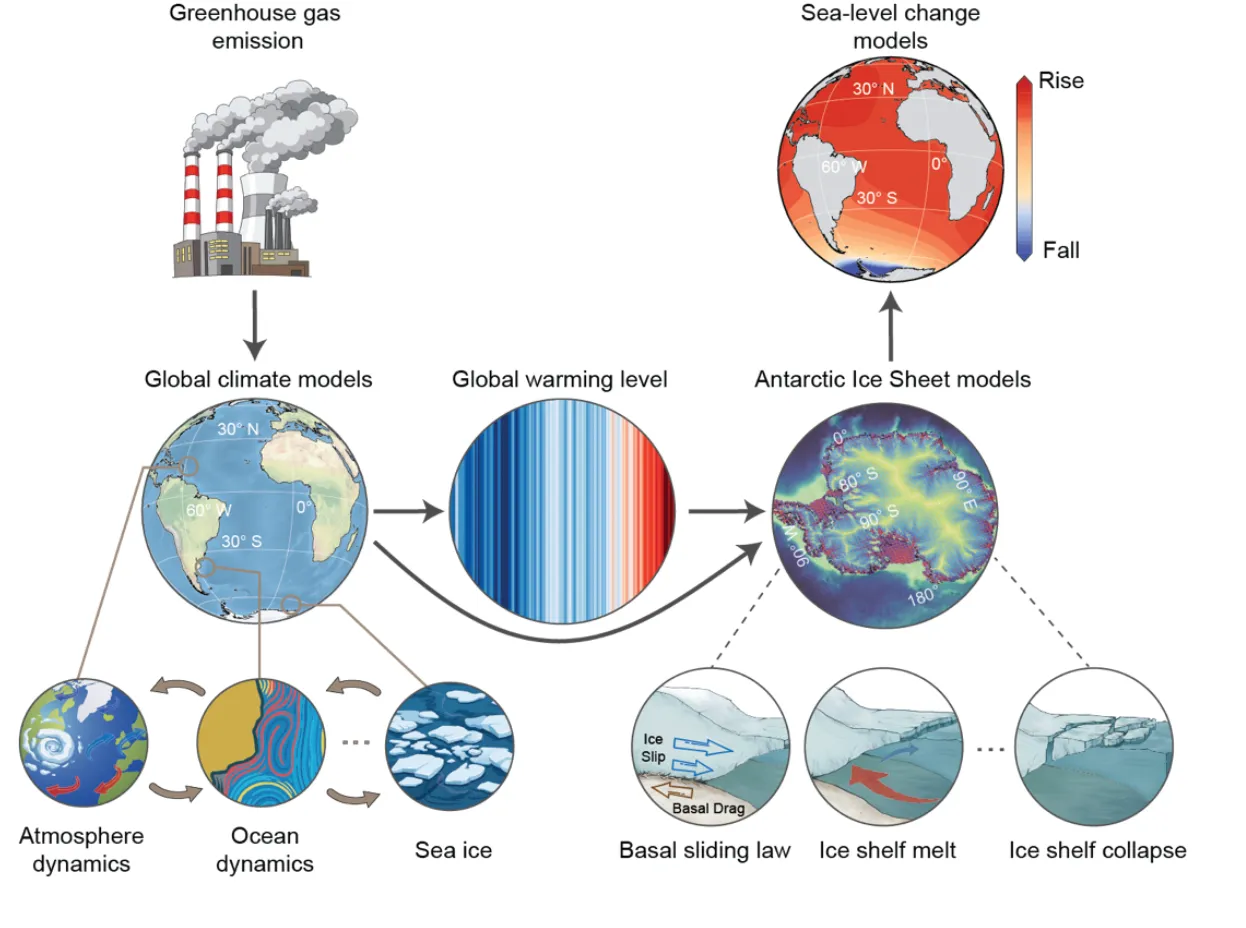
The chain of models used to project Antarctica’s future, from greenhouse gas emissions to sea-level change. Every handoff adds uncertainty. © Yucheng Lin
Curator: Bora Pajo
Committed Antarctic Ice Sheet mass loss by the end of the twenty-first century
Lin, Y., Zhang, X., Golledge, N. R., Kopp, R. E., Church, J. A., Jin, Y., Zhao, C., … Stokes, C. R. (2026). Committed Antarctic Ice Sheet mass loss by the end of the twenty-first century. Nature Geoscience. https://doi.org/10.1038/s41561-026-02102-1
Available here →October 30, 2026
20261030-lin-committed-antarctic-ice-sheet-mass-loss-by-the-end-of-the-twenty-first-century-a-close-up
A close-up
The rest of this thread

© Yucheng Lin
Yucheng Lin
Yucheng Lin is an assistant professor in the School of Energy and Environment at City University of Hong Kong. He earned his PhD in physical geography at Durham University, then worked as a postdoctoral researcher at Rutgers University and a research scientist at CSIRO in Australia. His research combines geophysics, Bayesian statistics and artificial intelligence to reconstruct the past, characterize the present and project the future of sea-level change, and to quantify the risks it poses. He led the 2026 Nature Geoscience study on committed Antarctic ice loss, and a 2025 Nature study on quantifying global sea-level rise since 1900 is at least faster than any century over the past 4,000 years.
Pull this thread
Antarctica will lose ice this century even at 1.5 °C, but emissions still decide how much.
More in Research
More in Books
Know something the rest of us don't?
Most threads on Rorotoko begin with our invitation. Any thread can begin with a proposal: you write it with the same prompts every thread answers, and we review it.
Propose a thread →