
Sine Plambech
Rescue
A very powerful woman's story
The film is called Rescue because Roro rescues her baby. It's not so much about a rescue ship rescuing migrants and refugees. It's about a mother rescuing herself and her children, and her striving for justice after she comes to Germany.
In the film, I follow the Doctors Without Borders rescue ship for about a year on the Mediterranean, to focus both on the political situation there and on the human stories of the people who are rescued at sea. That was my idea from the get-go: to see how I could combine the political with the human story. But when you film at sea with a rescue ship, you don't know who is going to be rescued. People are migrating, and are refugees, from so many countries these years. So I had to be open to the fact that it could be anyone who came on board, while knowing that I needed my anthropological analysis and the perspective of these two levels, the more global and the more intimate.
When we were filming at sea, we witnessed and documented the kidnapping of 25 women and 4 children by a Libyan militia. The militia took the women and children back to Libya. They shot at the men, and the men jumped into the water and were rescued by Doctors Without Borders.
So in the film I follow one of the husbands, Hani, whose wife was kidnapped. Over the months that follow, I follow his life in Italy and in Germany where he applies for asylum. It is the story of the young mother, his wife Roro, who was fighting for herself and her children while being held captive in Libya.
It's a story about why such a kidnapping happened at all. What is going on in the Mediterranean, so that a Libyan militia can kidnap refugee women in front of my camera? But also: how did it feel to be her? What did she endure? It's maybe a plot spoiler, but the film ends with them being reunited in Germany, after seven attempts to cross the sea, and sexual exploitation, and many things that happened to her. So it's a story about the consequences of the political for this little family, and about how she is trying to rescue herself.
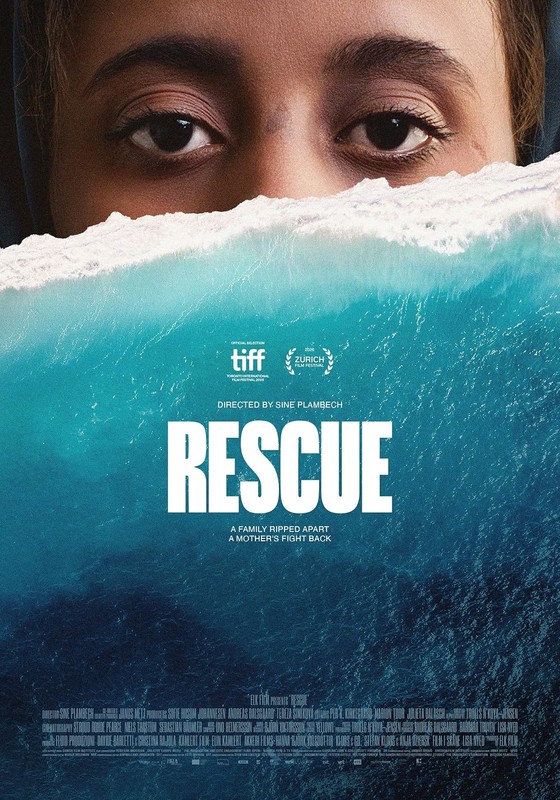
The kidnapping is not allowed. But during what we call the first European refugee crisis, let's say ten years ago, during the war in Syria, the European countries had a common, shared rescue flotilla to rescue people crossing the sea. So many people were crossing that they decided: no, we are going to stop them on the North African coast instead. They shouldn't risk their lives to come to Europe. That was how they legitimized it, that it was actually to rescue the people themselves. So they would send money to Libya, to Tunisia, to North African countries, and have their border guards and coast guards stop people.
But when you send billions of euros to a country like Libya, which is already in conflict, with a lot of militias and two governments, only one of them recognized by the UN, you don't always know where the money ends up. What we have seen is that a lot of this money from the EU circulates among legal and illegal entities, among them a lot of militias, who make a lot of money sailing out to sea and kidnapping people back. Then selling them again, back and forth, in an endless system of ransom, of buying and selling people, which exploded when Europe started to send money to Libya.
So when you ask how the kidnapping could happen, it is because of these larger political structures that have nothing to do with Hani and Roro, but which ended up influencing their lives in such a deep way.
Ongoing thread. More from Sine Plambech to follow.
Curator: Bora Pajo
Rescue
Available here →October 23, 2026
20261023-plambech-rescue-in-a-nutshell
In a nutshell
The rest of this thread

© Mirjam Kluka
Sine Plambech
Dr. Sine Plambech is an anthropologist, author, film director, and Senior Researcher at the Danish Institute for International Studies. Sine specializes in the areas of migration, smuggling, trafficking, and the sex industry. She works and films in migrant communities, border areas, red-light districts, and along migrant routes in West Africa, Asia, Europe’s southern border, and Denmark. With the multi-award-winning films, Heartbound and Fra Thailand til Thy, Sine Plambech stepped firmly onto the international documentary film scene. She dedicates her time to research, filmmaking, and social justice movements on the rights of migrants, women, and sex workers.
Pull this thread
European money sent to stop migrants in Libya feeds a militia trade in kidnapping and ransom.
Know something the rest of us don't?
Most threads on Rorotoko begin with our invitation. Any thread can begin with a proposal: you write it with the same prompts every thread answers, and we review it.
Propose a thread →