
Timothy Lang
Detection and Analysis of an Upward Jet-Like Electrical Discharge Intercepting a High-Altitude Research Aircraft
Everyone knows that lightning is a hazard that strikes from the base of a thundercloud, but lightning can come out of the top too. Not many airplanes can fly high enough to go over the tops of thunderstorms, but the National Aeronautics and Space Administration (NASA) ER-2 – adapted from the famous military reconnaissance U-2 aircraft to perform scientific research instead – flies at 65,000 feet, allowing it to go over just about any cloud our atmosphere can produce. Scientists have often wondered about the risk of flying the ER-2 over thunderstorms, which sometimes produce upward lightning flashes called blue starters, blue jets, or gigantic jets depending on how high they go. These are members of a larger family of electrical phenomena that occur over thunderclouds called transient luminous events (TLEs). The intrepid ER-2 pilots are willing to do just about anything for science, but for a single-seat plane flying far out over the ocean, at an altitude so high the pilot needs to wear what amounts to a space suit, the consequences of an upward lightning strike need to be considered.
That being said, prior to an airborne field campaign in 2023, the ER-2 had never reported a lightning strike, upward or otherwise. In a sense, NASA pilots were flying blind – many thunderstorm overflights had been done over the decades, sometimes with the pilots even observing upward lightning, but no aircraft strikes were recorded. But then in the early morning hours of 24 July 2023 off the west coast of the Yucatán Peninsula, while flying over one of the most intense tropical thunderstorms ever measured by the ER-2, the aircraft was indeed hit by an upward discharge. However, the pilot didn’t even realize it, nor did the scientists on the ground monitoring their instruments from home base in Florida. The mechanics who inspect the aircraft after every flight didn’t find any damage either.
What happened? As it turns out, upward lightning from cloud tops can be comprised of what are known as streamers. Streamers are a wave of ionized plasma, but they don’t have much electrical current compared to what we normally think of as lightning: bright hot leader channels that can carry thousands of amps of current over tens of miles. Streamers are a type of lightning that can turn into leaders, or they can just occur on their own. The upward flash that hit the ER-2 that summer night was mostly just streamers. Streamers cause some electrical shock, enough to upset an instrument or two, but they aren’t likely to damage an airplane. So, when the plane was hit the ground-based scientists noticed they needed to reboot a couple of their instruments, but that wasn’t unusual at all – instruments fail in flight all the time, and power cycling is a tried-and-true method of fixing that, as anyone who’s ever used a computer knows. But months later, as scientists combed through the campaign’s data, they noticed something unusual in their lightning measurements and found the first scientific evidence of a TLE hitting an aircraft.
Ongoing thread. More from Timothy Lang to follow.
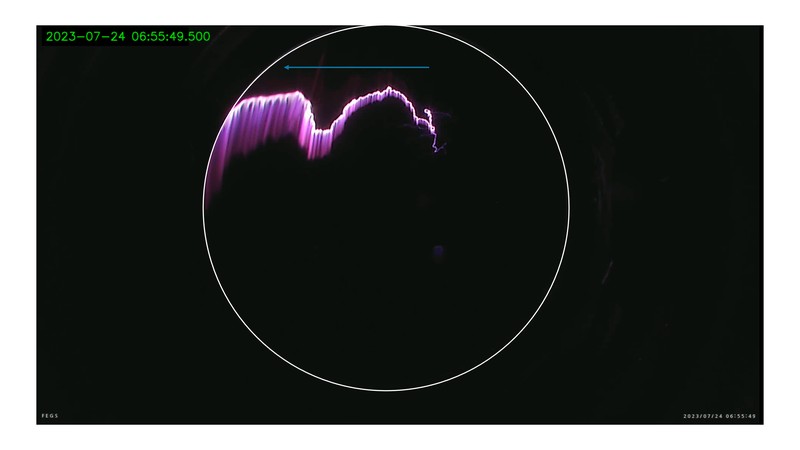
A frame from the FEGS video camera at the time of the TLE strike (06:55:49.5 Coordinated Universal Time, UTC, on 24 July 2023). The camera viewed through a circular window (indicated by a white circle not in original image), and the limited field of view prevented full imaging of the discharge. The blue arrow indicates approximate direction of discharge propagation, determined by the relative amount of aircraft-induced motion blurring in the video, with less blurring when the discharge is further away (right) and more blurring when it is closer (left).
Curator: Bora Pajo
Detection and Analysis of an Upward Jet-Like Electrical Discharge Intercepting a High-Altitude Research Aircraft
Lang, T. J., Mezentsev, A., Quick, M. G., Amiot, C. G., Bateman, M., Blakeslee, R., Cummer, S., Heymsfield, G. M., Kroodsma, R. A., Lehtinen, N. G., Mach, D., Marisaldi, M., Walker McLinden, M., Østgaard, N., Pazos, M., Sarria, D. A. S., Schultz, C. J., Walker, T. D., van der Velde, O., & Virts, K. (2026). Detection and analysis of an upward jet-like electrical discharge intercepting a high-altitude research aircraft. Geophysical Research Letters, 53(19), e2026GL124761. https://doi.org/10.1029/2026GL124761
Available here →October 25, 2026
20261025-lang-detection-and-analysis-of-an-upward-jet-like-electrical-discharge-intercepting-a-high-altitude-research-aircraft-in-a-nutshell
In a nutshell
The rest of this thread

Timothy Lang
Timothy Lang is a research scientist studying convection, lightning, precipitation, and ocean winds at NASA Marshall Space Flight Center, where he has worked since 2012. Prior to that he worked as an atmospheric scientist at Colorado State University and Harvard University. He served as the project scientist for the ALOFT airborne campaign discussed in this article, a role he is reprising for a follow-on campaign schedule for 2028.
Pull this thread
Upward lightning from storm tops can strike high-flying aircraft, and spaceborne sensors need ultraviolet channels to see it.
Know something the rest of us don't?
Most threads on Rorotoko begin with our invitation. Any thread can begin with a proposal: you write it with the same prompts every thread answers, and we review it.
Propose a thread →