
Timothy Lang
Detection and Analysis of an Upward Jet-Like Electrical Discharge Intercepting a High-Altitude Research Aircraft
The 2023 ER-2 field campaign was called ALOFT, an acronym which is too tortured and annoying to define here. (NASA loves its complicated acronyms.) The goal of ALOFT was to detect gamma-ray emissions from thunderstorms, which come in the form of bright but quick events called terrestrial gamma-ray flashes (TGFs) and longer-lived but lower-energy gamma-ray glows. Prior to this campaign TGFs were thought to be extremely rare, but ALOFT detected well over 100 TGFs and more than 500 glows over just 10 research flights. This treasure trove meant that every new dive into the data found something new and interesting to study. One day, several months after the project concluded, an ALOFT researcher looking for more gamma-ray events from the 24 July flight found something unexpected: The optical lightning sensor on the aircraft saw pulses with essentially instantaneous rise times. Normally, for lightning occurring within a cloud, it can take milliseconds for the light from a flash to scatter around and finally escape out the top. (This is why storm clouds can appear dark, there are too many cloud particles for light to pass through easily.) A near-instantaneous rise time meant only one thing: This lightning channel was above the cloud in the clear air.
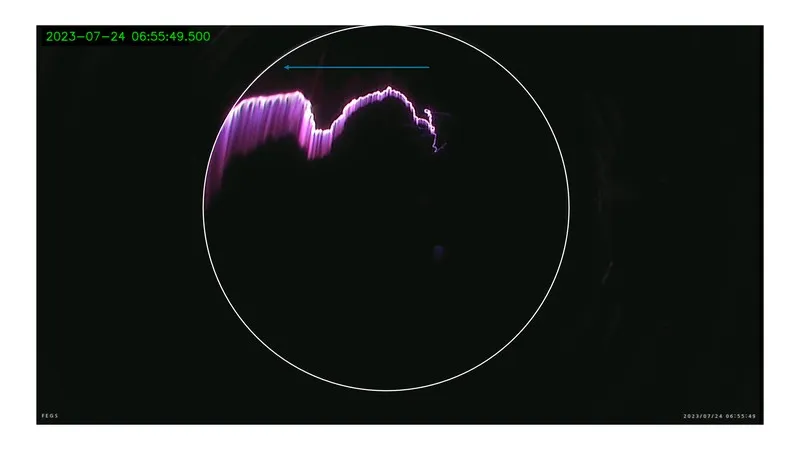
The optical sensor also included a standard HD video camera. This camera had poor low-light sensitivity and really was only useful for daytime context imagery of the storm clouds the ER-2 flew over. At night the video was always just black, like someone forgot to remove the lens cap. But knowing that the other components of the sensor were seeing above-cloud lightning activity, ALOFT researchers pored through the video. Sure enough, at the same time the above-cloud pulses were detected, a bright flash was seen in the video extending from the cloud below up to the plane itself (see image below). A ground-based lightning sensor deployed in the Yucatán for ALOFT confirmed that the lightning originated near cloud top, which was just 10,000 feet below the ER-2. Another sensor on the aircraft measured electric fields at this time that were so strong they should cause spontaneous breakdown of the thin air molecules at that altitude into conducting plasma; that is, lightning.
The evidence was overwhelming; an upward lightning discharge from the top of the storm had hit the ER-2. Since TLEs were discovered in 1989, there had been speculation about what would happen if aircraft or even spacecraft encountered them, but no one had ever documented such an event. ALOFT made groundbreaking discoveries regarding TGFs and now it had added another new result, this time about TLEs. Thankfully, this special type of lightning was streamer-based, so no real damage happened to the plane, and the pilot made it home safely without even knowing he had enabled yet another discovery.
Ongoing thread. More from Timothy Lang to follow.
A frame from the FEGS video camera at the time of the TLE strike (06:55:49.5 Coordinated Universal Time, UTC, on 24 July 2023). The camera viewed through a circular window (indicated by a white circle not in original image), and the limited field of view prevented full imaging of the discharge. The blue arrow indicates approximate direction of discharge propagation, determined by the relative amount of aircraft-induced motion blurring in the video, with less blurring when the discharge is further away (right) and more blurring when it is closer (left).
Curator: Bora Pajo
Detection and Analysis of an Upward Jet-Like Electrical Discharge Intercepting a High-Altitude Research Aircraft
Lang, T. J., Mezentsev, A., Quick, M. G., Amiot, C. G., Bateman, M., Blakeslee, R., Cummer, S., Heymsfield, G. M., Kroodsma, R. A., Lehtinen, N. G., Mach, D., Marisaldi, M., Walker McLinden, M., Østgaard, N., Pazos, M., Sarria, D. A. S., Schultz, C. J., Walker, T. D., van der Velde, O., & Virts, K. (2026). Detection and analysis of an upward jet-like electrical discharge intercepting a high-altitude research aircraft. Geophysical Research Letters, 53(19), e2026GL124761. https://doi.org/10.1029/2026GL124761
Available here →October 25, 2026
20261025-lang-detection-and-analysis-of-an-upward-jet-like-electrical-discharge-intercepting-a-high-altitude-research-aircraft-the-wide-angle
The wide angle
The rest of this thread

Timothy Lang
Timothy Lang is a research scientist studying convection, lightning, precipitation, and ocean winds at NASA Marshall Space Flight Center, where he has worked since 2012. Prior to that he worked as an atmospheric scientist at Colorado State University and Harvard University. He served as the project scientist for the ALOFT airborne campaign discussed in this article, a role he is reprising for a follow-on campaign schedule for 2028.
Pull this thread
Upward lightning from storm tops can strike high-flying aircraft, and spaceborne sensors need ultraviolet channels to see it.
Know something the rest of us don't?
Most threads on Rorotoko begin with our invitation. Any thread can begin with a proposal: you write it with the same prompts every thread answers, and we review it.
Propose a thread →