
Foong Shaohui
ALBATROSS: A Bioinspired, Aerially Deployable, Autonomous Sailing Sensor Platform
The most sophisticated robots are often the ones that do more with less.
A robot can become more sophisticated precisely by having fewer parts.
We tend to imagine the future of robotics as machines bristling with cameras, motors and sensors. Every new challenge seems to demand another mechanism. Yet I have spent much of my research career pursuing the opposite question: what happens when we ask a single component to do several jobs, and let physics do as much of the work as possible?
I call this philosophy “sophisticated simplicity”. Simple does not mean simplistic. It means putting the sophistication into the design, rather than adding complexity to compensate for a poor one.
For years, my team at the Singapore University of Technology and Design (SUTD) has studied monocopters, unconventional flying robots inspired by the maple seed. Drop a maple seed, and its lone wing starts spinning. This autorotation generates aerodynamic lift, slowing its descent without a battery, motor or parachute. We have used that elegant motion to develop aerial robots that can descend controllably with remarkably little actuation. Nature is doing much of the heavy lifting.
Our new Science Robotics study takes this idea somewhere unexpected: onto water.
Consider the problem of monitoring a distant patch of ocean. A boat can stay in the area, but reaching it may take time. An aircraft can get there quickly, but cannot hover above the same location indefinitely. What if we could combine the speed of aerial delivery with the persistence of a sailboat, without building two separate vehicles into one?
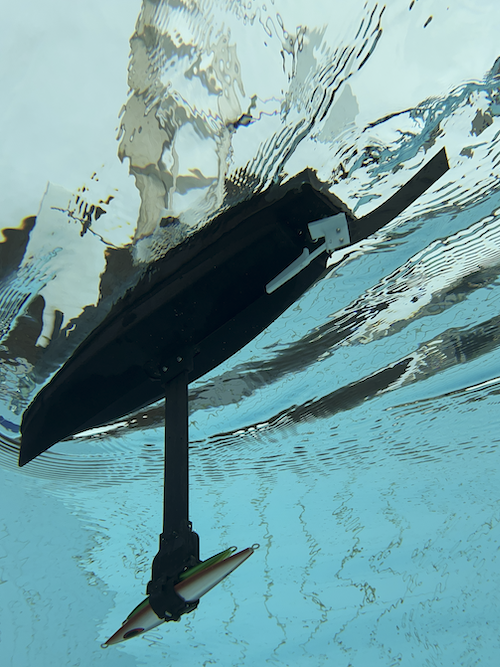
That question led to ALBATROSS, a small robot whose rigid wings have two lives. Released from the air, the wings autorotate like a maple seed, cushioning its descent. After it touches the water, a low centre of gravity causes the craft to right itself. The very same wings then serve as sails, catching the wind to propel it across the surface. No parachute needs to be discarded and no elaborate transformation mechanism or actuator is required.
The recycling of functions continues. A freely rotating main sail adjusts itself to the wind, guided by a small tail vane. A rudder inspired by a fish's tail steers the craft, and can oscillate to push it forward when the breeze dies. The entire vehicle navigates using only three actuators and three primary navigation sensors. Majority of its mass serves useful functions in both the aerial and aquatic phases.
This is not just a pleasing idea on paper. In experiments, ALBATROSS was released from 150 metres, descended in stable autorotation and righted itself after landing. In separate reservoir trials, it navigated set routes and collected environmental data over roughly three hours. It is still a research prototype, not an ocean-ready vessel; tougher conditions and much longer missions remain ahead.
What excites me is the principle. We did not make the robot simpler by asking it to do less. We made each part work harder, in harmony with its environment. To me, that is the beauty of sophisticated simplicity.
Ongoing thread. More from Foong Shaohui to follow.
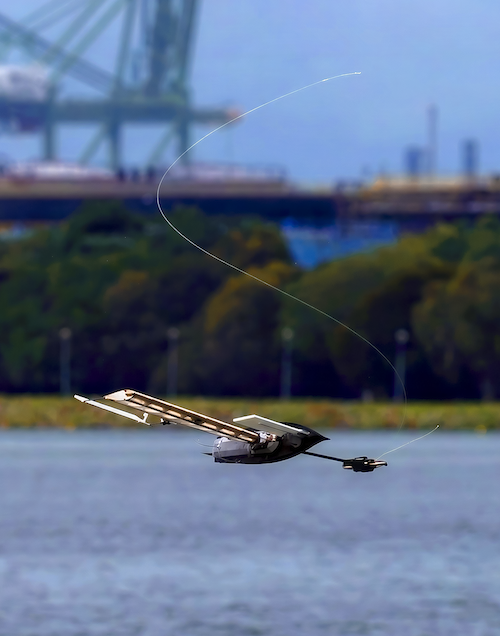
Close up shot of autorotation flight; Temasek Laboratories @ SUTD and Singapore University of Technology and Design (SUTD)
Curator: Bora Pajo
ALBATROSS: A Bioinspired, Aerially Deployable, Autonomous Sailing Sensor Platform
Win, S. K. H., Sufiyan, D., Suhadi, B. L., Win, L. S. T., Cai, X., Ang, W. J., & Foong, S. (2026). ALBATROSS: A bioinspired, aerially deployable, autonomous sailing sensor platform. Science Robotics, 11(118). https://doi.org/10.1126/scirobotics.aed1423
Available here →October 27, 2026
20261027-foong-albatross-in-a-nutshell
In a nutshell
The rest of this thread
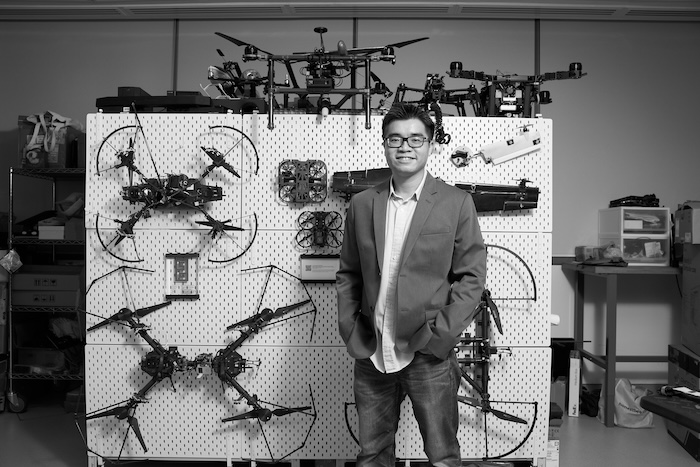
Foong Shaohui
Professor Shaohui Foong is a Professor in the Engineering Product Development Pillar and the Kwan Im Thong Hood Cho Temple Chair Professor at the Singapore University of Technology and Design (SUTD). He also serves as Associate Head of Pillar (Education) and Co-Director of the Dyson–SUTD Innovation Studios. He leads the Aerial Innovation Research Laboratory (AIR Lab), where his research focuses on nature-inspired robotics, efficient mechatronics, and multimodal robotic systems. Guided by a philosophy of “sophisticated simplicity,” his work explores how minimalist designs can achieve sophisticated robotic capabilities across different environments.
Pull this thread
A robot grows more capable when each part does several jobs and physics does the rest.
Know something the rest of us don't?
Most threads on Rorotoko begin with our invitation. Any thread can begin with a proposal: you write it with the same prompts every thread answers, and we review it.
Propose a thread →