
Foong Shaohui
ALBATROSS: A Bioinspired, Aerially Deployable, Autonomous Sailing Sensor Platform
The most sophisticated robots are often the ones that do more with less.
One day, I visited Singapore's National Sailing Centre to test a prototype designed to reduce injuries among competitive sailors. Racing sailboats can move surprisingly fast, and when a boat stops abruptly, the sailor may keep moving, risking serious injury. Our quick-release mechanism helps sailors disengage safely in such situations.
During the tests, I watched sailboats and windsurfers out on the water. Having grown up near the sea in Singapore, I had seen sails almost every day. They were so familiar that I barely gave them a second thought. But that day, something clicked.
At the Singapore University of Technology and Design (SUTD), my team and I had spent years studying maple seeds. Their single wings make them spin gracefully as they fall, slowing their descent without a motor or parachute. We had used this natural trick to develop monocopters, minimalist aerial robots inspired by the same principle. Yet I had never connected those spinning wings with the sails I grew up seeing.
Standing there, I realized that a sail and a maple-seed wing both harness aerodynamic forces, although for different purposes. Then came an almost absurdly simple question: Could the same wing let a robot descend from the sky like a maple seed, then become its sail on the water?
Sometimes research begins with an equation. This idea began by seeing two familiar things in a completely new way. What excited me was that we might not need separate mechanisms for the journey through air and the journey across water. One carefully designed structure could serve both.
Our years of research on samara-inspired monocopters and autorotating wings provided a starting point. We already knew how to make a wing descend slowly and guide its direction with minimal actuation. The real leap was to stop treating landing as the end of the mission.
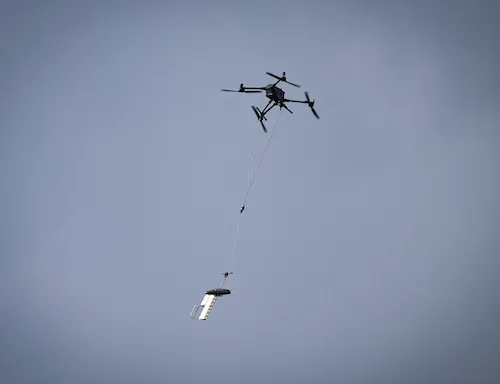
This mattered because remote marine monitoring faces a fundamental trade-off. Boats can remain at sea for long periods, but reaching distant waters takes time. Aircraft can deliver equipment rapidly, but cannot remain there indefinitely. We imagined a sensor that could be deployed from the air, land safely, and then sail autonomously to where it was needed.
Making that vision work was far from straightforward. The wing had to slow the fall and also catch enough wind to sail. The craft had to land without damage, right itself if overturned, and navigate in changing winds. Every design choice involved a compromise, and we wanted to avoid solving each problem by simply adding another motor.
Working closely with my team, including the paper's lead author, Dr Shane Kyi Hla Win, we developed ALBATROSS. Its rigid wings double as sails. Its low-mounted weight helps stabilize descent and enables passive self-righting on water. Even its rudder serves two roles: steering the boat and, by moving like a fish's tail, providing thrust when the wind is weak.
In field trials, we released ALBATROSS from 150 metres. It autorotated down, landed on the water and righted itself, then began sailing. A larger test version later navigated between waypoints in Singapore reservoirs. It is not yet ready for rough open seas, but the technical principle works.
For me, the most remarkable part is where it began: not with an unfamiliar discovery, but with a familiar sail I had seen all my life. I love that this project began while I was thinking about an entirely different problem. It reminded me that innovation is often less about inventing a new principle than noticing two familiar things that nobody thought to put together.
Ongoing thread. More from Foong Shaohui to follow.
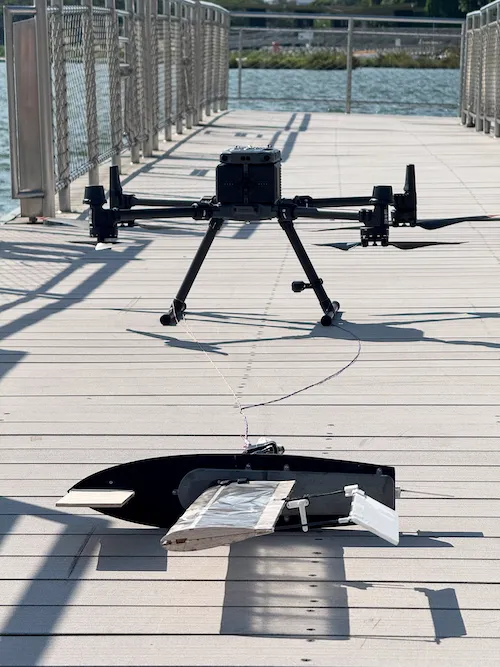
Prototype tethered to drone before takeoff; Temasek Laboratories @ SUTD and Singapore University of Technology and Design (SUTD)
Curator: Bora Pajo
ALBATROSS: A Bioinspired, Aerially Deployable, Autonomous Sailing Sensor Platform
Win, S. K. H., Sufiyan, D., Suhadi, B. L., Win, L. S. T., Cai, X., Ang, W. J., & Foong, S. (2026). ALBATROSS: A bioinspired, aerially deployable, autonomous sailing sensor platform. Science Robotics, 11(118). https://doi.org/10.1126/scirobotics.aed1423
Available here →November 3, 2026
20261103-foong-albatross-the-wide-angle
The wide angle
The rest of this thread
Foong Shaohui
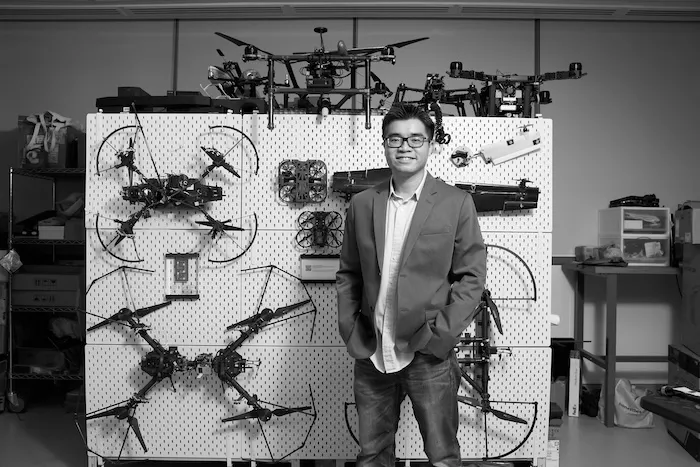
Professor Shaohui Foong is a Professor in the Engineering Product Development Pillar and the Kwan Im Thong Hood Cho Temple Chair Professor at the Singapore University of Technology and Design (SUTD). He also serves as Associate Head of Pillar (Education) and Co-Director of the Dyson–SUTD Innovation Studios. He leads the Aerial Innovation Research Laboratory (AIR Lab), where his research focuses on nature-inspired robotics, efficient mechatronics, and multimodal robotic systems. Guided by a philosophy of “sophisticated simplicity,” his work explores how minimalist designs can achieve sophisticated robotic capabilities across different environments.
Pull this thread
A robot grows more capable when each part does several jobs and physics does the rest.
More in Research
More in Books
Know something the rest of us don't?
Most threads on Rorotoko begin with our invitation. Any thread can begin with a proposal: you write it with the same prompts every thread answers, and we review it.
Propose a thread →