
Nicolas Guilhot
Conspiracy: The History of a Political Obsession
It has become a commonplace to say that we live in an age of “post-truth,” fake news, conspiracy theories, and all kinds of disinformation, and to assume these have disastrous political consequences. It is by “abandoning facts,” the story goes, that people pave the way toward fascism. We assume that conspiracy theories are essentially a problem of psychology, cognitive alignment, or epistemology. They have to do with the individual mind, not with the world: their only relation to the real world is being false, period.
The book tries instead to understand conspiracy theories as a phenomenon that has something to do with the real world and with liberal political culture in particular. It peels off layers of history to understand how we came to think about conspiracy theories the way we do—how the fear of conspiracies became the fear of conspiracy theories. It tries to understand why the notion of conspiracy theory has become something akin to an ideological threat, and what this says about our current vision of politics and history.
We make a mistake—and it is a mistake the origins of which I trace in the book—when we consider conspiracy theories as low-grade ideologies. We confuse their over-coherent vision of history and society with an ideological program hostile to liberal democratic values. The reason for that, as I show in the book, is that in the past, liberal political theorists viewed ideological thinking as a variety of conspiracy theorizing. So it is not surprising if today we invert the terms. But that is not what they are. We have to make room for the possibility that people find in them something that resonates with and allows them to articulate a feeling of loss of agency and exclusion. In rationalizing a state of anxiety, conspiracy theories operate very differently from a political manifesto. They are not just a flawed form of thinking; they express an existential position. “Believing is being,” the psychiatrist François Tosquelles, who appears in the book, once said. People make sense of their conditions with whatever cultural and political material is available—and in that sense, the spread of conspiracy theories is an indictment of the poverty of our political culture. This is not to say conspiracy theories are not toxic and cannot deliver people to the worst kind of politics, but that when it happens, it is for reasons that have very little to do with “abandoning facts” or embracing “post-truth.”
We have to ask ourselves what work do conspiracy theories do as a narrative? What are they a symptom of? And what are they trying to rationalize—perhaps confusedly, perhaps unconsciously, yet dramatically and often dangerously?
Conspiracy theories often belong to the genre of apocalyptic narratives: they posit the existence of a principle of intelligibility behind a world that is opaque and hostile. They compensate for a feeling of disempowerment and loss of control—again, sometimes through a mechanism of scapegoating that is repulsive, but they nonetheless tell us something about a structure of experience. That structure of experience, the book suggests, is the sense that the future is foreclosed or, in other words, that we live at the end of history.
The last chapter of the book is a reflection about what it means to live at the end of history. Is it possible to go on assuming that, basically, what you see is what you get, that this is it, this is the final stop? Everything indicates that human beings are not wired for that. There is a rich archive—I mostly look at psychiatry and psychology, anthropology, literature—that suggests that it is not possible to live a healthy life at the end of history. The end of history inevitably means the end of human creation and self-creation. It means experiencing the world as alien, as something that we no longer fashion, that does not reflect our creative powers—in one word, our freedom. We are no longer free. That experience is also a crisis of the self, a destructive experience. It is no coincidence that this apocalyptic feeling, which is very much part of the cultural atmosphere today, was identified by psychiatrists in the early 20th century as the main symptom of schizophrenia (they called it Weltuntergangserlebnis, or experience of the end of the world). Conspiracy theories are narratives that are particularly good at encapsulating this experience, at giving it a semblance of rationality. It becomes the folk tale that captures the sense of a lost freedom and a lost agency.
Ongoing thread. More from Nicolas Guilhot to follow.
Curator: Bora Pajo
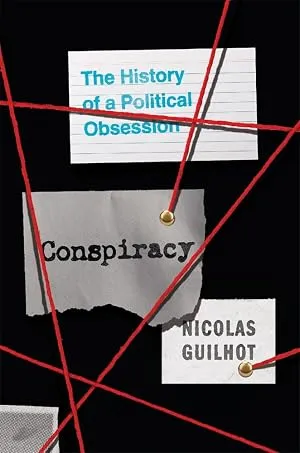
Conspiracy: The History of a Political Obsession
Guilhot, N. (2026). Conspiracy: The history of a political obsession. The Belknap Press of Harvard University Press.
Available here →November 2, 2026
20261102-guilhot-conspiracy-in-a-nutshell
In a nutshell
The rest of this thread

Nicolas Guilhot
Nicolas Guilhot is professor of intellectual history at the European University Institute, Florence, and incoming professor of political science at City College New York. He lives in New York.
Pull this thread
Conspiracy theories express a lost sense of agency and future, not a failure to accept facts.
Know something the rest of us don't?
Most threads on Rorotoko begin with our invitation. Any thread can begin with a proposal: you write it with the same prompts every thread answers, and we review it.
Propose a thread →