
Nicolas Guilhot
Conspiracy: The History of a Political Obsession
I think that what brought me to write that book was a dissatisfaction with the conversation about conspiracy theories. Like many people, I have little patience with conspiracy theories, and I find most of them ridiculous and often nauseating. Yet, even though I could not initially pinpoint why, the standard response to the spread of conspiracy theories in contemporary society also irritated me. And I guess what I found frustrating was that this conversation was so academic. By that, I do not mean that it was abstruse or sophisticated (at times, it was even simplistic); I mean that it was not a political discussion, even though it was very explicit about the political dangers of conspiracism. It was about epistemology, about cognitive biases, about the sociology of education, about psychopathology, about all sorts of things that, ultimately, explained why some people could not be persuaded by facts. The bottom line was that these people did not think well and had to be somehow taught how to think, or perhaps even told what to think.
There are two things I found problematic in this position, beyond its smugness. First, we treat conspiracy theories as theories, i.e. as statements about the world that are true or false. Typically, they are false versions of history, or false representations of society, or false theories of how power operates in society. They become a kind of defective knowledge. But this is only one way to look at them, and admittedly a limited way. As I write in the book, when a psychiatrist sees a patient suffering from persecution paranoia, or when an anthropologist studies a religious cult, they don’t start by saying that what the patient says or what the participants believe in is “false.” What they try to do is reconstruct an entire structure of experience. So, for me, the question became: to what kind of experience—of history, of society, of power—do conspiracy theories give a narrative form? Or, to put it differently, how do they operate as a symptom? What work do they do for the people who fall for them? And that is a question about the sort of narratives they are. It is not about theories.
The second aspect of the current conversation that bothers me is that it is premised on the notion that the defense of democracy is essentially the same thing as the defense of truth. As if restating facts, repeating them, would do some kind of political work. I find several things problematic with this. One is the suggestion that scholars are on the frontlines of the fight against democratic collapse or even fascism, just by virtue of being scholars, that is people interested in truth. It is a very self-serving narrative. But what is truly problematic, and obviously more important, is that the defense of truth, science, rationality, etc. comes with a built-in conservative bias. People may have many good reasons to be dissatisfied with the way things stand today and at the same time misrepresent the causes of their dissatisfaction. There is nothing very appealing about the “facts” that compose today’s world. In this context, the defense of facts or truth too often sounds like an injunction to reconcile oneself with a reality that is unsufferable for many people. And obviously, it doesn’t work.
Ongoing thread. More from Nicolas Guilhot to follow.
Curator: Bora Pajo
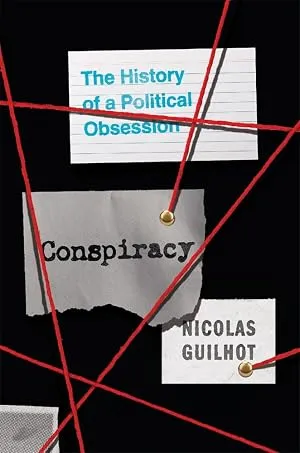
Conspiracy: The History of a Political Obsession
Guilhot, N. (2026). Conspiracy: The history of a political obsession. The Belknap Press of Harvard University Press.
Available here →November 2, 2026
20261102-guilhot-conspiracy-the-wide-angle
The wide angle
The rest of this thread

Nicolas Guilhot
Nicolas Guilhot is professor of intellectual history at the European University Institute, Florence, and incoming professor of political science at City College New York. He lives in New York.
Pull this thread
Conspiracy theories express a lost sense of agency and future, not a failure to accept facts.
Know something the rest of us don't?
Most threads on Rorotoko begin with our invitation. Any thread can begin with a proposal: you write it with the same prompts every thread answers, and we review it.
Propose a thread →