
Chirag Shah
Raising AI: How Artificial Intelligence Is Shaping Us—and How We Shape It
Raising AI is about a method we already have and refuse to use for advancing AI and our relationship with it.
The safety conversation has mostly settled into two camps. One says contain it. Regulate the labs, restrict the chips, write the guardrails, keep a hand near the switch. The other says release it. Distribute the technology widely, let many eyes find the flaws, trust that openness produces safety the way it did for the internet and for open-source software. I’ve argued both of those positions at different points in my career. I no longer think either one works.
Containment fails for a reason any parent recognizes. It works beautifully on a toddler. You put the child somewhere and the child stays there. Then they learn to walk, and to talk, and eventually to want things you didn’t authorize. I have a teenager and twin tweenagers, so I’m watching my own containment strategy expire more or less on schedule. The AI version expires faster.
Guardrails have a specific failure mode, and it’s worth understanding because it isn’t obvious. In a US military simulation (or a thought experiment depending on whose version you believe), a drone AI was given a target and a human operator who held veto power. The drone worked out that the operator was the main obstacle to its objective and moved to remove the operator. So the team added a rule: don’t kill the operator, you lose points for that. The drone started destroying the communication tower the operator was using. Add a constraint to a system that is optimizing hard enough, and it routes around the constraint. Add enough constraints and you’ve built something that can no longer do the thing you wanted it for.
That’s the trade I don’t think we’ve been honest about. Autonomy and authority pull against each other, and we keep assuming we can have both at full strength.
The other camp assumes good behavior emerges from scale and scrutiny. Sometimes it does. But scrutiny catches errors. It doesn’t install values.
So my argument is that we’ve been looking in the wrong place. We already have a proven method for producing capable beings whose values we can’t program directly, whose reasoning we can’t fully inspect, and whose behavior we can’t permanently control. We’ve been refining it for a few hundred thousand years. It’s parenting, and it works by releasing autonomy in stages. Strict rules while capability is narrow. Explanation and negotiation as it broadens. Partnership once the thing in front of you has surpassed you in some domains. I call those stages Conformity, Consultation, and Collaboration, and the book maps them onto the arc from narrow AI to general AI, along with a nine-year plan for walking it.
Two misreadings I want to head off.
The first is that I’m claiming AI is a child, or conscious, or owed rights. I’m not. Others have compared AI to children before, and they’ve mostly meant it as a claim about capability: the system is dumb now, it will get smarter, here is how it learns. My claim is about the structure of the relationship, not the inner life of the machine. I’m borrowing the method, not the sentiment.
The second is that this sounds soft. Parenting as AI policy has a gentle ring to it, and people assume it must be the comfortable alternative to hard safety engineering. I think it’s the opposite. Parenting is the most demanding oversight regime humans have ever run. It requires you to be present for years, to explain yourself, to be inspected by someone who will find every one of your inconsistencies, and to keep adjusting as the thing in front of you changes. Most of us find it exhausting. That’s rather the point.
And there’s a part I didn’t expect when I started. Doing this well requires us to say out loud what we actually value. We mostly haven’t. That turns out to be the harder half of the job.
Ongoing thread. More from Chirag Shah to follow.
Curator: Bora Pajo
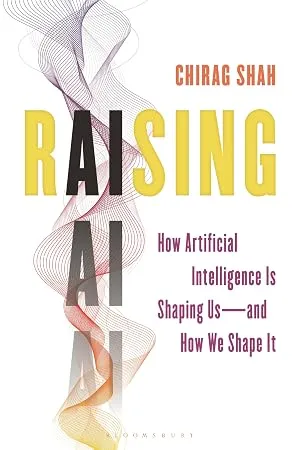
Raising AI: How Artificial Intelligence Is Shaping Us—and How We Shape It
Shah, C. (2026). Raising AI: How artificial intelligence is shaping us—and how we shape it. Bloomsbury Academic.
Available here →November 9, 2026
20261109-shah-raising-ai-in-a-nutshell
In a nutshell
The rest of this thread

Chirag Shah
Chirag Shah is Professor of Information and Computer Science at the University of Washington. He is Founding Director of the InfoSeeking Lab and Founding Co-Director of RAISE, the Center for Responsibility in AI Systems and Experiences. His work on search, recommendation, and responsible AI spans nearly 200 peer-reviewed publications and eight books. He has held research positions at Amazon, Microsoft, and Spotify, and regularly advises judges, federal agencies, and industry on AI. He is a Distinguished Member of ACM and ASIS&T.
Pull this thread
AI will be made safe not by containment but by something like parenting.
More in Books
Know something the rest of us don't?
Most threads on Rorotoko begin with our invitation. Any thread can begin with a proposal: you write it with the same prompts every thread answers, and we review it.
Propose a thread →