
Emily Lawhead
salt 18: Amor Muñoz
Technology is older than we imagine, more expansive, and deeply intertwined with the natural world.
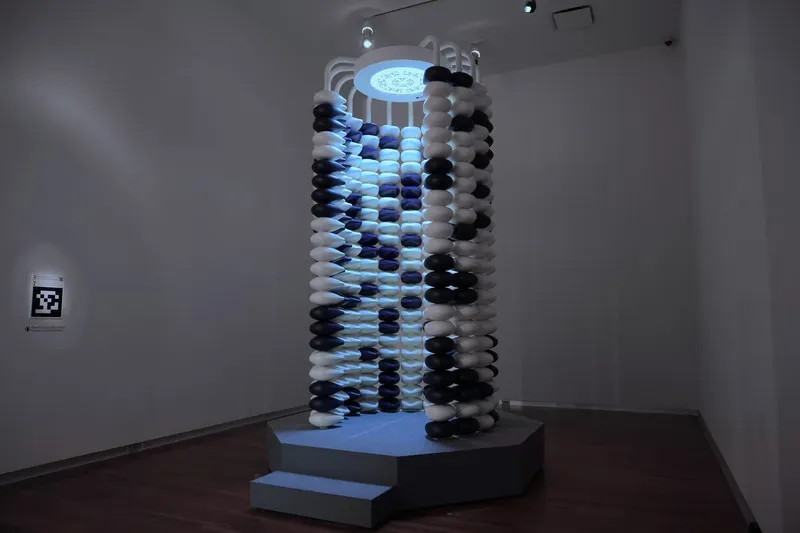
KaleidescopElote_Amor © Muñoz Studio
Technology is older than we imagine, more expansive, and deeply intertwined with the natural world.
salt 18: Amor Muñoz expands our understanding of technology, making connections across thousands of years: corn (or elote) as a source of information, ancient architectural engineering, the 19th-century kaleidoscope, and today's interactive digital technologies. At the center of the exhibition is KaleidescopElote, a monumental interactive sculpture that takes the form of an ear of corn. Amor invites us to consider corn not simply as something we grow and eat, but as something that has fundamentally shaped human civilization. She asks us to consider the corn kernel itself as high-tech: a small piece of nature that contains an extraordinary amount of information that has shaped the world around us.
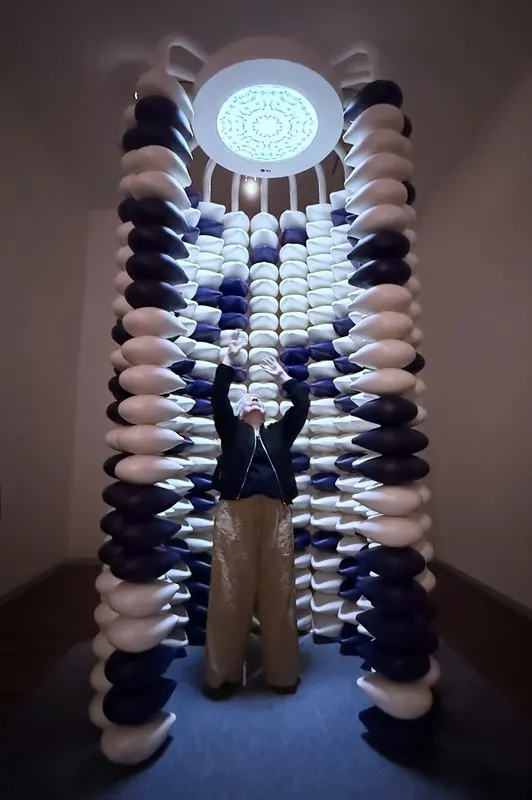
For many people, particularly Indigenous communities in Mesoamerica and the Greater Southwest, corn carries generations of accumulated knowledge. Its cultivation has required careful observation of seasons, weather, and celestial cycles. It has shaped how civilizations organize their lives, build structures, and understand their place in the universe. In this sense, corn is a living record of cultural memory and exchange. And it continues to be one of the world's most important crops today—symbolically, culturally, spiritually, and, of course, nutritionally.
What I find particularly compelling is how Amor’s approach to corn brings ancient histories into conversation with contemporary technology. We tend to think of technology as something new, something that moves us away from the natural world. But agriculture, architecture, and even the observation of the stars were all technologies developed through close relationships with the environment. Amor asks us to expand our understanding of intelligence itself, recognizing that knowledge has always existed beyond the human—in plants, landscapes, and the natural systems that sustain us. That's why I decided to frame my essay around the idea of Ancient Intelligence: perhaps a new way of thinking about "AI" today.
Ongoing thread. More from Emily Lawhead to follow.
Curator: Bora Pajo
The rest of this thread
salt 18: Amor Muñoz
Available here →November 28, 2026
20261128-lawhead-salt-18-in-a-nutshell
In a nutshell

Emily Lawhead
Emily Lawhead is Curator of Modern and Contemporary Art at the Utah Museum of Fine Arts. She holds an MA in Museum Studies from the University of San Francisco and a PhD in Art History from the University of Oregon, with a research interest in the intersections of art and technology. At the UMFA, Emily spearheads the salt exhibition series, site-specific commissions in the Great Hall, and the Museum’s vibrant photography, new media, and modern and contemporary art collections.
More in Arts
More in Books
Know something the rest of us don't?
Most threads on Rorotoko begin with our invitation. Any thread can begin with a proposal: you write it with the same prompts every thread answers, and we review it.
Propose a thread →