
Edward Scheinerman
A Guide to Infinity
I had a not-so-hidden agenda in writing this book: to have readers see what mathematics really is about. Mathematics is not arithmetic any more than literature is spelling and grammar.
There are ideas that are unimaginable that can be well understood by mathematical reasoning. A rectangle extends into three dimensions to form a cube; this we can visualize. A cube extends into four dimensions to form a hypercube. Can we picture a hypercube in our minds? That doesn’t seem possible. But can we understand and deal with it mathematically? Absolutely. We finite humans may not be able to visualize the infinite; mathematics gives us a way to handle infinity precisely.
Challenge Problem - A rectangle has 4 edges and a cube has 12 edges. How many edges does a four-dimensional hypercube have?
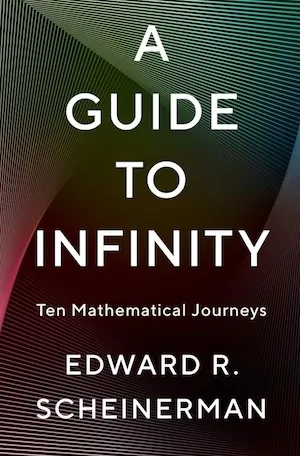
A Guide to Infinity
Edward R. Scheinerman, A Guide to Infinity: Ten Mathematical Journeys, Yale University Press, 192 pages, 6 x 9 inches, 70 b-w illustrations, ISBN: 9780300284799
Available here →January 22, 2026
20260124-edward-scheinerman-guide-to-infinity-ten-mathematical-journeys
In a nutshell
The rest of this thread

Edward Scheinerman
Ed Scheinerman is a professor in the Applied Mathematics & Statistics department of the Whiting School of Engineering at Johns Hopkins University where he also serves as a vice dean. Scheinerman studied mathematics as an undergraduate at Brown and as a graduate student at Princeton. His research focus is graph theory—the mathematics that models networks (roads, social, neurons, computers, and so forth). He has twice been honored with the Paul Halmos-Lester Ford award for mathematical writing. He is the author of a variety of books including The Mathematics Lover’s Companion which is also written for a general audience.
Pull this thread
Infinity is inconceivable but not inscrutable, and mathematics contains several mutually inequivalent infinities.
Know something the rest of us don't?
Most threads on Rorotoko begin with our invitation. Any thread can begin with a proposal: you write it with the same prompts every thread answers, and we review it.
Propose a thread →