
Nicholas Dagen Bloom
Public Housing That Worked
The fields of design and urban history are dominated by public housing enmity. Public housing projects are key proofs, for instance, in the theory that design determines social behavior. When New Urbanists, say, cite the superiority of their charming little villages like Seaside, Florida over suburban sprawl or urban renewal, they frequently mention public housing as a negative frame for their brave new world. The modernist superblocks and brick apartment buildings are viewed as ironclad guarantees of social and community failure. When urban historians want to show that politicians in the past acted unjustly, they also point to public housing towers as an example of social policy gone awry.
Time and again public housing is cited as an indicator of either design malfunction or social injustice. Even the destruction of public housing in recent years has become a framework for new injustice. Tenants, once thought to be suffering in public housing, are newly framed as victims losing community when they are forced by unfeeling administrators from their public housing homes.
Public Housing That Worked does not gloss over problems in cities such as Chicago or New Orleans—or New York for that matter. But the New York example allows for a more sophisticated discussion about the complex interrelationship of design, social context, and public policy.
Though New York’s towers have had and continue to have their share of problems, they make an interesting foil for traditional thinking about public housing. These towers have been preserved even under social stress and continue to house over 400,000 tenants in what are supposed to be completely unlivable environments.
Could the design have been better and played a more positive role in the management today? Yes. But what makes New York so fascinating is that a mix of sometimes controversial social and management policies (including constant maintenance and tough policing) have gone a long way to keeping up thousands of public housing towers.
My book is rooted in a strange family history. My grandfather was head of the St. Louis Housing Authority in the 1960s when the most notorious example of public housing collapse took place. The Pruitt-Igoe towers in St. Louis had become unmanageable and during the 1960s became the most famous examples of social and design failure. My grandfather really wasn’t entirely to blame for the crisis—the towers were already in crisis when he took over—but his involvement with public housing always made the subject personal.
My parents also moved in the 1990s across from Grant Houses, one of New York’s large public housing towers, and I was impressed how much better Grant Houses seemed than Pruitt-Igoe or other notorious projects. Wasn’t housing like this supposed to have been totally ruined by now? Finally, moving to New York to teach at the New York Institute of Technology made it possible to research and write the book at a rapid clip, as I could just get on the subway and go the archives of the Housing Authority at LaGuardia Community College as well as visit projects across the city.
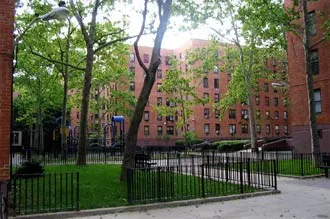
Vladeck Houses on New York City’s Lower East Side. Photo Nicholas Bloom.
Editor: Erind Pajo
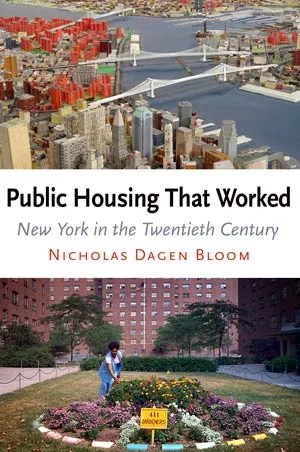
Public Housing That Worked
Nicholas Dagen Bloom Public Housing That Worked: New York in the Twentieth Century University of Pennsylvania Press 368 pages, 6 x 9 inches ISBN 978 0812240771 ISBN 978 0812220674
Available here →May 18, 2009
20090518-bloom-nicholas-public-housing-that-worked-new-york-2
The wide angle
The rest of this thread
.webp)
Nicholas Dagen Bloom
Nicholas Dagen Bloom is an associate professor and chairman of interdisciplinary studies at the New York Institute of Technology. He was born and raised in Baltimore and educated at the University of Wisconsin and Brandeis University. Besides Public Housing That Worked, he is the author of Suburban Alchemy: 1960s New Towns and the Transformation of the American Dream (2001) and Merchant of Illusion: James Rouse, America’s Salesman of the Businessman’s Utopia (2004), and editor of Adventures Into Mexico: American Tourism Beyond the Border (2006). Dr. Bloom has been an invited speaker on public housing history at Columbia University, the MIT, the New School University, and the New York City Housing Authority.
Pull this thread
New York's tower-block public housing worked, carried by constant maintenance, tough policing, tenant selection and community planning.
Know something the rest of us don't?
Most threads on Rorotoko begin with our invitation. Any thread can begin with a proposal: you write it with the same prompts every thread answers, and we review it.
Propose a thread →