
Mary E. Stuckey
Jimmy Carter, Human Rights, and the National Agenda
Scholars of the presidency argue about whether what the president says matters. We wonder if anyone is listening; if they are, whether the president has the ability to persuade them; what the limits of that ability are; whether language choices, style, etc. matter. This book contributes to that conversation by arguing that presidents—even those who were notoriously poor at public communication—can influence the public while they are in office and even long after they have left. Carter’s longevity as a public figure with a particular authority on human rights issues is evidence of this.
The questions of what sorts of effects rhetoric has, and how we might know what those effects are, are tricky and occupy a good deal of time in the field. These questions go to the heart of democracy. If democracy is understood as a form of government that requires leaders to make arguments to defend their actions to the governed, then it is vital that we understand the nature of those arguments and how they affect people and politics.
I have been working at the intersection of communication and political science my whole career. I’ve worked on understanding the rhetoric of particular presidencies, especially Ronald Reagan’s, on understanding specific events like the speech given in response to the Challenger crisis, and on understanding the role of presidential rhetoric in forming and reforming our sense of who we are as a people. I’ve also worked in the area of media criticism. So I read a lot of the literature on priming, framing, and agenda setting. And I’m trained as a political scientist, so I read a lot of the work on public opinion and the presidency. The latter isn’t usually read by rhetoricians, while many presidency and media scholars don’t normally read a lot of rhetorical analyses.
Writing this book was so fun because very few people could have written it. As a scholar of the presidency, of the mass media and of political rhetoric, I am familiar with a broad array of literature that is usually compartmentalized—but those compartments can be brought into conversation with each other.
Editor: Erind Pajo
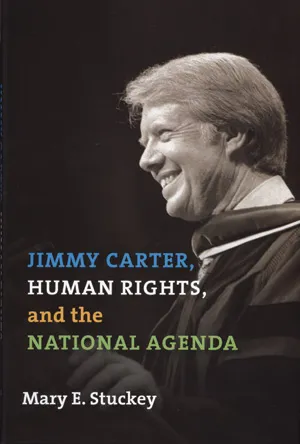
Jimmy Carter, Human Rights, and the National Agenda
Mary E. Stuckey Jimmy Carter, Human Rights, and the National Agenda Texas A&M University Press 197 pages, 9 1/2 x 6 1/2 inches ISBN 978 1603440745
Available here →June 29, 2009
20090629-stuckey-mary-jimmy-carter-human-rights-national-agenda-2
The wide angle
The rest of this thread

Mary E. Stuckey
Mary E. Stuckey specializes in political and presidential rhetoric, political communication, and American Indian politics. She is the author, editor, or co-editor of twelve books and author or coauthor of roughly 80 essays and book chapters. She has received the NCA Distinguished Scholar Award, the Michael M. Osborn Teacher/Scholar Award, the Rose B. Johnson Award (with Zoe Hess-Carney), the Roderick P. Hart Outstanding Book Award, the Marie Hochmuth Nichols Award, and the inaugural Carl Couch Center Bruce E. Gronbeck Political Communication Award. She has served as editor of the Southern Communication Journal and as book review editor for Rhetoric and Public Affairs. She is Editor-elect of the Quarterly Journal of Speech. She currently co-edits (with Mitchell McKinney) Peter Lang’s series, The Frontiers of Political Communication. She received the John Sisco Teaching Award from the Southern States Communication Association, the Pi Sigma Alpha Teaching Award from the American Political Science Association, and the Elsie M. Hood Teaching Award from the University of Mississippi. Her current book project is on the rhetoric of political change.
Pull this thread
Presidential influence has to be judged over decades, not terms.
Know something the rest of us don't?
Most threads on Rorotoko begin with our invitation. Any thread can begin with a proposal: you write it with the same prompts every thread answers, and we review it.
Propose a thread →