
Mary E. Stuckey
Jimmy Carter, Human Rights, and the National Agenda
Selecting one particular close-up is hard: I’m trying to make the argument that all the different elements of Carter’s treatment of human rights were important. If just one thing had to pulled out, however, it would be the chapter on how four presidents used “human rights.” I looked at the ways Jimmy Carter, Ronald Reagan, Bill Clinton and George W. Bush all used similar language—sometimes to very similar ends and sometimes to very different ones.Carter wanted to see human rights at the center of our foreign policy—and he wanted to be able to criticize and applaud any nation, whether ally or not, on human rights grounds. He was often criticized, in fact, for being kinder to our opponents than to our allies. Reagan had a very different approach to human rights, and tended to overlook human rights problems in allied countries while focusing on abuses in communist nations. Bill Clinton, governing after the Cold War, took a complex approach to human rights, in which he used the issue as a rationale for intervention in some areas (Bosnia) while avoiding intervention in other areas (Rwanda). And George W. Bush, of course, is the most problematic of the lot, for he used human rights as a reason for the Iraq invasion, and yet had to deal with events like the Guantanamo prison scandal.This history is crucial because on the one hand, it doesn’t matter who is president—the institution is strong, and whoever sits behind that desk is going to make the same decisions. On the other hand, it matters a great deal who the president is—some decisions, such as the choice to go to war in Iraq, are extraordinarily dependent upon who is in office. The trick is knowing which decisions are which.I think this book is significant for two reasons.First, there is so much smart work in the world that it is almost impossible to keep up with your own field, much less get into a field where you aren’t comfortable. I’m lucky because I’ve always been at the intersection of different areas. That is not to say that I am the expert in any one of them, but I am aware of the work in a lot of different fields. So I was able to synthesize some of the most important ideas from several different subfields. Hopefully, the book brings some insight that we wouldn’t otherwise have.Second, I think it is important for us to understand how the presidency really works in relation to the mass public. When are presidents persuasive? How does that persuasion work? What are the consequences? The presidency looms so large in public affairs and the stakes are so high that any insight we can muster on the institution is important.
Editor: Erind Pajo
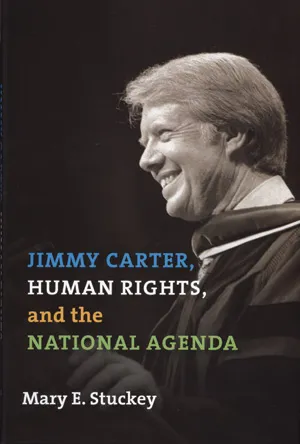
Jimmy Carter, Human Rights, and the National Agenda
Stuckey, Mary Jimmy Carter, Human Rights, and the National Agenda Texas A&M University Press197 pages, 9 1/2 x 6 1/2 inches ISBN 978 1603440745
Available here →June 29, 2009
20090629-stuckey-mary-jimmy-carter-human-rights-national-agenda-3
A close-up
The rest of this thread

Mary E. Stuckey
Mary E. Stuckey specializes in political and presidential rhetoric, political communication, and American Indian politics. She is the author, editor, or co-editor of twelve books and author or coauthor of roughly 80 essays and book chapters. She has received the NCA Distinguished Scholar Award, the Michael M. Osborn Teacher/Scholar Award, the Rose B. Johnson Award (with Zoe Hess-Carney), the Roderick P. Hart Outstanding Book Award, the Marie Hochmuth Nichols Award, and the inaugural Carl Couch Center Bruce E. Gronbeck Political Communication Award. She has served as editor of the Southern Communication Journal and as book review editor for Rhetoric and Public Affairs. She is Editor-elect of the Quarterly Journal of Speech. She currently co-edits (with Mitchell McKinney) Peter Lang’s series, The Frontiers of Political Communication. She received the John Sisco Teaching Award from the Southern States Communication Association, the Pi Sigma Alpha Teaching Award from the American Political Science Association, and the Elsie M. Hood Teaching Award from the University of Mississippi. Her current book project is on the rhetoric of political change.
Pull this thread
Carter, thwarted in the short run, permanently installed human rights on the national agenda.
Know something the rest of us don't?
Most threads on Rorotoko begin with our invitation. Any thread can begin with a proposal: you write it with the same prompts every thread answers, and we review it.
Propose a thread →