
Ronald H. Fritze
Invented Knowledge
There is a section in the book that many readers might find particularly amusing, on the relation between occultism and spiritualism concerning Atlantis. One of the primary characters involved here is the flamboyant Madame Helena Blavatsky. She founded the Theosophical Society. Later she would make the existence of Atlantis an integral part of the belief system of Theosophy.
Madame Blavatsky claimed that she received instructions on how the Theosophical Society should be organized and operated from spiritual beings known as Masters. These beings would make their wishes known through precipitated letters, i.e., letters that seemingly appeared or materialized out of nowhere. Interestingly, when disagreements arose within the Theosophical movement, rival factions each produced precipitated letters from a Master who agreed with them. Wars of precipitated letters followed.
Another interesting section is called “The China Syndrome.” It deals with the theories of Gavin Menzies, whose book 1421 asserts that great Chinese fleets sailed around the world during the early 1420s, circumnavigating Africa, discovering the Americas and Australia, and navigating the icebound Northeast Passage. That is pretty amazing stuff.
Even more amazing is the story of how Menzies’ book came to be published. My account is based on interviews that Menzies and his publisher gave to an Australian radio show. They reveal the rather cynical way that a book widely regarded by experts as of dubious historical authenticity can be manipulated and marketed into becoming a bestseller.
The section telling the story of the catastrophist Immanuel Velikovsky could be thought-provoking for many readers. Velikovsky was a Jewish Russian who immigrated to the United States after a sojourn in Palestine. During the 1940s he developed ideas in which he claimed that Venus and Mars had on several occasions during antiquity wandered very near the earth. These near-misses of the earth created havoc and catastrophes throughout the world. Some of this turmoil is recorded in the Bible as aspects of the Ten Plagues of Egypt, the Israelite conquest of Canaan, and the destruction of Sennacherib’s Assyrian army besieging Jerusalem.
When Velikovsky’s book Worlds in Collision first came out it met with dismissal, derision, and hostility by scientists. So much hostility was directed against Velikovsky that many people came to view him as a sympathetic under-dog being bullied by the academic establishment.
In fact, Velikovsky had many academic friends, including most prominently Albert Einstein. Controversies over Velikovsky’s theories about ancient history raged for years. They provide a case study of how scholars should not deal with pseudo-science and pseudo-history. Velikovsky’s career also reveals a little known episode in Einstein’s life—his tolerance and even sympathy for mavericks espousing fringe theories.
While researching and writing Invented Knowledge, I would sometimes worry that the topic of pseudo-history and pseudo-science would become passé. In fact, there is no danger of that happening any time soon.
Shortly after I submitted my manuscript to the publisher, Gavin Menzies brought out his 1434: The Year a Magnificent Chinese Fleet Sailed to Italy and Ignited the Renaissance. The title says it all—though it is a little perplexing to scholars of fifteenth-century Italy how the myriad of historians and chroniclers living in Italy at that time failed to comment on the Chinese visit.
Later, at about the time that Invented Knowledge appeared in print, the History Channel aired a new documentary titled Ancient Aliens. The producers provided the window dressing of giving both the true believers and the skeptics some screen time. In the end, however, the final presentation was heavily stacked in favor of those who believe in ancient astronauts. The documentary also managed to resurrect the clearly irrepressible Erik von Däniken one more time. As an editor at a major publishing company told a friend of mine several years ago, bunk sells, debunking doesn’t.
But my hope is that Invented Knowledge will inform and entertain my readers about a topic that can be fascinating, silly, and sometimes rather ominous and frightening—often all at the same time.
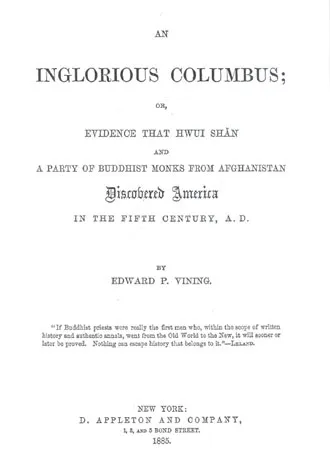
Part of the long tradition of Chinese visitors to Pre-Columbian America
Editor: Erind Pajo
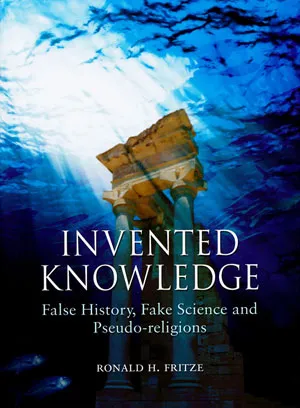
Invented Knowledge
Ronald Fritze Invented Knowledge: False History, Fake Science and Pseudo-Religions Reaktion Books 272 pages, 9 x 6 inches ISBN 978 1861894304
Available here →July 8, 2009
20090708-fritze-ronald-invented-knowledge-false-history-fake-science-pseudo-3
A close-up
The rest of this thread

Betty Marks
Ronald H. Fritze
Ronald H. Fritze is Dean of the College of Arts and Sciences and Professor of History at Athens State University. Formerly he was on the faculty of Lamar University where he was University Professor of History. Besides Invented Knowledge he is the author of Legend and Lore of the Americas before 1491: An Encyclopedia of Visitors, Explorers, and Immigrants (1993) and New Worlds: The Great Voyages of Discovery, 1400-1600 (2002) along with a number of other books. He appeared in the History Channel series Conquest of America produced by Lone Wolf Documentary in 2005.
Pull this thread
Pseudo-history is a product of modern mass society, built from the obsolete and discredited scholarship of earlier eras.
Know something the rest of us don't?
Most threads on Rorotoko begin with our invitation. Any thread can begin with a proposal: you write it with the same prompts every thread answers, and we review it.
Propose a thread →