
Deborah Cohen
Household Gods
Household Gods is a history of the British love-affair with the domestic interior from the age of mass manufacture to modernism. In no other country was domesticity so celebrated and studiously cultivated. Money fed house-pride: between the mid-nineteenth century and the Second World War, Britons enjoyed the highest average standard of living in Europe. Though we have in so many ways inherited the world the Victorians made, we know surprisingly little about how they responded to their unprecedented prosperity. How did the legendarily duty-bound middle classes of the nineteenth century reconcile moral good with material abundance? How can we explain their apparently insatiable, and to our eyes quixotic, demand for things?
Why, to put it simply, did they stuff their houses full of objects? When—and why—did people first begin to believe, as many of us do, that our homes reflect our personalities? In Household Gods, I argue that our modern consumer society has its roots in early nineteenth-century religious fervor. Over the course of the Victorian era, consumerism shed the taint of sin to become the pre-eminent means for the expression of individuality.
The manner by which the Victorians reconciled their newfound prosperity with moral good is a crucial step in the making of modern materialism.
Unlike previous histories of British interiors, which have concentrated on opulent rooms or avant-garde developments, this book delves into the realm of middle-class self-fashioning—what critics have often dismissed as bad taste. Victorian luminaries such as critic John Ruskin and designer William Morris had less influence than we have assumed. I draw upon a wealth of untapped sources to explore the much broader set of forces that shaped consumer desires. Religious and moral qualms figure in this story, as do anxieties about the regard of neighbors and friends. The temptations of shopping vie with the constraints of the pocketbook; the urge to differentiate oneself from others confronts, time and again, the desire to fit in.
In a wide-ranging account that ventures from musty antique shops to London’s luxurious furnishing emporia, from suburban semi-detached houses to aestheticism’s leading lights, from married men who fretted about the appearance of mantelpieces to women who embraced home decoration as a feminist cause, Household Gods asks how people made and re-made themselves in a country in which the question was no longer merely “who are you” but “what have you.”
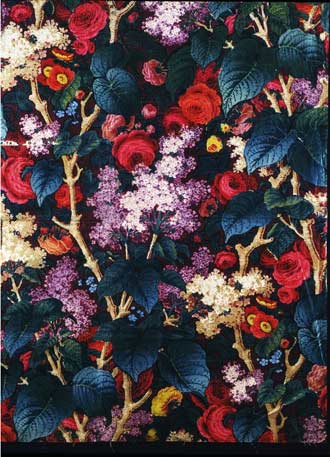
“Naturalistic” design. A furnishing fabric from 1850 of roller-printed and glazed cotton. The guest who lowered himself onto a sofa upholstered in this fabric had to fear that he might be impaled by a protruding twig.
Editor: Erind Pajo
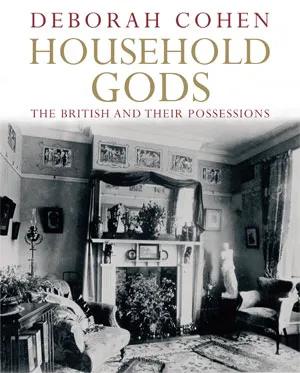
Household Gods
Deborah Cohen Household Gods: The British and Their Possessions Yale University Press 336 pages, 9 x 8 inches ISBN 978 0300112139
Available here →December 9, 2009
20091209-cohen-deborah-on-household-gods-british-possessions-1-1
In a nutshell
The rest of this thread

Deborah Cohen
Deborah Cohen teaches at Brown University. Her first book, The War Come Home: Disabled Veterans in Britain and Germany, 1914-1939 (University of California Press, 2001), was awarded the Allan Sharlin Prize. Household Gods, her second book, won the American Historical Association's Forkosch Prize and was the co-winner of the North American Conference on British Studies' Albion Prize. Cohen has held fellowships from the National Humanities Center, the Cullman Center for Scholars and Writers at the New York Public Library, the American Council of Learned Societies’ Burkhardt Fellowship, and the John Simon Guggenheim Memorial Foundation.
Pull this thread
Modern consumer society was born out of religious fervor rather than its defeat.
Know something the rest of us don't?
Most threads on Rorotoko begin with our invitation. Any thread can begin with a proposal: you write it with the same prompts every thread answers, and we review it.
Propose a thread →