
Deborah Cohen
Household Gods
My book began as an inquiry into the origins of consumer demand. In the past two decades, economic historians have established that consumer demand provided an important catalyst for industrialization. However, we still don’t know very much about the reasons why people wanted things. Pioneering scholarship on the so-called “consumer revolution” assumed either that demand was an intrinsic, ever-present force, or that (following Thorstein Veblen) the middle classes spent money in order to ape their social betters. Research on the eighteenth century has done much to revise that narrative, pointing to, among other factors, a peculiarly modern form of hedonism. Nonetheless, the literature on consumer demand in the later period of mass manufacturing is far less well developed. This omission is all the more striking given significance contemporary scholars accord to questions of demand from the 1840s through the 1930s. In the aftermath of the Great Exhibition, consumer taste (and, specifically, the public’s purportedly bad taste) became a matter of political and moral import in Britain. Design reformers—among them, Ruskin and Morris—sought to improve the quality of British goods by educating consumers, impressing upon them a preference for more tasteful products. Nonetheless, though the efforts of Ruskin and Morris have been exhaustively chronicled, we know almost nothing about their intended audience. We don’t know why people originally embraced the objects that reformers deplored, nor do we know how they responded to campaigns to improve their taste. Understanding why people wanted things, especially in the case of the Victorians, requires us to grapple with the relationship between consumerism on the one hand, and religion and morality on the other. Religious strictures had, at various times in early modern European history, served to regulate consumption. Here I’m thinking of Simon Schama’s seventeenth-century Dutch, torn between the rigors of Calvinist discipline and the consumerist pleasures of the Golden Age, and of Max Weber’s capitalist entrepreneur, whose manner of life, as Weber famously described it, “was distinguished by a certain ascetic tendency.”
However agonizing these conflicts had been in the past, the nineteenth century put forth the issue with new urgency, for the Victorians were both richer and by some measurements also decidedly more religious than their eighteenth-century forebears. The evangelical revival of the early 19th century exercised a profound influence upon the British middle classes, who were, at least through the First World War, notoriously concerned with questions of faith and morals. But if Victorianism was synonymous with morality, the British were also, from the mid-nineteenth century on, the beneficiaries of Europe’s first real consumer boom. In Britain, the average per capita income rose from a marginal 25% above subsistence in 1850 to a comfortable 150% above subsistence in 1914.
With a few notable exceptions, the relation between religion and consumerism is an issue that has largely been ignored both in the literature on consumption and in scholarship about religion. But given the evangelical underpinnings of the Victorian period, what needs to be explained, at the outset, is the long co-existence of consumerist impulses and moral concerns—“the conciliation,” as George Eliot put it, of “piety and worldliness, the nothingness of this life and the desirability of cut glass.” How that reconciliation was achieved—and what its effects were—is the subject of Household Gods.
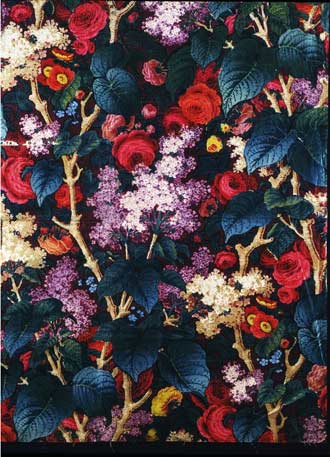
“Naturalistic” design. A furnishing fabric from 1850 of roller-printed and glazed cotton. The guest who lowered himself onto a sofa upholstered in this fabric had to fear that he might be impaled by a protruding twig.
Editor: Erind Pajo
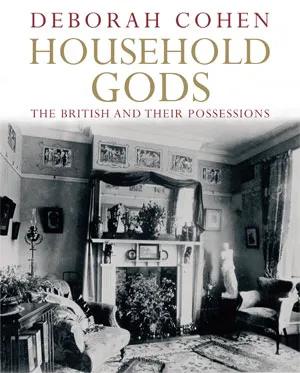
Household Gods
Deborah Cohen Household Gods: The British and Their Possessions Yale University Press 336 pages, 9 x 8 inches ISBN 978 0300112139
Available here →December 9, 2009
20091209-cohen-deborah-on-household-gods-british-possessions-2
The wide angle
The rest of this thread

Deborah Cohen
Deborah Cohen teaches at Brown University. Her first book, The War Come Home: Disabled Veterans in Britain and Germany, 1914-1939 (University of California Press, 2001), was awarded the Allan Sharlin Prize. Household Gods, her second book, won the American Historical Association's Forkosch Prize and was the co-winner of the North American Conference on British Studies' Albion Prize. Cohen has held fellowships from the National Humanities Center, the Cullman Center for Scholars and Writers at the New York Public Library, the American Council of Learned Societies’ Burkhardt Fellowship, and the John Simon Guggenheim Memorial Foundation.
Pull this thread
Modern consumer society was born out of religious fervor rather than its defeat.
Know something the rest of us don't?
Most threads on Rorotoko begin with our invitation. Any thread can begin with a proposal: you write it with the same prompts every thread answers, and we review it.
Propose a thread →