
William Egginton
In Defense of Religious Moderation
I would hope your casual reader would first happen upon some of the pages in which I discuss how moderates and fundamentalists believe in very different ways.
Religious moderation is a kind of religious belief that refuses the logic of the code of codes. Moderate believers find comfort, solace, community, and pleasure in their belief systems and the practices that accompany them—without assuming that these beliefs represent a direct, unfettered, or in some way absolute knowledge of the world.
Moderate believers are thus perfectly capable of reciting the tenets of their own faiths without ever feeling that they are in irresolvable contradiction with other, perhaps more practical ways of understanding the world. For this very reason, not only are such forms of belief entirely compatible with scientific knowledge, they are also inherently tolerant, since moderate believers make a constant practice of reconciling apparently incompatible versions of reality.
This implicit commitment to tolerance along with its suspicion of claims to ultimate knowledge make religious moderation one of the best possible defenses against fundamentalisms of all kinds—in particular the religious fundamentalisms that are so openly threatening the modern, democratic world view.
I am of the opinion that fundamentalism is seldom beneficial, no matter what form it takes.
While a religious fanatic can channel his fervor into good works—and many certainly have—I do not believe that fundamentalist thinking is necessarily or even directly linked with such passion and commitment.
As I discuss in relation to the neuroscience of belief, the way of believing that makes one a fundamentalist has more to do with those brain functions that seek closure and resist uncertainty than with the kind of passion and creativity that leads to positive change or great discoveries. Likewise, scientific progress is far more profoundly linked to creativity than to belief in the ultimate nature of the reality one is busy discovering.
We are fundamentalists whenever we treat our knowledge not as a model or version of reality, but as reality itself. While today we tend to associate this sort of impulse with religion, one of the primary tendencies of the theological traditions that accompanied the development of western culture was to undermine human claims to total knowledge of the world.
Many scholars have noted that religious fundamentalism is really a modern phenomenon, the term itself dating to the early 20th century. But in some ways a more general fundamentalism defined as adherence to the code of codes is itself coterminous with the modern age—with western culture since the dawn of the scientific revolution.
The idea here is that the relative success of one particular model of reality—in which reality is pictured as an independent objective realm gradually revealed by human observation and experimentation—created the expectation that this model should apply equally in all domains of knowledge.
And it is for this reason that the sort of biblical literalism consistent with what we now call Christian fundamentalism could only take hold in a thoroughly modern society like our own.
Editor: Erind Pajo
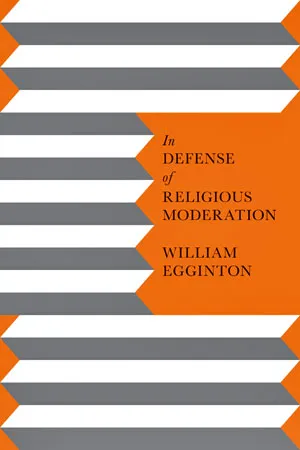
In Defense of Religious Moderation
William Egginton In Defense of Religious Moderation Columbia University Press 176 pages ISBN: 978 0231148788
Available here →July 11, 2011
20091228-william-egginton-on-theater-truth-ideology-neobaroque-aesthetic-3
A close-up
The rest of this thread
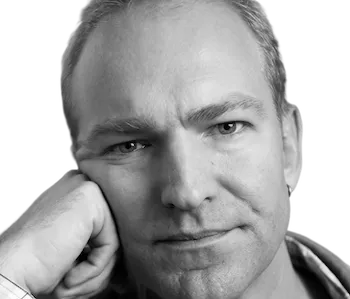
William Egginton
William Egginton is Professor and Chair of German and Romance Languages and Literatures at the Johns Hopkins University, where he teaches courses on Spanish and Latin American literature, literary theory, and the relation between literature and philosophy. He is the author of How the World Became a Stage (SUNY, 2003), Perversity and Ethics (Stanford, 2006), A Wrinkle in History (Davies Group, 2007), and The Philosopher's Desire (Stanford, 2007). He is also co-editor, with Mike Sandbothe, of The Pragmatic Turn in Philosophy (SUNY, 2004), and translator of Lisa Block de Behar's Borges, the Passion of an Endless Quotation (2002).
Pull this thread
Fundamentalism is a way of believing, so the New Atheists and the biblical literalists hold the same position.
Know something the rest of us don't?
Most threads on Rorotoko begin with our invitation. Any thread can begin with a proposal: you write it with the same prompts every thread answers, and we review it.
Propose a thread →