
Mark Traugott
The Insurgent Barricade
Although it was only in the course of the nineteenth century that the barricade emerged as the preeminent symbol of the modern revolutionary tradition, its origins can be traced as far back as sixteenth-century France.
The great cyclical peaks in the history of French contention—the “Day of the Barricades” in Paris in 1588, the second “Day of the Barricades” in 1648, and the revolutions of 1789, 1830, and 1848—mark major turning points in the evolution of this technique of insurrection. They succeeded in transforming a custom that had remained exclusively French for the first two hundred years of its existence into a pan-European phenomenon.
The remarkable persistence and eventual diffusion of barricades must be understood in terms of the crucial functions they perform in insurrectionary situations. The most obvious are practical in nature and help explain the tactic’s initial adoption: providing cover for insurgents on the one hand, and serving to isolate troops and prevent their free circulation on the other.
Less evident, but no less essential, are a series of sociological functions that include mobilizing the population and attracting new recruits to the insurgent cause, building solidarity among participants and helping them to gauge their chances of success, identifying leaders and facilitating the emergence of an efficient division of labor among the barricade’s defenders, and making it possible for insurgents to fraternize with soldiers and police in an effort to sway their loyalties.
In the modern era, after the military began to make systematic use of artillery and experimented with new strategies for the repression of civil unrest, the purely pragmatic utility of the barricade diminished. But the barricade’s symbolic functions became more prominent, highlighting the central role of barricades in a culture of insurrection that gradually assumed global proportions.
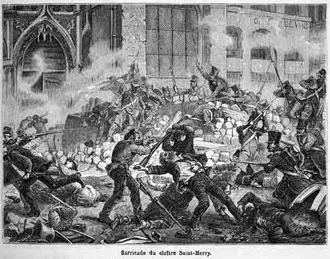
First of two nineteenth-century images of barricades: The insurgents’ last stand in June 1832 took place before the cloister of the Eglise Saint-Merri in a district that was a center of combat in several nineteenth-century uprisings. “Barricade before the Eglise Saint-Merri” (above, from page 7 in the book) does not highlight the structure to any great extent but has the virtue of showing actual barricade combat.
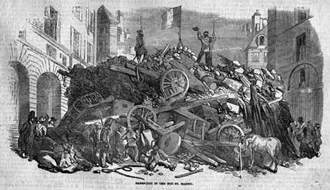
Second of two nineteenth-century images of barricades: This one is captioned “Barricade in the rue Saint-Martin” (appears in the book on page 13). This barricade from the February Days of 1848 exemplifies the sort of improvised structure typical of insurrectionary situations. Note the mix and haphazard arrangement of the found materials from which this barricade has been fashioned. This engraving may lack the dynamism of the one above, but it provides a particularly vivid picture of a massive barricade in all its glory.
Editor: Erind Pajo
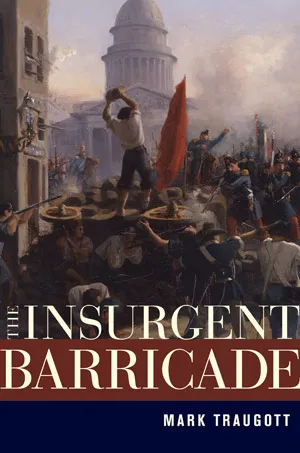
The Insurgent Barricade
Mark Traugott The Insurgent Barricade University of California Press 436 pages, 9 x 6 inches ISBN 978 0520266322
Available here →January 12, 2011
20110112-traugott-mark-on-the-insurgent-barricade-1
In a nutshell
The rest of this thread

Patti Traugott
Mark Traugott
Mark Traugott is Professor of History and Sociology at the University of California at Santa Cruz. Besides The Insurgent Barricade, featured in his Rorotoko interiview, he is the author of Armies of the Poor: Determinants of Working-Class Participation in the Parisian Insurrection of June 1848 (1985), The French Worker: Autobiographies from the Early Industrial Era (1993), and Repertoires and Cycles of Collective Action (1995).
Pull this thread
The barricade outlived its military use because it built solidarity and sorted out leaders.
Know something the rest of us don't?
Most threads on Rorotoko begin with our invitation. Any thread can begin with a proposal: you write it with the same prompts every thread answers, and we review it.
Propose a thread →