
Mark Traugott
The Insurgent Barricade
The search for the origins of the barricade and attempts to identify the key moments in its evolution led me to some surprising conclusions.For example, it has long been accepted that the barricade originated at the time of the First Day of the Barricades in 1588. Indeed, the standard account even assigns its “invention” to a specific date (May 12), a precise location (the Place Maubert in Paris), and a particular individual (Charles de Cossé, compte de Brissac, who is said to have instructed the supporters of the Duke of Guise in how to build the first such structure).The historical record, however, provides a far more muted and ambiguous picture. I found no fewer than three distinct versions of how barricades came to be constructed in 1588, and they differ in most particulars, including both when the plan was devised and who was responsible for this innovation.As I looked into the matter more closely, I came to believe that about the only thing these various accounts of the origins of the barricade had in common was the fact that they are all wrong.My conclusion was initially based less on historical documentation than on linguistic evidence. In effect, the first use of the French word “barricade” dates from 1570 when it was used to describe a battle in Mont-de-Marsan, a town in the southwest of France caught up in the wars of religion that were then raging in that region. If the term itself existed at this earlier date, then the concept of the barricade—and, of course, the thing itself—must also have existed.It was this line of inquiry that convinced me that I needed an explicit and carefully constructed definition of the insurgent barricade as something more than a physical object, requiring both a certain shared understanding of the concept and a clearly articulated relationship to the insurrectional setting.The case of the barricade also led me to examine the problem of retracing historical origins in general. Historians’ tendency to invest the moment of origination with a spurious precision—here exemplified by the standard account of the invention of the barricade by a well documented individual who played a central role in one of the landmark events of the era, one which just happened to take place in the most important and storied city of the realm—flies in the face of the reality uncovered by patient inquiry. The consistent lesson is that origins lie shrouded in uncertainty because they are the result of a gradual process involving multiple overlapping steps, more or less simultaneously undertaken by a number of independent actors, most of whom stubbornly resist efforts to penetrate their anonymity.My investigation into the origins of the barricade thus not only complicated the story as it has customarily been told but offered the opportunity to reflect on the reasons why origin myths are so common and persistent.In my efforts to pinpoint the critical moments in the development of a barricade culture, I was also surprised to learn that the period of the French Revolution was one in which this insurrectionary technique was in frequent use. This can only be considered surprising in light of the fact that there has been virtually no acknowledgment of the role barricades played in those events, and in fact the categorical assertion on the part of a number of prominent historians that none existed at all.In reality, the barricade played a minor but consistent role in many of the key events of that period—including not only July 14, 1789 but also the Flight to Varennes and the Parisian insurrections of Prairial and Vendémiaire in 1795.This opportunity to broaden historians’ awareness of the incidence of barricade events seemed all the more important because this was the very period that witnessed Belgians’ use of barricades in the Brabant revolution, the first appearance of the tactic outside its country of origin.My work lies at the intersection of the disciplines of history and sociology. I am interested in the ways that long-term patterns in the form of violent conflict reflect the changing relationship between those in power and those who seek to influence or overthrow them.The construction of barricades, though a relatively rare occurrence in any given time or place, has persisted for more than four hundred years and remains a highly visible form of modern contention. The history of this technique of insurrection is significant for what it reveals about the motives and intentions of forces on both sides of a civil conflict and for what it teaches us about how the methods of protest available to the members of society originate and evolve.Through the study of the barricade, we learn about the almost ritualized nature of the preliminaries to violent civil conflict and the complex byplay that accompanies the actual fighting, as insurgents launch fraternal appeals aimed at winning over troops whose officers battle valiantly to retain the loyalty of the rank and file.The acts of heroism, self-sacrifice, vainglory, and desperation that the barricade inspires explain why it has become the iconic representation of a tradition of revolution that now spans the globe.
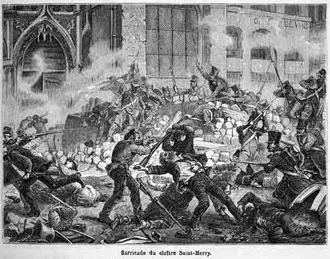
First of two nineteenth-century images of barricades: The insurgents’ last stand in June 1832 took place before the cloister of the Eglise Saint-Merri in a district that was a center of combat in several nineteenth-century uprisings. “Barricade before the Eglise Saint-Merri” (above, from page 7 in the book) does not highlight the structure to any great extent but has the virtue of showing actual barricade combat.
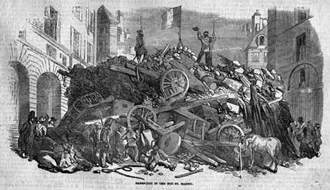
Second of two nineteenth-century images of barricades: This one is captioned “Barricade in the rue Saint-Martin” (appears in the book on page 13). This barricade from the February Days of 1848 exemplifies the sort of improvised structure typical of insurrectionary situations. Note the mix and haphazard arrangement of the found materials from which this barricade has been fashioned. This engraving may lack the dynamism of the one above, but it provides a particularly vivid picture of a massive barricade in all its glory.
Editor: Erind Pajo
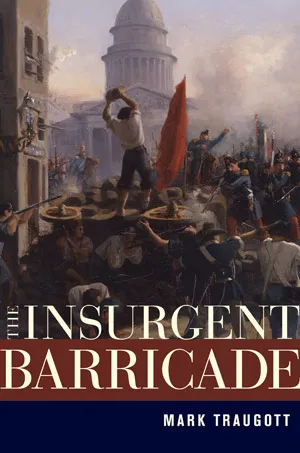
The Insurgent Barricade
Mark Traugott The Insurgent Barricade University of California Press436 pages, 9 x 6 inches ISBN 978 0520266322
Available here →January 12, 2011
20110112-traugott-mark-on-the-insurgent-barricade-3
A close-up
The rest of this thread

Patti Traugott
Mark Traugott
Mark Traugott is Professor of History and Sociology at the University of California at Santa Cruz. Besides The Insurgent Barricade, featured in his Rorotoko interiview, he is the author of Armies of the Poor: Determinants of Working-Class Participation in the Parisian Insurrection of June 1848 (1985), The French Worker: Autobiographies from the Early Industrial Era (1993), and Repertoires and Cycles of Collective Action (1995).
Pull this thread
The barricade outlived its usefulness against artillery because it recruited, built solidarity and sorted out leaders.
Know something the rest of us don't?
Most threads on Rorotoko begin with our invitation. Any thread can begin with a proposal: you write it with the same prompts every thread answers, and we review it.
Propose a thread →