
Kathy Peiss
Zoot Suit
Zoot Suit is a history of one of the most famous “street styles” of the 20th century. With its broad shoulders, tapered long jacket, pegged pants, and swinging key chain, this extreme male fashion caught the imagination of many young Americans in the World War II era. As the United States mobilized for war, it also became a highly controversial style, especially as civil unrest broke out in Los Angeles in 1943, known to this day as the “zoot suit riot.”
In my book, I explore what this exaggerated fashion meant in the war years and after. I show how this style took hold among young men, circulated rapidly in the popular culture, and then became caught up in the racial politics of the home front.
As it did so, the zoot suit became a symbol, but an enigmatic one. The style eluded the efforts of experts and academics to fix its meaning—then and now.
The zoot suit started in the streets and dancehalls of Harlem and spread rapidly around the country. Those who wore the zoot suit loved its spectacular look, how it moved on the body, and the way it drew public attention. It was especially popular among African Americans and Mexican Americans (known as pachucos), but young men of Filipino, Japanese, Jewish, and Italian background also embraced the style. It appealed to middle-class jitterbugging teens, workers newly flush from defense jobs, and jazz musicians.
The zoot suit entered into public notice when government regulators began to curb the use of textiles needed for the war effort. Although to some this rendered the zoot suit an unpatriotic style, many found it a fit subject for humor and popular culture. They celebrated its youthful spirit and wacky individualism, with some even linking the style to the American way of life. (For contrasting popular images of the zoot suit, see Disney’s Spirit and MGM’s 1944 cartoon, The Zoot Cat.)
I examine how this style became identified with a menacing “underclass” of poor blacks and pachucos, especially in Los Angeles, where the sensational press hammered at zoot-suited gangs and criminals supposedly threatening the city. During the zoot suit riot, servicemen coursed through the streets of Los Angeles seeking Mexican American youths in zoot suits, beating them, and stripping the clothes off their backs. Race riots occurred in many places during the summer of 1943, but only in Los Angeles was a clothing style blamed as the instigator. This is both odd and remarkable, and one of the things the book does is explain why there was such a fixation on the political implications of the zoot suit.
In the aftermath of the riot, everyone wanted to understand its symbolism.
Social and behavioral scientists attributed a host of dire psychological and societal meanings to the style. To some it indicated homosexuality and an inferiority complex, to others, a reaction against racial prejudice and discrimination. This orientation to reading the social symbolism of clothing and style, sparked by the zoot suit, continues to inform how we think about youth subcultures and fashion more generally.
The zoot suit also traveled around the world, during and after World War II, appearing everywhere from Mexico, Canada, and Trinidad, to France, the Soviet Union, and South Africa. Eventually, a style that began among poor black “sharpies” in Harlem—and became seen as an alien, dangerous style—became a touchstone of American culture for young people in many places.
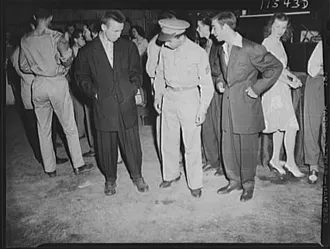
Zoot suiters and soldier at a 1942 Woody Herman concert in Washington, D.C. (Image courtesy of the Library of Congress, Prints & Photographs Division, FSA-OWI Collection, LC-USF34-011543-D DLC.)
Editor: Erind Pajo
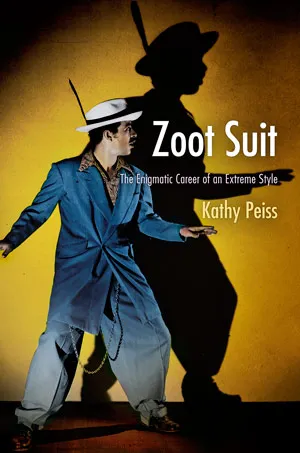
Zoot Suit
Kathy Peiss Zoot Suit: The Enigmatic Career of an Extreme Style University of Pennsylvania Press 240 pages, 6 x 9 inches ISBN 978 0812243376
Available here →August 29, 2011
20110829-peiss-kathy-zoot-suit-enigmatic-career-extreme-style-1-1
In a nutshell
The rest of this thread

Kathy Peiss
Kathy Peiss is the Roy F. and Jeannette P. Nichols Professor of American History at the University of Pennsylvania, where she teaches courses in 20th century American cultural history and the history of gender and sexuality. Besides Zoot Suit, featured in her Rorotoko interview, her books include Cheap Amusements: Working Women and Leisure in Turn-of-the-Century New York, and Hope in a Jar: The Making of America’s Beauty Culture.
Pull this thread
pulls againstpulls alongside
The evidence that zoot suiters wore the style as a gesture of refusal is slight and ambiguous.
Against JA · The Depression documentary book deconstructs witness, confronting readers with scattered voices rather than an authoritative picture. On: Formal radicalism in art carries a determinate political valence
Against KV · Black social dance from jazz through hip-hop is one continuum, and it made the American body. On: Subcultural style, leisure and consumption are forms of political resistance
Against JP · All opera is postcolonial, but opera cannot be decolonial. On: Formal radicalism in art carries a determinate political valence
Against CJ · For unemployed educated young men in north India, waiting is a fertile condition that breeds friendships and protest. On: Subcultural style, leisure and consumption are forms of political resistance
Alongside KP · What social media did to politics cannot be understood without assembly, the form where arrangement itself is the utterance. On: Formal radicalism in art carries a determinate political valence
Alongside JC · Pop around 1989 registered the disappearance of the century's organizing antagonism, and the cost was the capacity to think historically. On: Subcultural style, leisure and consumption are forms of political resistance
Alongside TG · What we want from film, love, violence, hide-and-seek, the supernatural, comes from innate mammalian and hunter-gatherer dispositions. On: Formal radicalism in art carries a determinate political valence
Alongside FG · Sport opened to marginalized athletes in the 1960s and 1970s on white owners' terms, and commercialization then undid the gains. On: Subcultural style, leisure and consumption are forms of political resistance
Know something the rest of us don't?
Most threads on Rorotoko begin with our invitation. Any thread can begin with a proposal: you write it with the same prompts every thread answers, and we review it.
Propose a thread →