
Kathy Peiss
Zoot Suit
Zoot Suit takes issue with historians and other scholars who interpret everyday life and culture largely as expressions of power and politics.
In this view, subcultural styles are a form of resistance to the social order. This perspective originated in the 1960s, and I show how it grew out of the Chicano rights and black nationalist movements, which emphasized the cultural dimensions of social change, as well as the academic discipline of cultural studies.
The “politics of style” has become the chief framework for understanding the popular culture of marginalized youth. I do not hold to an old-fashioned concept of culture as a domain separate from the political world. I would argue, however, that many interpreters of style have imposed a political reading on this phenomenon.
In the case of the zoot suit, they assume that young black men and pachucosexpressed their opposition to discrimination, the government, capitalism, or the war in part through style. This framework turns on its head the approach of the social scientists described above, yet by claiming a fixed meaning for the zoot suit and other youth fashion, they follow in their predecessors’ footsteps.
The historical evidence that the zoot suit is an expression of opposition, a “gesture of refusal,” is slight and ambiguous. In fact, we have relatively little record of the understanding and intentions of those who wore this style. A “fashion statement” does not yield its meaning so clearly. My work examines when, and under what circumstances, the zoot suit has been understood as political, and when it has not.
I have always been interested in the importance of everyday rituals, styles, and interactions in history. I have already written on early 20th century working-class leisure, the history of American beauty culture, and the rise of modern sexual mores. Style seemed an arena in which a modern sense of personal and group identity could be articulated.
My interest in the zoot suit itself came out of an undergraduate course I taught that emphasized research methods and inductive approaches to history. I posed a provocative question—could a fashion cause a riot?—and then we examined a host of primary sources, including newspapers, motion pictures, archival records, and court cases. After the course was over, I couldn’t let the subject go. The “riddle” of the zoot suit, as Ralph Ellison called it, seemed a perfect vehicle to explore the many meanings of style.
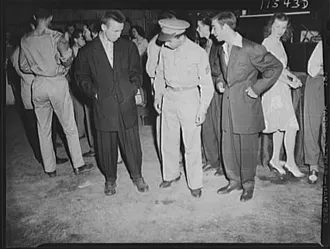
Zoot suiters and soldier at a 1942 Woody Herman concert in Washington, D.C. (Image courtesy of the Library of Congress, Prints & Photographs Division, FSA-OWI Collection, LC-USF34-011543-D DLC.)
Editor: Erind Pajo
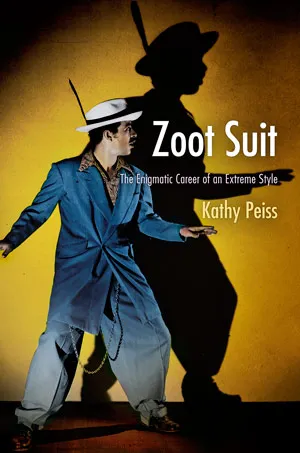
Zoot Suit
Kathy Peiss Zoot Suit: The Enigmatic Career of an Extreme Style University of Pennsylvania Press 240 pages, 6 x 9 inches ISBN 978 0812243376
Available here →August 29, 2011
20110829-peiss-kathy-zoot-suit-enigmatic-career-extreme-style-2
The wide angle
The rest of this thread

Kathy Peiss
Kathy Peiss is the Roy F. and Jeannette P. Nichols Professor of American History at the University of Pennsylvania, where she teaches courses in 20th century American cultural history and the history of gender and sexuality. Besides Zoot Suit, featured in her Rorotoko interview, her books include Cheap Amusements: Working Women and Leisure in Turn-of-the-Century New York, and Hope in a Jar: The Making of America’s Beauty Culture.
Pull this thread
pulls againstpulls alongside
The evidence that zoot suiters wore the style as a gesture of refusal is slight and ambiguous.
Against JA · The Depression documentary book deconstructs witness, confronting readers with scattered voices rather than an authoritative picture. On: Formal radicalism in art carries a determinate political valence
Against KV · Black social dance from jazz through hip-hop is one continuum, and it made the American body. On: Subcultural style, leisure and consumption are forms of political resistance
Against JP · All opera is postcolonial, but opera cannot be decolonial. On: Formal radicalism in art carries a determinate political valence
Against CJ · For unemployed educated young men in north India, waiting is a fertile condition that breeds friendships and protest. On: Subcultural style, leisure and consumption are forms of political resistance
Alongside KP · What social media did to politics cannot be understood without assembly, the form where arrangement itself is the utterance. On: Formal radicalism in art carries a determinate political valence
Alongside JC · Pop around 1989 registered the disappearance of the century's organizing antagonism, and the cost was the capacity to think historically. On: Subcultural style, leisure and consumption are forms of political resistance
Alongside TG · What we want from film, love, violence, hide-and-seek, the supernatural, comes from innate mammalian and hunter-gatherer dispositions. On: Formal radicalism in art carries a determinate political valence
Alongside FG · Sport opened to marginalized athletes in the 1960s and 1970s on white owners' terms, and commercialization then undid the gains. On: Subcultural style, leisure and consumption are forms of political resistance
Know something the rest of us don't?
Most threads on Rorotoko begin with our invitation. Any thread can begin with a proposal: you write it with the same prompts every thread answers, and we review it.
Propose a thread →