
Clifford Ando
Law, Language, and Empire in the Roman Tradition
The book falls into two parts, the first with two chapters, and the second with three. The first part concentrates on legal thought, the second on the interaction between specific bodies of law and the nature and effects of empire; the two projects are deeply interrelated. Like the parts, the individual chapters were written so as to be readable and intelligible on their own, though I think each also benefits from being read alongside the other questions I was asking at the time.
Let me attempt to introduce the two parts in turn, with the caution that many themes are present in one form or another throughout the book.
For a variety of reasons, many people think about the law in terms of rules. What are the rules governing sales tax, for example, and how might I get around them? A richer historical perspective on the law would embrace questions such as the following. How have rules changed and why? What kinds of pressures, voiced by what kinds of people, in what kinds of contexts, brought about that change? How did lay people, and how did legal actors, understand the relationship between legal rules and other norms? One can imagine many others.
For complicated reasons, Roman law as an academic discipline long remained fixated on describing its rules. How did one write a will at Rome? What was the age of marriage? Books had titles like “The Roman law of slavery.”
My book attempts to side-step questions about what Romans lawyers thought—in order to ask about how they thought. Why did they think law changed? How did they think change in the law could or should be justified? And how did they think legal institutions could or should adapt to social change?
For the fact of the matter was, Roman society was in constant flux. The same might be said of nearly any society, of course. But Roman society underwent acute change of particular kinds from a very specific source: it was an imperial society, and so it was constantly absorbing new populations, who spoke new languages and brought with them new customs.
As a related problem, Roman law initially came into existence when Roman society was largely confined to the city of Rome and its extensive agricultural hinterland. But imperial action rapidly carried Romans farther afield. How could the institutions of a small Mediterranean city be expanded to regulate a world empire? And could that expansion really take place without significant effects, for good or ill, on the system of law—and the very rule of law—in Rome itself?
Editor: Erind Pajo
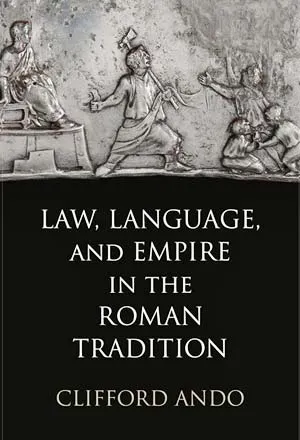
Law, Language, and Empire in the Roman Tradition
Clifford Ando Law, Language, and Empire in the Roman Tradition University of Pennsylvania Press 192 pages, 6 x 9 inches ISBN 978 0812243543
Available here →January 16, 2012
20120116-ando-clifford-on-law-language-empire-roman-tradition-1-1-1
In a nutshell
The rest of this thread

University of Chicago
Clifford Ando
Clifford Ando is Professor of Classics, History, and Law at the University of Chicago. He studied at Princeton University and the University of Michigan. Besides Law, Language, and Empire in the Roman Tradition, featured on Rorotoko, Ando is also the author of Imperial Ideology and Provincial Loyalty in the Roman Empire (2000) and The Matter of the Gods (2008).
Pull this thread
Roman lawyers made rules fit the world while saying otherwise, and legal fictions are that operation in the open.
Know something the rest of us don't?
Most threads on Rorotoko begin with our invitation. Any thread can begin with a proposal: you write it with the same prompts every thread answers, and we review it.
Propose a thread →