
Clifford Ando
Law, Language, and Empire in the Roman Tradition
The book attempts to keep its feet firmly planted in two different worlds. On the one hand, it is a work of history. Moreover, it is a work of history with an agenda: I would like to reveal Roman lawyers as more creative, more human and, indeed, more humane than some reconstruction of a body of rules is likely to show.
Their world was changing, and, being charged with regulating that world, they were forced to confront that change, to acknowledge the limitations of their rules and of the very language of their rules. More than many, they understood keenly that one cannot simply make the world fit the rules. It is rather a matter of making rules fit the world, even if, to preserve the authority and autonomy of the law, one must describe this practice in some other way.
And yet, this is also a work of contemporary scholarship. Its questions are therefore very often modern questions.
Chapter 4, for example, asks how the ancient world’s two most famous democracies, Athens and Rome, understood themselves and other peoples, such that they could without apparent hesitation undertake wars of choice to deprive other states of freedom and enslave their populations. A significant body of modern political science urges that democracies, among their many virtues, do not choose to go to war with other democracies—and I’m sure many Americans would like to believe that of their own country.
Likewise, chapter 5 investigates the nature of freedom in Roman thought in the age of its democracy—with a focus on law, of course, and on arguments for majoritarian rule. It then asks whether that vision of freedom could be sustained—it shows that it was not sustained—under pressure from imperial expansion. Rome was forced to choose between retaining its empire but losing its democracy, or remaining a democracy but losing the empire. It chose the former, but the transition to monarchy entailed by this choice had effects in legal philosophy and legal thought both subtle and immense.
I came to this project by a circuitous route. My first book studied the practices of communication between Rome and the subject populations of the empire, and the development of a shared political culture as a result of that process. It attempted to assess the significance of this remarkable process.
But I rapidly came to see that its very modern focus on speech as the heart of politics ignored another reality, in which the practices of government placed a hugely important role. Despite popular visions of Rome as a society of empire and of laws, this was not how professional historians saw the matter. For a generation at least, the dominant picture had instead been of ancient government as minimalist in its achievements and even its intents.
I therefore embarked on a large-scale history of the role of government in social and cultural change. To do that, I had to take Roman law more seriously than I had in the past. This book is a by-product of that effort.
Editor: Erind Pajo
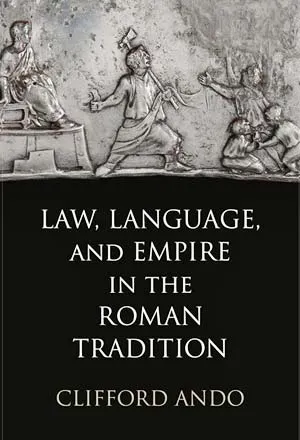
Law, Language, and Empire in the Roman Tradition
Clifford Ando Law, Language, and Empire in the Roman Tradition University of Pennsylvania Press 192 pages, 6 x 9 inches ISBN 978 0812243543
Available here →January 16, 2012
20120116-ando-clifford-on-law-language-empire-roman-tradition-2-1
The wide angle
The rest of this thread

University of Chicago
Clifford Ando
Clifford Ando is Professor of Classics, History, and Law at the University of Chicago. He studied at Princeton University and the University of Michigan. Besides Law, Language, and Empire in the Roman Tradition, featured on Rorotoko, Ando is also the author of Imperial Ideology and Provincial Loyalty in the Roman Empire (2000) and The Matter of the Gods (2008).
Pull this thread
Roman law worked by making rules fit the world while claiming to do the opposite.
Know something the rest of us don't?
Most threads on Rorotoko begin with our invitation. Any thread can begin with a proposal: you write it with the same prompts every thread answers, and we review it.
Propose a thread →