
Clifford Ando
Law, Language, and Empire in the Roman Tradition
That’s a very hard question to answer! It’s tempting to direct your browsing reader to, say, the middle section of Chapter 3, pages 46-56, because the argument there gets at two concerns central to the project.
Chapter 3 studies the laws of war at Rome, and the various ways in which modes of reasoning central to private law (which is to say, to law made by Romans to structure their relations with each other) came to shape Roman relations with the wider world.
In the central section of Chapter 3, two issues come to the fore. First, the Romans had some sense that their rules and practices in declaring war must have changed as the empire got bigger, even as their rules and practices for declaring ownership of private property must have changed as the state got bigger. Roman writings on these topics bring one face-to-face with their historical imagination, with their ability to imagine their own archaic past. The chapter also reveals their capacity to imagine developmental processes that brought them from that past to the present as they understood it.
The second issue central to this section is the relationship between private and international law. There’s no necessary reason why the rules governing a property dispute with one’s neighbor should be the same as, or even similar to, the rules that govern disputes between nations. After all, nations can exist far away from each other and have next to nothing in common, neither language nor cultural norms, nor even gods. That said, in many but not all respects, the Romans devised rules in the international arena based on laws they devised first for themselves.
One way the Romans surmounted such differences in practice was through the use of fictions. Fictions in Roman law are the special focus on chapter 1, another section of the book dear to my heart. Fictions were used by Roman lawyers to effect ad hoc changes in the way one described the world in order to make certain things possible in the law. For example, if a law specified that it treated only disputes between Roman citizens but a Roman governor had to judge a dispute between aliens or between an alien and a citizen, he might posit for the sake of the dispute that the alien was in fact a citizen.
As I try to show, thinking about legal fictions—about the fit between the language of the law and the world the law sought to regulate—provoked fascinating reflection on the part of Roman lawyers and legal philosophers: about the nature of the world, about the difference between legal facts and social facts, and about the limits of the law.
First, I’d very much like the book to draw attention to the astonishing creativity of Roman lawyers. Indeed, Roman legal writing seems to me to capture and convey something essential and unique about Rome as a society and Latin as a language. Likewise, to my mind, Roman legal thought represents the most remarkable and certainly the most essentially Roman achievement of intellectual life under the empire.
Second, the book draws attention to an understudied problem in the history of the Roman law, namely, the historical priority of private law at Rome, in contrast to all other forms of legal thought (constitutional law, international law, and so forth). What is more, because in different ways at different times, Roman law served as the foundation for law in continental Europe, this problem persists. One doctrine of property used by European powers to seize land elsewhere—the doctrine of “res nullius,” or “property of no one”—was not in origin a concept in international law at all. It arose in private law to cover such problems as rivers changing their course: when that happens, stretches of riverbed became dry land, and as a matter of logic, Roman lawyers asserted, they cannot have been private property before.
As I see it, the implication of international law in private law—and specifically in the private law of an imperial power—laid the ground for huge problems in the history of law in the late middle ages and early modern Europe. I’ll be turning my attention there by and by.
Editor: Erind Pajo
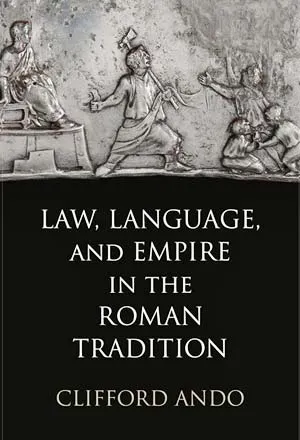
Law, Language, and Empire in the Roman Tradition
Clifford Ando Law, Language, and Empire in the Roman Tradition University of Pennsylvania Press 192 pages, 6 x 9 inches ISBN 978 0812243543
Available here →January 16, 2012
20120116-ando-clifford-on-law-language-empire-roman-tradition-3-1
A close-up
The rest of this thread

University of Chicago
Clifford Ando
Clifford Ando is Professor of Classics, History, and Law at the University of Chicago. He studied at Princeton University and the University of Michigan. Besides Law, Language, and Empire in the Roman Tradition, featured on Rorotoko, Ando is also the author of Imperial Ideology and Provincial Loyalty in the Roman Empire (2000) and The Matter of the Gods (2008).
Pull this thread
Roman lawyers made rules fit the world while saying otherwise, and legal fictions are that operation in the open.
Know something the rest of us don't?
Most threads on Rorotoko begin with our invitation. Any thread can begin with a proposal: you write it with the same prompts every thread answers, and we review it.
Propose a thread →