
Philip Lieberman
The Theory That Changed Everything
The first chapter, “Strawberries,” presents the formative experience: the voyage of HMS Beagle that formed Darwin’s views on the common humanity of all people and set the stage for his life’s work. In a similar, lesser manner, the treks on which my wife, Marcia, and I walked off the map into remote regions of Nepal, was time-travel that changed the way that we viewed life and focused our work.
The first pages of “Strawberries” demonstrate the mechanism and impact of Natural Selection. The strawberries on your plate are the result of natural selection practiced over hundreds of years; not God’s gift. GMOs are nothing new, suggesting, as noted in the concluding chapter of my book, that Darwin’s reaction to the debate on GMOs and other current issues would not be what many readers might expect. It puts Darwin’s experiences in the Galapagos islands into perspective. Darwin collected birds there but forgot to label where they had lived. An epiphany revealing the theory of evolution did not occur.
The chapter also presents examples revealing the process of Natural Selection and how it is tied to environment and culture. It shows why Darwin did not realize that Natural Selection can act rapidly. The germ theory of disease was then unknown and Darwin could not have realized that Natural Selection was acting in a savage manner to preserve people whose with robust immune systems or who were lucky to avoid infection. Marcia and I found that it still was unknown when we walked to Inner Dolpo, Nepal. Doctors in developed nations disputed the germ theory throughout most of the nineteenth century.
Pages 30 to 44 of Chapter Two, “No Cats, No Flowers “ present the other major elements of Darwinian evolutionary theory in text that avoids jargon. It also presents the theory in George Chambers’ 1844 Vestiges of the Natural History of Creation; a mixture of intelligent design and phrenology. Chambers’s theory, surprisingly, is at the heart of Noam Chomsky’s views concerning the evolution of language, morality, and art. Chomsky, like Chambers, views evolution as a process directed by some vague unspecified criterion. To Chomsky, Natural Selection is a meaningless concept; in his view, language suddenly came into being about 80,000 years ago through an unknown process that is unique to humans.
I hope that what Darwin actually proposed will sink into the consciousness of inquisitive readers, enhance support for evolutionary biology, and bring it to the attention of the next generation of potential scientists.
Darwin’s insights apply to matters of general interest, such as population growth and global warming; both crucial to our and the planet’s survival. My book might convince some people born into families holding to a literal interpretation of the bible to become open to other views, though they, most likely, would not read it. However, it might convince some linguists and psychologists to re-evaluate theories such as Chomsky’s to pursue more productive lines of inquiry.
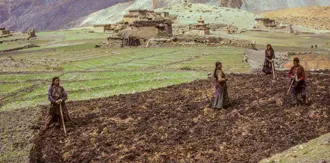
Women working in village field. Inner Dolpo, Nepal. Copyright Philip Lieberman.

Home near Tende. Inner Dolpo, Nepal. Copyright Philip Lieberman.
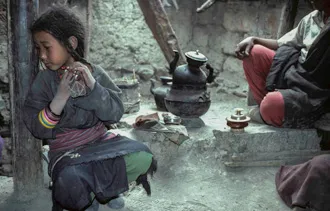
Bon-Po lama's son, Samling. Inner Dolpo, Nepal. Copyright Philip Lieberman.
Editor: Judi Pajo

The Theory That Changed Everything
Philip Lieberman The Theory That Changed Everything: “On the Origin of Species” as a Work in Progress Columbia University Press 232 pages, 5.8 x 8.8 inches ISBN 978 0231178082
Available here →January 22, 2018
20180122-lieberman-philip-on-book-theory-changed-everything-origin-species-3-1
A close-up
The rest of this thread
Giorgia Müller
Philip Lieberman
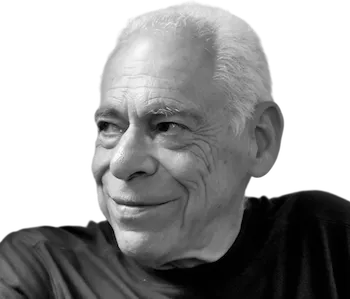
Philip Lieberman was born in New York City in 1934. In high school he was a finalist in both national photography contests and the Westinghouse Science Talent Search. He selected science and has since published eight books and published or presented more than 200 papers. However, he kept up photography. He and his wife, Marcia have enjoyed walking on mountain paths since they were married, which in time brought them to Nepal and an interest in Tibetan culture documented in his photographs and her publications. Many of his photographs have been published and are in museum collections.
Pull this thread
pulls againstpulls alongside
Neanderthals could not produce the vowels that make speech clear, yet they talked, so language was no sudden human event.
Against GS · Reason and language are irrelevant to moral status, so killing and eating animals is unjustifiable. On: There is a difference in kind, not merely of degree, between human minds and animal minds
Against JG · Story is what most sets humans apart, and fiction survived evolution because stories are flight simulators for social life. On: There is a difference in kind, not merely of degree, between human minds and animal minds
Against ET · Gods were an incidental byproduct of brain evolution, born when autobiographical memory taught humans they would die. On: There is a difference in kind, not merely of degree, between human minds and animal minds
Alongside KO · The philosophers who insist most on the man/animal divide depend most heavily on animals for their arguments. On: There is a difference in kind, not merely of degree, between human minds and animal minds
Alongside DS · The physics and neuroscience behind every musical style can be taught with grade-school arithmetic, and conservatories teach none of it. On: There is a difference in kind, not merely of degree, between human minds and animal minds
Alongside AM · The traits we treat as definingly human are shared with birds, especially parrots and corvids. On: There is a difference in kind, not merely of degree, between human minds and animal minds
Know something the rest of us don't?
Most threads on Rorotoko begin with our invitation. Any thread can begin with a proposal: you write it with the same prompts every thread answers, and we review it.
Propose a thread →