
Gerald R. North
The Rise of Climate Science
I describe my experiences and observations over a career that has grown parallel to a field of scientific and practical interest that has grown from raw data collection to its mature status embracing all the rigors of statistical, physical, and mathematical standards. I came to climate science after training as a theoretical physicist. I was one of many bringing those theoretical ideas and methods to the field.
My first paper in climate science was published in 1975—I was age 37, a time when many say a theorist is done. In physics I was done, but the passion for science remained. I learned statistical methods such as the behavior of random fields being applied to maps in climate science. Using these statistical methods colleagues and I developed methods of estimating the sampling errors committed in the analysis of continuous data maps and in feasibility studies for satellites in different orbital configurations.
By this time, I was working at NASA in Greenbelt Maryland.
From my time in Boulder I also constructed simple climate models that could be solved without supercomputers, and these opened the gate for numerous studies in paleoclimatology. Some of these papers clarified the stability of ice caps and the importance of the seasonal cycle in paleobiology and the formation of the ice ages. Later at Texas A&M University I collaborated with great students on the statistical detection of faint signals in the climate system. At that time the effects of global warming were faint, but the distinct patterns of their response in space and time was enough for us to sort out the patterns from sunspot cycles, aerosols, volcanic eruptions, and greenhouse gases. Now, the signals are so strong, one hardly needs this level of fine signal processing.
As I passed through my time in climate science, I visited many different governmental and academic institutions as a reviewer or board member for nonprofit organizations. I learned how these entities operated. I also played a role in foreign visits to institutions in England, Japan and China, mainland and Taiwan, in connection with satellites. I visited the USSR five times, once for a summer, in connection with an agreement intended to warm the relations between the two superpowers. I was able to draw some inferences as to the efficacies of practices in these institutions.
I have concerns with the overuse of metrics in evaluating the status or value of individuals, departments, and whole institutions, all to the detriment of diversity in subcultures, age, and other considerations that are basic to our American heritage. The failure of these practices, when applied to extreme, was a major factor in the fall of the USSR. One problem is that it is so easy to game the system with a kind of corruption, first in tiny steps, but it grows. The institutions work well for a time, and their collective metrics improve, but later it does not work in the nation’s interest.
Editor: Judi Pajo

The Rise of Climate Science
Gerald R. North The Rise of Climate Science: A Memoir Texas A&M University Press 336 pages, 6 x 9 inches ISBN 978 1623498672
Available here →October 14, 2020
20201014-north-gerald-on-book-rise-climate-science-memoir-2-1
The wide angle
The rest of this thread
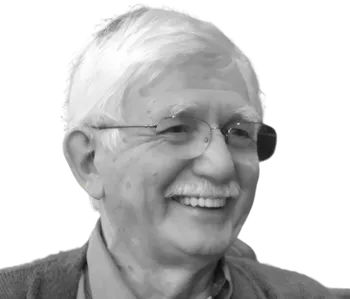
Laura North
Gerald R. North
Gerald R. North was born in Sweetwater, Tennessee, in 1938. He grew up in Knoxville, attended Fulton High School, and earned a BS in Physics from the University of Tennessee. He worked at the Oak Ridge National Laboratory as a co-op student and junior physicist, 1957-61. He earned a PhD in Physics from the University of Wisconsin, Madison, 1966, and was a Postdoc in Physics at the University of Pennsylvania, 1966-68. He worked from Assistant Professor to Full Professor at the University of Missouri-St. Louis, 1968-1978; spent a sabbatical year at the National Center for Atmospheric Research in Boulder, Colorado, 1974-75; served as a research Scientist at NASA/Goddard Space Flight Center in Greenbelt, Maryland, 1978-1986; and University Distinguished Professor at Texas A&M University, 1986-2016, now Emeritus. He is the author or more than 170 refereed scientific publications, 50 book chapters, book reviews, and other publications; co-author of Paleoclimatology (Oxford Press), Introduction to Thermodynamics (Cambridge UP), Energy Balance Climate Models (Wiley-VCH); co-editor of Impact of Global Warming on Texas (2nd Edition, University of Texas Press); and Editor in Chief of Encyclopedia of the Atmospheric Sciences (2nd Ed., Elsevier, 1914). His recent book, The Rise of Climate Science, is featured in his Rorotoko interview.
Pull this thread
Climate science became a science in the late 1960s, when physics displaced data collection and description as its paradigm.
Know something the rest of us don't?
Most threads on Rorotoko begin with our invitation. Any thread can begin with a proposal: you write it with the same prompts every thread answers, and we review it.
Propose a thread →