
Gerald R. North
The Rise of Climate Science
The book is full of stories connected with each of these segments of my life. I hope different browsers will first look at the table of contents, then open to a section that appeals to them. Not every reader will find every chapter of interest. But there are several that will appeal to any reader.
Most people will probably open the first chapter, and it is the one describing my sabbatical year in Boulder, Colorado. First, it is a beautiful city, and the building I worked in was located in a most remarkable location with rugged mountains, trees, wild deer grazing just outside the windows, etc. There I had the experience of solving a difficult problem in climate science, which was exciting and even intoxicating. This led to awards and recognition throughout the field—rare for a newcomer. Invitations flowed to me including a summer on Cape Cod where world leaders congregated for six weeks, and I was treated like an equal. While there, I was invited to be a member of a delegation of American climate scientists to visit to the USSR.
In that fifteen-day trip in September 1976 the delegation consisted of the leading climate modelers in the US. Not only was the trip interesting and exciting; it included a hike up a huge glacier in Uzbekistan. I took the cover picture of my book on that trip. I was one of the guys.My life and career should be interesting to many people who are considering a life in science, or persons in position to advise young people interested in science. I grew up in the golden age for my choice of science as a profession. I was a late bloomer who could not have made it in many countries or times.
I managed to squeeze through all the traditional gates. Although it seems that my path was unique, I found that I was among a cohort of ambitious kids from the lower middle class that were successful. I fear that this path is closed now for this group that I remember so well. I fear that the current concentration of wealth elsewhere shuts the gates on this route for all too many to the detriment of our nation.
Climate science began with geographers and geologists collecting and organizing data. It took an abrupt change in the late sixties to a paradigm of putting physics (mostly through meteorologists and oceanographers, but others as well) into climate models, as they evolved from weather forecast models. Theoretical models required physical, mathematical, and statistical skills for their solution. A key ingredient was the parallel growth of digital computers and other technologies such as drilling cores from the sea floor, lake bottoms and coral formations. Satellite observing systems enabled us to gain a global view of our planet’s climate and how it works. The giant computers, the internet, and satellites systems also corralled the gushing flow of information that was needed by the models.
The model simulations and the data streams set up a dance of iterating between models suggesting data, data testing, and adjusting models. This beautiful picture is now clear enough for us to believe what climate scientists have been telling us for decades. The planetary climate is changing for the warmer with negative ramifications. It is so obvious now that the number of scientifically educated supporters denying the change has nearly vanished. In the terms of Thomas Kuhn, climate science is in the stage of normal science.
Basic climate science is now blessed with funding from numerous governmental agencies in the United States and in nearly every other country in the world. The largest corporations are agreed on its inferences. Climatic conditions evolve on multi-generational time scales. The changes are gradual to the observer, but the manifestations of it are becoming clear to the laypersons at last, and they should begin to deal with it with a mix of adaptations and mitigations.
Editor: Judi Pajo

The Rise of Climate Science
Gerald R. North The Rise of Climate Science: A Memoir Texas A&M University Press336 pages, 6 x 9 inches ISBN 978 1623498672
Available here →October 14, 2020
20201014-north-gerald-on-book-rise-climate-science-memoir-3-1
A close-up
The rest of this thread
Laura North
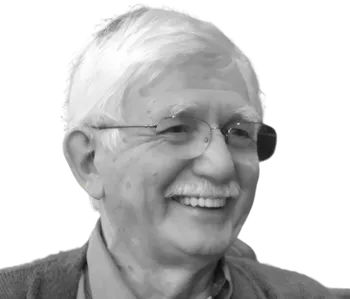
Gerald R. North
Gerald R. North was born in Sweetwater, Tennessee, in 1938. He grew up in Knoxville, attended Fulton High School, and earned a BS in Physics from the University of Tennessee. He worked at the Oak Ridge National Laboratory as a co-op student and junior physicist, 1957-61. He earned a PhD in Physics from the University of Wisconsin, Madison, 1966, and was a Postdoc in Physics at the University of Pennsylvania, 1966-68. He worked from Assistant Professor to Full Professor at the University of Missouri-St. Louis, 1968-1978; spent a sabbatical year at the National Center for Atmospheric Research in Boulder, Colorado, 1974-75; served as a research Scientist at NASA/Goddard Space Flight Center in Greenbelt, Maryland, 1978-1986; and University Distinguished Professor at Texas A&M University, 1986-2016, now Emeritus. He is the author or more than 170 refereed scientific publications, 50 book chapters, book reviews, and other publications; co-author of Paleoclimatology (Oxford Press), Introduction to Thermodynamics (Cambridge UP), Energy Balance Climate Models (Wiley-VCH); co-editor of Impact of Global Warming on Texas (2nd Edition, University of Texas Press); and Editor in Chief of Encyclopedia of the Atmospheric Sciences (2nd Ed., Elsevier, 1914). His recent book, The Rise of Climate Science, is featured in his Rorotoko interview.
Pull this thread
Climate science became a true science in the late 1960s, when physics took over.
Know something the rest of us don't?
Most threads on Rorotoko begin with our invitation. Any thread can begin with a proposal: you write it with the same prompts every thread answers, and we review it.
Propose a thread →