
Ryan D. Griffiths
Colonization
This book corrects a Eurocentric picture of International Relations (IR) that has dominated the study of international relations over the past decades, and especially the statistical study of IR. If we were to ask a basic question like, how many “sovereign states” are there today, we could broadly agree on the answer because of sovereignty-attributing institutions like the United Nations. But if we were to ask how many states there were 200 years ago, in 1825, social scientists did not have a good answer. Although registers of sovereign states exist that cover the nineteenth century, these are heavily biased towards Europe and the Americas, representing the regions of Africa, Asia, and the Middle East as blank.
We know this picture is wrong, and using a new dataset on sovereign states in the 19th century, we show that places like South Asia, West Africa, and Southeast Asia were dense state systems. Indeed, when we correct existing biases in the field, there were more states in 1825 than there are today. We also quantify the scale of mass state death that occurred with the coming of European colonialism. We then zoom into East Asia, South Asia, Southeast Asia, and West Africa, asking what the states in these systems were like, did they rule as centralized governments, or was rule more decentralized? Since non-Western states have typically been excluded from systematic and comparative studies, we also ask whether some of the main theories of why states centralize their rule apply outside of the European context in which they were developed. We find that most states ruled in a decentralized way through systems of vassalage that allowed local leaders a high degree of autonomy. This decentralized form of rule produced a different form of international system, one where states had fuzzy borders, power was more graded than uniform, and forms of overlapping sovereignty were more common. Moreover, we find that some of the most important theories of European state centralization don’t seem to apply – rather, factors like trade and war seem to have caused states to decentralize their rule as often as they caused centralization. We argue that basic limits on the ability to transport people, goods, and ideas that characterized the 19th century put a limit on the extent to which centralized states were able to form.
Curator: Rachel Althof
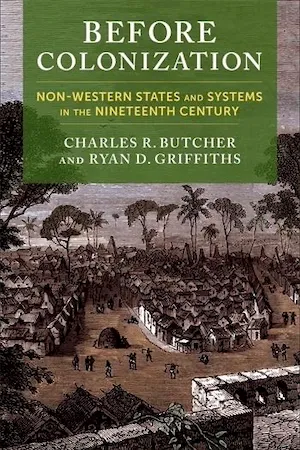
Colonization
Charles R. Butcher & Ryan D. Griffiths Colonization: Non-Western States and Systems in the Nineteenth Century Columbia University Press 344 pages 6 x 9 inches, ISBN 9780231219365
Available here →November 3, 2025
20251103-ryan-griffiths-before-colonizaion-nonwestern-states-systems-nineteenth-century-1-1
In a nutshell
The rest of this thread

Ryan D. Griffiths
Ryan Griffiths a Professor in the Department of Political Science at the Maxwell School of Citizenship and Public Affairs, Syracuse University. His research focuses on the dynamics of secession and the study of sovereignty, state systems, and international orders. He teaches on topics related to nationalism, international relations, and international relations theory. He has published a number of other books, including most recently Before Colonization: States and Systems in the Nineteenth Century (Columbia University Press, 2025, with Charles Butcher).
Pull this thread
There were more states in 1825 than there are today, and European colonialism destroyed most of them.
Know something the rest of us don't?
Most threads on Rorotoko begin with our invitation. Any thread can begin with a proposal: you write it with the same prompts every thread answers, and we review it.
Propose a thread →