
Ryan D. Griffiths
The Disunited States
The book is about secession in America. There is a growing interest in secession, or what some refer to as a national divorce between Red and Blue America. There is a developing literature on this topic, and one Axios poll found that 20% of Americans support a national divorce. The key factor driving this interest in secession is polarization. Whether it is the Red-State secessionists, the Blue Exiters, the California Independence Party, or the Texas Nationalists, they all point to unstoppable polarization and political dysfunction as the reason secession is necessary. They have lost faith in the American political system.
The book outlines three common arguments that secessionists make: (1) That the two sides have irreconcilable differences (the polarization argument); (2) That secession is a legal right; and (3) That smaller political units are better. The book draws on interviews with secessionist organizations, and considerable time is spent developing their positions. Secession occurs when part of a sovereign state breaks away to form its own recognized sovereign state. The American Civil War was an attempt at secession, just as the American Revolution was a successful case of secession. There are roughly 70 active secessionist movements in the world, and the last state to be born via secession was South Sudan in 2011.
The thesis of the book is that while polarization is a serious problem in America, secession is not the solution. Roughly half of secessionist movements turn violent, and most of them fail to gain independence. When they do secede peacefully, it is when specific conditions hold. There is a distinct and regionally concentrated nation, with clear internal borders, and a special administrative status that justifies why that nation can secede when others cannot. The Czechoslovak Velvet Divorce was an example. But these conditions do not hold in America.
The attempt to divide America into two or more countries would almost certainly produce great violence. The so-called red and blue populations are intermixed, and many Americans hold moderate positions. Trying to unmix that population and disassemble the country would create a cascade of hyper-polarization and ideological conflict. The book is written for a general audience. It argues that rather than turning to secession as a solution to America’s problems – and this is a false solution – the better choice is to target the roots of polarization and seek common ground.
Curator: Rachel Althof
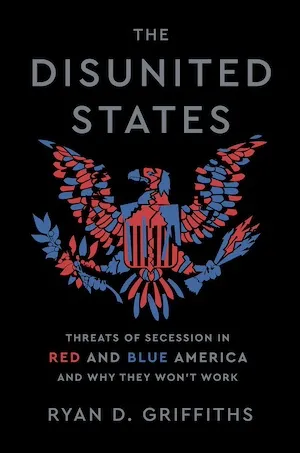
The Disunited States
Ryan D. Griffiths The Disunited States: Threats of Secession in Red and Blue America and Why They Won't Work Oxford University Press 200 pages 6 x 9 inches ISBN: 9780197816257
Available here →November 17, 2025
20251117-griffiths-ryan-disunited-states-1-1
In a nutshell
The rest of this thread

Ryan D. Griffiths
Ryan Griffiths a Professor in the Department of Political Science at the Maxwell School of Citizenship and Public Affairs, Syracuse University. His research focuses on the dynamics of secession and the study of sovereignty, state systems, and international orders. He teaches on topics related to nationalism, international relations, and international relations theory. He has published a number of other books, including most recently Before Colonization: States and Systems in the Nineteenth Century (Columbia University Press, 2025, with Charles Butcher).
Pull this thread
Secession is a false solution to American polarization, and the attempt would almost certainly produce great violence.
Know something the rest of us don't?
Most threads on Rorotoko begin with our invitation. Any thread can begin with a proposal: you write it with the same prompts every thread answers, and we review it.
Propose a thread →