
Ryan D. Griffiths
The Disunited States
There are two sections that I hope browsers would encounter. The first is from a section at the beginning called the Year of Two Presidents. It is a fictional vignette that imagines a 2032 Presidential election in the context of extreme polarization, one that collapses into a violent civil war.
The two candidates are Alexandria Ocasio-Cortez and Donald Trump Jr. By the time of the election, American politics has become hyper-polarized and both parties think that they need to win at any cost. Political violence has become common. The election results are so close, and the attempts at cheating are so rampant, that both candidates end up claiming the Presidency and denouncing the other. What follows is the establishment of two Presidential administrations, one based on Washington D.C. and the other in Florida. Political violence begins to spiral out of control and martial law is declared. As the situation disintegrates and the fear and distrust metastasize, some leaders call for a national convention to divide the country. But they quickly run into obstacles such as how borders would be drawn, who decides, and how many countries should be created. Eventually, the United States collapses into five new states that each possess additional secessionist movements. There is substantial inter-militia violence and internal refugee crises. The section ends when Russia and China recognize the new states and offer to send peacekeeping forces to alleviate the suffering and end the violence.
The second section that might interest browsers is a chapter called “Three Blueprints for American Divorce.” In the chapter, I attempt to map out different ways that America could be divided between a so-called Redland and Blueland. I discuss three blueprints based on: (1) a division by red and blue states; (2) a division by red and blue congressional districts; (3) a division by red and blue counties. The blueprints illustrate the fundamental problem of trying to divide a population of 340 million Americans who are quite intermixed geographically and ideologically. Most of America is purple and political divisions run through neighborhoods and households.
The three blueprints demonstrate what I call the “scale problem.” That is, there is no way to draw new borders that both create a rational map and reduce the political minority problem. The scale at which you draw the map come with tradeoffs. If Redland and Blueland are divided by states, then the map is somewhat coherent, but millions of Americans will find themselves in the wrong country. If the map is divided by the 5,000 or so counties, then more Americans will be properly sorted into the country they want, but the resulting map will be a hopeless jigsaw of intermixed islands of red and blue.
The chapter includes maps and is a useful and interesting way to think through the fundamental challenges of disassembling America.
This is a non-partisan book. It was not written for Red America or Blue America; it was written for all Americans. One of my hopes is that it will interest readers from across the political spectrum.
Another central aim in the book is to convince the reader that secession won’t work. This is not easy to do because once an individual believes in a secessionist cause, it is hard to change their view. Most secessionists will see the issue through an ideological lens. That is, they will argue that groups of like-minded individuals (or nations) ought to have a right to create their own state if the current one is broken. However, that is an ideological argument and not one based on pragmatism. In the book, I do not take a position on normative claims about deserving independence. I contend that when it comes to secession, it’s not simply about whether a group is righteous, there is also the reality of how secession works, and how it can rapidly descend into violence. This is one of the things I want the reader to understand.
My aim is to shift the reader’s attention to the extreme practical challenges of trying to disentangle a hopelessly entangled population. America is simply not set up in a way that will enable a smooth and peaceful national divorce.
I also want to explain that while the analogy between secession and marital divorce has some usage, it is nevertheless imperfect. A marriage consists of only two individuals and not 340 million. Marital divorce managed by domestic law and there are guardrails in place to prevent it from becoming overly conflictual. There are no such guardrails in place for secession between Redland and Blueland. It would truly be anarchy.
Finally, I end the book with a short plea for seeking common ground. Although it is far from perfect, America has made countless achievements. Its people are far less polarized than its current leadership, and they still have much to offer as a united nation.
Curator: Rachel Althof
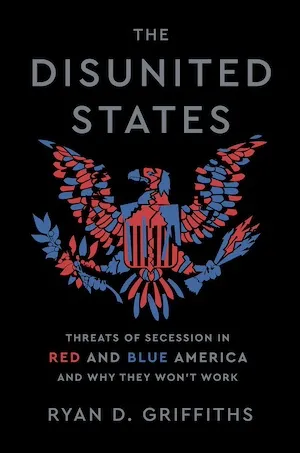
The Disunited States
Ryan D. Griffiths The Disunited States: Threats of Secession in Red and Blue America and Why They Won't Work Oxford University Press 200 pages 6 x 9 inches ISBN: 9780197816257
Available here →November 17, 2025
20251117-griffiths-ryan-disunited-states-3
A close-up
The rest of this thread

Ryan D. Griffiths
Ryan Griffiths a Professor in the Department of Political Science at the Maxwell School of Citizenship and Public Affairs, Syracuse University. His research focuses on the dynamics of secession and the study of sovereignty, state systems, and international orders. He teaches on topics related to nationalism, international relations, and international relations theory. He has published a number of other books, including most recently Before Colonization: States and Systems in the Nineteenth Century (Columbia University Press, 2025, with Charles Butcher).
Pull this thread
Secession is a false solution to American polarization, and the attempt would almost certainly produce great violence.
Know something the rest of us don't?
Most threads on Rorotoko begin with our invitation. Any thread can begin with a proposal: you write it with the same prompts every thread answers, and we review it.
Propose a thread →