
Ryan D. Griffiths
Colonization
Our book relates to big questions such as what counts as a state in the international system and how many states there were at different points in time. These are basic and important questions because basic states are the unit over which we measure many things like democracy, conflict, or development, as basic as a square meter, a day, or a voting district. The exclusion of hundreds of states in the 19th century raises important questions about how well theories of – for example – the rise of the centralized state can generalize to regions outside of Europe. The book also relates to broader questions and theories about why states sometimes centralize their rule. Centralization is when rulers remove the autonomy of local actors to decide their own laws, levy their own taxes, and keep their own militaries, and concentrate those decision-making powers in a central government. Some of the most influential theories in the field emphasize that European states centralized in response to pressures from war and incentives provided by trade (or a combination). But our findings suggest that these factors had mixed impacts on states in West Africa, South Asia, and Southeast Asia in the 19th century. Sometimes they produced limited centralization, but more often they caused further decentralization and the fragmentation of states. We argue that this is because of low levels of interaction capacity (the ability to move people, goods, and ideas), which make centralization projects expensive for state rulers and might even reverse the impacts that war and trade had on centralization in Europe. The book is the product of more than a decade of work together. Our first attempt to create the dataset began with a book on the stamps of 19th-century states that no longer exist. It was a great find, and it reinforced our suspicion that there were previously many states and systems that were mostly ignored in the field of international relations. From there, we were able to obtain grants from the Australian Research Council, the European Research Council, and the National Science Foundation, and those grants enabled us to create large research teams. The work continues, and we are now creating data on related issues like conflict and precolonial legacies. It’s been a fascinating project.
Curator: Rachel Althof
Colonization
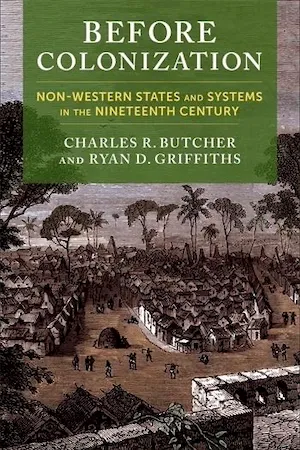
Charles R. Butcher & Ryan D. Griffiths Before Colonization: Non-Western States and Systems in the Nineteenth Century Columbia University Press 344 pages 6 x 9 inches, ISBN 9780231219365
Available here →November 3, 2025
20251103-ryan-griffiths-before-colonizaion-nonwestern-states-systems-nineteenth-century-2
The wide angle
The rest of this thread

Ryan D. Griffiths
Ryan Griffiths a Professor in the Department of Political Science at the Maxwell School of Citizenship and Public Affairs, Syracuse University. His research focuses on the dynamics of secession and the study of sovereignty, state systems, and international orders. He teaches on topics related to nationalism, international relations, and international relations theory. He has published a number of other books, including most recently Before Colonization: States and Systems in the Nineteenth Century (Columbia University Press, 2025, with Charles Butcher).
Pull this thread
There were more states in 1825 than there are today, and European colonialism destroyed most of them.
Know something the rest of us don't?
Most threads on Rorotoko begin with our invitation. Any thread can begin with a proposal: you write it with the same prompts every thread answers, and we review it.
Propose a thread →