
Caitlin Vincent
Opera Wars
Opera Wars is very much an examination of where the opera industry currently stands and all of the pressure points and conflicts that have emerged from having this four-century-old art form collide with contemporary society. I divide the book into eight key battlegrounds. They’re not the only battlegrounds in the opera industry, but they’re the most front-of-mind ones. In each chapter, I dig into the tensions and arguments happening within the industry—around casting, how operas are meant to be staged, historical practices like blackface and yellowface (which are still very common in opera), and fidelity to long-dead composers and librettists.
I also look backstage at opera as a site of employment—rehearsal room dynamics, power dynamics, career pathways or lack thereof, and financial pressures. It’s aimed at people who are curious about opera but don’t quite know where to start, as well as people who are already opera fans or even opera insiders. It’s meant to be accessible: to bring everyone together, set a common denominator, and then dig into the really fascinating, dysfunctional aspects of the opera world.
Curator: Bora Pajo
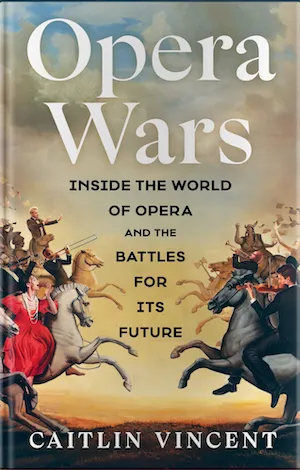
Opera Wars
Vincent, Caitlin. Opera Wars: Inside the World of Opera and the Battles for Its Future. Scribner, 304 pp. ISBN 978-1-66808-406-9.
Available here →February 14, 2026
20260214--caitlin-vincent-opera-wars
In a nutshell
The rest of this thread

Caitlin Vincent
Dr. Caitlin Vincent is an ARC DECRA Fellow and Senior Lecturer in Creative Industries at the University of Melbourne, where she researches cultural labour, opera, and diversity, equity, and inclusion. Dr. Vincent has an extensive publication record across traditional and non-traditional research outputs and has gained international recognition for her expertise in operatic labour markets. Prior to entering academia, Dr. Vincent was a professional opera singer and served as artistic director of an opera company in Baltimore, Maryland. She currently maintains a career as an award-winning opera librettist and lyricist. For more information, visit here
Pull this thread
pulls againstpulls alongside
Opera's fights over casting, blackface and new work are labor and power conflicts as much as aesthetic ones.
Against AW · Literature yields existential and sentient knowledge, and that, not any political payoff, is why we read it. On: A canon records real artistic quality rather than the machinery that assembled it
Against BB · Nabokov is a maximalist, and readers who halt at modernist irony miss what makes him write. On: A canon records real artistic quality rather than the machinery that assembled it
Alongside BN · Western philosophy's refusal to teach Chinese, Indian and African thought is a lingering effect of Kantian racial theory. On: A canon records real artistic quality rather than the machinery that assembled it
Alongside TW · Jazz history, told as a succession of God-like male heroes, enforces masculine and heterosexual norms. On: A canon records real artistic quality rather than the machinery that assembled it
Alongside TS · What passes for art history is criticism in disguise, and there will be a period when Rembrandt is not admired. On: A canon records real artistic quality rather than the machinery that assembled it
Alongside DV · Orientalism was canonized without being read through, and Said's own thesis is itself an essentialism. On: A canon records real artistic quality rather than the machinery that assembled it
Know something the rest of us don't?
Most threads on Rorotoko begin with our invitation. Any thread can begin with a proposal: you write it with the same prompts every thread answers, and we read it.
Propose a thread →