
Caitlin Vincent
Opera Wars
This is tricky. A lot of people see the word opera or a horned helmet and think it’s not for them. They think it’s hard work. My first hope is that they’re not turned off and actually open the book. Once they do, it’s clear this is not your grandmother’s opera book. There’s serious research, but it’s entertaining and funny. I make fun of tenors. There’s snark from the first line.
I structured the book cumulatively. These battlegrounds build on each other—casting affects hiring, fidelity affects economics, programming affects careers. It starts with the score, then the stage, the cast, rehearsal rooms, companies, and keeps expanding so you can wrap your head around the industry. I do get flack for calling opera an industry. It is an art form, obviously, but there’s a machine behind it. It’s a site of employment. Audiences are consumers. Ignoring the human-resource aspects does everyone a disservice.
I intentionally made the cover funny—battling opera singers, Valkyries. I want people to think, this isn’t what I expect from opera. They hear opera everywhere—commercials, pasta sauce. People should know about it.
I don’t promise to solve the opera wars. These issues aren’t going away. I lay out both sides objectively, though my opinions come through. I want people to think differently and make different choices. Cultural practices don’t happen in a vacuum. There’s discourse, history, and consequence. Selfishly, I hope opera-curious people buy tickets. Not just writing it off after one experience. Eighty percent of first-time opera-goers don’t go back. That shouldn’t be the case. Try different operas. Different works. The audience can be a continuum.
I hope the book sparks conversation. Most of my work ends up in journals people never see. This is for a public audience. I enjoyed it. This was more fun to write than a monograph. I wrote it like a libretto, reading it aloud for rhythm. I also processed my own complicated feelings about opera while writing it. It’s a love-hate relationship. I do love opera, but I also see the issues clearly. I hope even people who don’t like opera understand it better. They’ll appreciate the drama, controversy, and nonsense. Go to the opera—it’s the last AI-free zone.
Curator: Bora Pajo
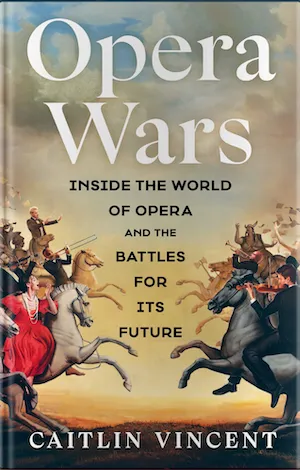
Opera Wars
Vincent, Caitlin. Opera Wars: Inside the World of Opera and the Battles for Its Future. Scribner, 304 pp. ISBN 978-1-66808-406-9.
Available here →March 2, 2026
20260302-caitlin-vincent-opera-wars
A close-up
The rest of this thread

Caitlin Vincent
Dr. Caitlin Vincent is an ARC DECRA Fellow and Senior Lecturer in Creative Industries at the University of Melbourne, where she researches cultural labour, opera, and diversity, equity, and inclusion. Dr. Vincent has an extensive publication record across traditional and non-traditional research outputs and has gained international recognition for her expertise in operatic labour markets. Prior to entering academia, Dr. Vincent was a professional opera singer and served as artistic director of an opera company in Baltimore, Maryland. She currently maintains a career as an award-winning opera librettist and lyricist. For more information, visit here
Pull this thread
pulls againstpulls alongside
Opera's fights over casting, blackface and new work are labor and power conflicts as much as aesthetic ones.
Against AW · Literature yields existential and sentient knowledge, and that, not any political payoff, is why we read it. On: A canon records real artistic quality rather than the machinery that assembled it
Against BB · Nabokov is a maximalist, and readers who halt at modernist irony miss what makes him write. On: A canon records real artistic quality rather than the machinery that assembled it
Alongside BN · Western philosophy's refusal to teach Chinese, Indian and African thought is a lingering effect of Kantian racial theory. On: A canon records real artistic quality rather than the machinery that assembled it
Alongside TW · Jazz history, told as a succession of God-like male heroes, enforces masculine and heterosexual norms. On: A canon records real artistic quality rather than the machinery that assembled it
Alongside TS · What passes for art history is criticism in disguise, and there will be a period when Rembrandt is not admired. On: A canon records real artistic quality rather than the machinery that assembled it
Alongside DV · Orientalism was canonized without being read through, and Said's own thesis is itself an essentialism. On: A canon records real artistic quality rather than the machinery that assembled it
Know something the rest of us don't?
Most threads on Rorotoko begin with our invitation. Any thread can begin with a proposal: you write it with the same prompts every thread answers, and we read it.
Propose a thread →