
Marian Stamp Dawkins
Who is Conscious?
I want a ‘just browsing’ reader to the first chapter first. That will tell them whether this is a book they want to read. They may put it down in disappointment, preferring instead a book that tells them clearly which animals are conscious and which are not. Or they may find the whole idea of questioning animal consciousness distinctly uncomfortable, preferring certainty to doubt, as many people do. I hope, however, that that the first chapter will also be reassuring. Doubt is healthy. It can even be an exhilarating part of new discoveries. It plays an essential part in filtering out what constitutes valid evidence from that what does not.
Furthermore – and this is a crucial point – raising doubts about animal consciousness may actually benefit the animals themselves. The evidence for animal consciousness may turn out to be stronger, not weaker as a result of a good dose of skepticism. The more watertight the evidence, the more likely it is that those not already convinced will take notice of it. Animal welfare decisions will benefit from being based on the best and most scrutinized evidence far more than if it is based on anecdotes, poorly designed experiments or people claiming to ‘just know’ that animals are conscious.
I can accept that a dog is conscious, behave towards it as a conscious being, believe it to be ethically wrong to cause it harm and support laws to protect its welfare while at the same time still saying that, from a scientific point of view, I do not know for certain whether it is conscious.
The purpose of probing the evidence is thus not - repeat not – to demolish the case for animal consciousness. It is to take a few steps towards a fuller understanding of something quite extraordinary that we currently do not understand – consciousness itself.
My main hope for this book is that it reading it will make people stop and think again about their views on consciousness in animals. I hope
- that people who have assumed the evidence is water-tight will realise that it is not
- that people who have dismissed the evidence will be impressed by what animal can achieve
- that the guide points for thinking about animal consciousness will help people to come to their own conclusions
- that some of the problems with determining whether animals are conscious also arise with advanced machines
- that scientists will be emboldened to point out problems with some of the research data without feeling that they are damaging the cause of animal welfare
- that philosophers and psychologists will follow up the idea of looking for the ‘computational correlates of consciousness’
- that there will be greater care taken with the words used to talk about animal consciousness – for example, being clear whether the word ‘emotion’ necessarily implies conscious feelings.
- that doubt and questioning will come to be seen as healthy and essential ways of understanding
- that people will be left with a sense of awe and wonder about the deepest mystery in the whole of biology – how brains give rise to conscious experience
- there will be a greater appreciation of how much we still do not understand about consciousness – human or otherwise.
Curator: Rachel Althof
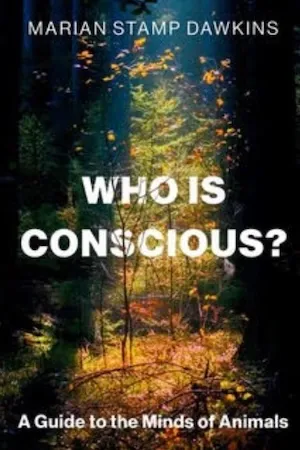
Who is Conscious?
Marian Stamp Dawkins, Who is Conscious? A Guide to the Minds of Animals, Oxford University Press, 160 pages, ISBN: 9780197818626
Available here →March 6, 2026
20260306-marian-stamp-dawkins-conscious-a-guide-to-the-minds-of-animals
A close-up
The rest of this thread

Marian Stamp Dawkins
Marian Stamp Dawkins is Professor of Animal Behaviour in the Department of Biology at the University of Oxford and Fellow Emeritus in Biological Sciences at Somerville College, Oxford. Her research interests are in animal welfare, animal communication and animal consciousness and she has a particular concern with the process of putting welfare research into practice. She has worked on the welfare of poultry for many years in collaboration with various industrial partners in both Europe and the United States and is currently engaged in developing an automated system for assessing the welfare of broiler chickens using image processing of flock behaviour (OpticFlock). In addition to publishing many research papers, she is the author of Animal Suffering: the Science of Animal Welfare (1980), Through Our Eyes Only? The Search for Animal Consciousness (1993), Why Animals Matter: Animal Consciousness, Animal Welfare and Human Well-Being (2012) and The Science of Animal Welfare: Understanding What Animals Want (2021). With Aubrey Manning, she co-authored An Introduction to Animal Behaviour (4th-6th editions). Marian was awarded the Niko Tinbergen Medal by the Association for the Study of Animal Behaviour in 2009, the Robert Fraser Gordon Medal by the World Poultry Association 2011, the Universities Federation for Animal Welfare Medal in 2012 and the Patrick Moore Award by the RSPCA in 2014. In 2014 she was made a Fellow of the Royal Society and awarded the CBE for services to animal welfare. In 2018 she was made an Honorary Fellow of the Society for Applied Ethology. Her latest book, Who is Conscious? A Guide to the Minds of Animals is available as open access from Oxford University Press.
Pull this thread
Confidence about animal consciousness outruns the evidence, and skepticism here helps animals rather than harming them.
Know something the rest of us don't?
Most threads on Rorotoko begin with our invitation. Any thread can begin with a proposal: you write it with the same prompts every thread answers, and we review it.
Propose a thread →