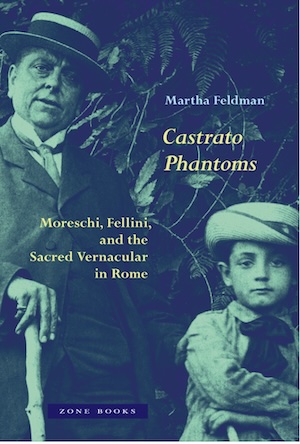
Castrato Phantoms emerged from two threads casually unloosed from papal lore by a Sistine chapel bass and collector of modern Roman chapel documents and scores, Luciano Luciani, whom I visited on the outskirts of Rome in the later 2000s when preparing for the Bloch Lectures. On a first visit, he casually mentioned that the castrato had had an “adopted son,” who later became a tenor and singing teacher in Rome and that the castrato had lived for a time with the child’s mother. On another visit, he said that in later decades the son’s daughter had married Fellini’s brother, who was a pupil of the castrato’s son.
It didn’t take much to realize that the son to whom he referred was Giulio Moreschi, a prominent singing teacher in Rome from the mid 1920s until his death in 1955, and that it was Giulio’s daughter who had married Fellini’s brother Riccardo (1921-1991), in turn producing Maria Rita (Rita) Fellini (1945-2012), who was then still living in Rome and running a belt shop there on the bustling via del Corso not far from piazza Venezia. By May of 2010 I arranged to visit Rita at the shop, but when I arrived I was greeted only by her husband Fabio Panconesi who took me to a nearby trattoria to tell me what they knew. Rita joined only by telephone because she was already unwell by then. I hoped that from Rita I might gain some purchase on her father’s singing practice, inherited from a castrato via his son Giulio, who was Riccardo’s singing teacher. She remembered nothing of her father’s practicing of singing, but Fabio and Rita began to unravel a complex family history marked by traumatic events, losses, haunted memories, and repetition compulsion. As I gradually discovered through archival research, the castrato Alessandro Moreschi had married the woman in question in 1896. She had had a child--not his progeny, of course--in 1904, and had abandoned both her child and her castrato husband in 1907. What the family remembered was mainly the birth of baby Giulio and the first name (only) of his birth mother, Guendalina, as well as her abandonment of both for a lover with whom she fled.
Gradually, through research in both family and city archives, including the cemetery where a significant joint tomb founded by Alessandro and his father-in-law survives, combined with work on Alessandro’s recordings and collection of oral histories of Rita’s childhood (coddled by her aunt and grandparents), it was possible to piece the earlier history together with the mid-twentieth-century one and to suture both to the present.